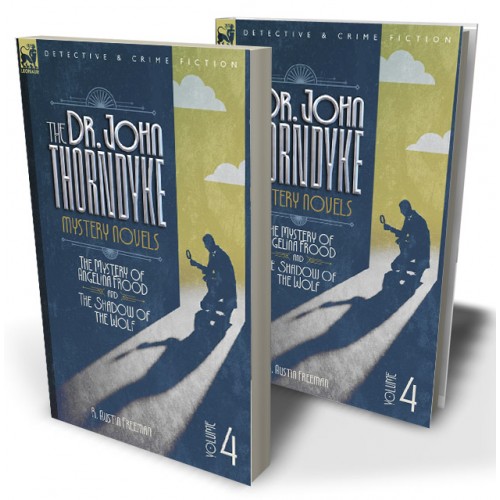
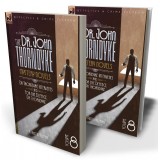
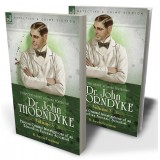
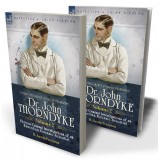
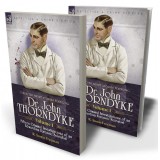
Volume 4- Mystery and Detection-two Thorndyke casebook novels
The author of this special Leonaur collection of the detective story novels, featuring Dr. John Thorndyke was, in fact, a physician himself, Dr. Richard Austin Freeman, (1862-1943). This eleven volume set of the longer stories of the 'Thorndyke' casebook has been introduced to complement the previously published Leonaur three volume collection of Thorndyke short stories. Shortly after Freeman qualified as a doctor, he volunteered for colonial service as a surgeon in West Africa and was involved in several dramatic incidents of the period. After he was invalided back to the UK he became a general medical practitioner, followed by a period in the Prison Service. Shortly afterwards his writing career accelerated until his literary output was, and remained for his entire life, prodigious. The first 'Thorndyke' story was published in 1907 and this Leonaur collection- featuring two novels per volume- has been collated chronologically. Although most modern readers are familiar with contemporary terms for the same activities, the pioneering Thorndyke is described as a medico-legal forensic investigator.Freeman's own background enabled him to ensure the scientific elements involved in his novels were authentic. Indeed, Freeman undertook verifying experiments to confirm their viability.Naturally, both Freeman and his most renowned character have become the focus of much attention by critics and enthusiasts of the detective fiction genre. Perhaps inevitably, comparisons, for several legitimate reasons, have been made to Sherlock Holmes. Some have observed that whilst Doyle was possibly the superior writer of entertaining tales,Thorndyke was-based on authentic science- the better detective. Be that as it may, readers may be assured that Thorndyke stories continue to be universally lauded as among the finest examples of the Edwardian detective fiction.
Volume four includes,' The Mystery of Angelina Frood' and ,'The Shadow of the Wolf'.
Leonaur editions are newly typeset and are not facsimiles; each title is available in softcover and hardback with dustjacket.
The foreman took the shovel and began very cautiously to scrape away the surface, flinging the scrapings of lime out on to the ground, where they were eagerly scrutinised by the sergeant, while the labourer picked out the larger lumps and cast them down. Thus the work went on for about a quarter of an hour, without any result beyond the accumulation on the ground below of a small heap of lime. At length I noticed the foreman pause and look attentively at the lime that he had just scraped up in his shovel.
“Here’s something that I don’t fancy any of our men put in,” he said, picking the object out and handing it down to the sergeant. The latter took it from him and held it out for me to see. It was another of Angelina’s coat buttons.
In the course of the next few minutes two more buttons came to light, and almost immediately afterwards I saw the labourer stoop suddenly and stare down at the lime with an expression that made my flesh creep, as he pointed something out to the foreman.
“Ah!” the latter exclaimed. “Here she is! But, my word! There ain’t much left of her. Look at this, sergeant.”
Very gingerly, and with an air of shuddering distaste, he picked something out of the lime and held it up; and even at that distance I could see that it was a human ulna. Cobbledick took it from him with the same distasteful and almost fearful manner, and held it towards me for inspection. I glanced at it and looked away. “Yes,” I said. “It is a human arm bone.”
On this, Cobbledick beckoned for the labourer to come down, and, taking out his official note-book, wrote something in pencil and tore out the leaf.
“Take this down to the station and give it to Sergeant Brown. He will tell you what else to do.” He gave the paper to the man, and having let him out of the gate, came back and climbed up to the exposed surface of the excavation, where I saw him draw on a pair of gloves and then stoop and begin to pick over the lime.
“This is a horrid business, isn’t it?” said Bundy. “Why the deuce couldn’t Cobbledick carry on by himself? I don’t see that it is our affair. Do you think we need stay?”
“I don’t see why you need. You have finished your part of the business. You have seen the wall opened. I am afraid I must stay a little longer, as Cobbledick may want me to identify some of the other objects that may be found. But I shan’t stay very long. There is really no question of the identity of the body, and there is no doubt now that the body is there. Detailed identification is a matter for the coroner.”
As we were speaking, we walked slowly away from the wall among the mounds of rubbish, now beginning to be hidden under a dense growth of nettles, ragwort and thistles. It was a desolate, neglected place, sordid of aspect and contrasting unpleasantly in its modern squalor with the dignified decay of the ancient wall. We had reached the further fence and were just turning about, when the sergeant hailed me with a note of excitement in his voice. I hurried across and found him standing up with his eyes fixed on something that lay in the palm of his gloved hand.
“This seems to be the ring that you described to me, Doctor,” said he. “Will you just take a look at it?”
He reached down and I received in my hand the little trinket of deep-toned, yellow gold that I remembered so well. I turned it over in my palm, and as I looked on its mystical signs, its crude, barbaric workmanship and the initials “A. C.” scratched inside, the scene in that dimly lighted room—years ago, it seemed to me now—rose before me like a vision. I saw the gracious figure in the red glow of the lamp and heard the voice that was never again to sound in my ears, telling the story of the little bauble, and for a few moments, the dreadful present faded into the irredeemable past.
“There isn’t any doubt about it, is there, Doctor?” the sergeant asked anxiously.
“None, whatever,” I replied. “It is unquestionably Mrs. Frood’s ring.”
“That’s a mercy,” said Cobbledick; “because we shall want every atom of identification that we can get. The body isn’t going to help us much. This lime has done its work to a finish. There’s nothing left, so far as I can see, but the skeleton and the bits of metal belonging to the clothing. Would you like to come up and have a look, Doctor? There isn’t much to see yet, but I have uncovered some of the bones.”

 your wishlist
 your account


 Click on image to enlarge
 Mouse over the image to zoom in