PAYMENT OPTIONS

​

Forthcoming titles

(Book titles are subject to change)

Air War: East Africa WW1

Raf Russia, 1940

The Asc In Africa

South African Gunners

The Supernatural Ludwig Tieck

Wellingtons Men

Shuttle Bury Cobb & Danby Croker

King William’s War

The Supernatural Jerome K. Jerome


The Doctor John Thorndyke Mystery Novels: Volume 10 - The Stoneware Monkey and Mr Polton Explains

enlarge Click on image to enlarge
enlarge Mouse over the image to zoom in
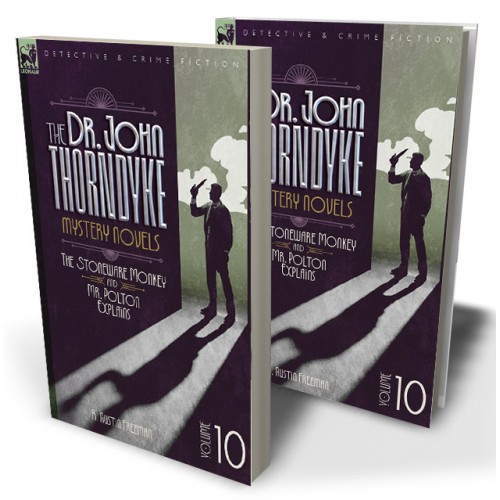
The Doctor John Thorndyke Mystery Novels: Volume 10 - The Stoneware Monkey  and Mr Polton Explains
Qty:     - OR -   Add to Wish List

Author(s): R. Austin Freeman
Date Published: 2026/06
Page Count: 396
Softcover ISBN-13: 978-1-918436-53-2
Hardcover ISBN-13: 978-1-918436-52-5

Volume 10 - The Edwardian doctor detective solves on two more puzzling cases

The author of this special Leonaur collection of the detective story novels, featuring Dr. John Thorndyke was, in fact, a physician himself, Dr. Richard Austin Freeman, (1862-1943). This eleven volume set of the longer stories of the 'Thorndyke' casebook has been introduced to complement the previously published Leonaur three volume collection of Thorndyke short stories. Shortly after Freeman qualified as a doctor, he volunteered for colonial service as a surgeon in West Africa and was involved in several dramatic incidents of the period. After he was invalided back to the UK he became a general medical practitioner, followed by a period in the Prison Service. Shortly afterwards his writing career accelerated until his literary output was, and remained for his entire life, prodigious. The first 'Thorndyke' story was published in 1907 and this Leonaur collection- featuring two novels per volume- has been collated chronologically. Although most modern readers are familiar with contemporary terms for the same activities, the pioneering Thorndyke is described as a medico-legal forensic investigator.Freeman's own background enabled him to ensure the scientific elements involved in his novels were authentic. Indeed, Freeman undertook verifying experiments to confirm their viability.Naturally, both Freeman and his most renowned character have become the focus of much attention by critics and enthusiasts of the detective fiction genre. Perhaps inevitably, comparisons, for several legitimate reasons, have been made to Sherlock Holmes. Some have observed that whilst Doyle was possibly the superior writer of entertaining tales,Thorndyke was-based on authentic science- the better detective. Be that as it may, readers may be assured that Thorndyke stories continue to be universally lauded as among the finest examples of the Edwardian detective fiction.

Volume ten features 'The Stoneware Monkey' and 'Mr. Polton Explains'

Leonaur editions are newly typeset and are not facsimiles; each title is available in softcover and hardback with dustjacket.
But speculation got me no more forward. Obviously, there was something abnormal about the kiln. There had been a prolonged and intense fire, but of the fired ware there was not a trace. What conceivable explanation could there be of such an extraordinary conflict of facts? The possibility occurred to me that the whole batch might have been disposed of by a single transaction or sent to an exhibition. But a moment’s reflection showed me that this would not do. There had not been time for the batch to be cooled, finished, glazed and refired, for the kiln was still quite warm inside.
The rough, box-like stool that Gannet had made to sit on at the bench was standing near the kiln. I slipped my hand through the lifting hole and drew the stool up to the open door in order more conveniently to examine the interior. But the examination yielded nothing. I threw the beam of light from my flashlight into every corner, but it simply confirmed my original observation. The kiln was empty, and no trace of its late contents remained beyond the few obscure white smears that the brush had left on the fire-clay floor.
I sat there for some minutes facing the open door and reflecting profoundly on this extraordinary problem. But I could make nothing of it, and at length, I started up to renew my explorations. For it had suddenly occurred to me that I had forgotten to examine the contents of the bins. But as I rose and turned round, I noticed a small white object on the floor which had evidently been covered by the stool before I had moved it. I stooped and picked it up, and at the first glance at it all my vague and formless suspicions seemed to run together into a horrible certainty.
The little object was the ungual phalanx, or terminal joint, of a finger—apparently a forefinger—burned to the snowy whiteness characteristic of incinerated bone. It was unmistakable. For if I lacked experience in some professional matters, at least my osteology was fresh; and as the instant recognition flashed on me, I stood as if rooted to the ground, staring at the little relic with a shuddering realisation of all that it meant.
The mystery of the absent pottery was solved. There had never been any pottery. That long and fierce fire had burned to destroy the evidence of a hideous crime. And the other mysteries, too, were solved. Now I could guess what the white substance was that had been ground in the grog mill; how it came that the hastily-made cupels were of such abnormally coarse material; and why it had been necessary to wash the studio floor. All the anomalies now fell into a horrid agreement and each served to confirm and explain the others.
I laid the little fragile bone tenderly on the stool and proceeded to re-examine the place by the light of this new and dreadful fact. First I went to the shelves by Boles’s muffle and looked over the cupels, taking them in my hand the better to examine them. Their nature was now quite obvious. Instead of the finely powdered bone-ash of which they were ordinarily composed, they had been made by cramming fragments of crushed, incinerated bone into the cupel press; and the cohesion of these was so slight that one of the cupels fell to pieces in my hand.
You may also like