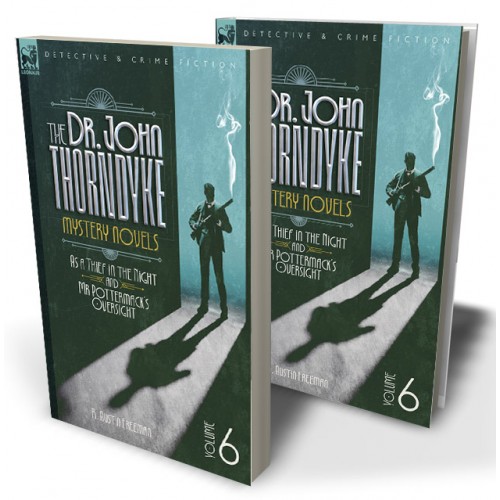
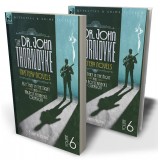
Volume 6 - The Edwardian doctor detective embarks on two more enthralling cases
The author of this special Leonaur collection of the detective story novels, featuring Dr. John Thorndyke was, in fact, a physician himself, Dr. Richard Austin Freeman, (1862-1943). This eleven volume set of the longer stories of the 'Thorndyke' casebook has been introduced to complement the previously published Leonaur three volume collection of Thorndyke short stories. Shortly after Freeman qualified as a doctor, he volunteered for colonial service as a surgeon in West Africa and was involved in several dramatic incidents of the period. After he was invalided back to the UK he became a general medical practitioner, followed by a period in the Prison Service. Shortly afterwards his writing career accelerated until his literary output was, and remained for his entire life, prodigious. The first 'Thorndyke' story was published in 1907 and this Leonaur collection- featuring two novels per volume- has been collated chronologically. Although most modern readers are familiar with contemporary terms for the same activities, the pioneering Thorndyke is described as a medico-legal forensic investigator.Freeman's own background enabled him to ensure the scientific elements involved in his novels were authentic. Indeed, Freeman undertook verifying experiments to confirm their viability.Naturally, both Freeman and his most renowned character have become the focus of much attention by critics and enthusiasts of the detective fiction genre. Perhaps inevitably, comparisons, for several legitimate reasons, have been made to Sherlock Holmes. Some have observed that whilst Doyle was possibly the superior writer of entertaining tales,Thorndyke was-based on authentic science- the better detective. Be that as it may, readers may be assured that Thorndyke stories continue to be universally lauded as among the finest examples of the Edwardian detective fiction.
Volume six includes 'As a Thief in the Night' and 'Mr Pottermack’s Oversight'.
Leonaur editions are newly typeset and are not facsimiles; each title is available in softcover and hardback with dustjacket.
“Ha!” said Thorndyke. “Now I wonder who he supposes is watching and following him.”
“I fancy he suspects you,” I replied. And so the murder was out, with the additional fact that I had not been very ready with my information.
Thorndyke, however, made no comment on my reticence beyond a steady and significant look at me.
“So,” said he, “he suspects me of suspecting him. Well, he is giving us every chance. But I think, Mayfield, you would do well to put Mrs Monkhouse on her guard. If Wallingford makes a public parade of his feelings towards her, he may put dangerous ideas into the head of Mr Superintendent Miller. You must realise that Miller is looking for a motive for the assumed murder. And if it comes to his knowledge that Harold Monkhouse’s secretary was in love with Harold Monkhouse’s wife, he will think that he has found a motive that is good enough.”
“Yes, that had occurred to me; and in fact, I did give her a hint to that effect, but it was hardly necessary. She had seen it for herself.”
As we now seemed to have exhausted this topic, I ventured to make a few enquiries about the rather farcical infernal machine.
“Did your further examination of it,” I asked, “yield any new information?”
“Very little,” Thorndyke replied, “but that little was rather curious. There were no fingerprints at all. I examined both the pistol and the jar most thoroughly, but there was not a trace of a finger-mark, to say nothing of a print. It is impossible to avoid the conclusion that the person who sent the machine wore gloves while he was putting it together.”
“But isn’t that a rather natural precaution in these days?” I asked.
“A perfectly natural precaution, in itself,” he replied, “but not quite consistent with some other features. For instance, the wadding with which the pistol-barrel was plugged consisted of a little ball of knitting-wool of a rather characteristic green. I will show it to you, and you will see that it would be quite easy to match and therefore possible to trace. But you see that there are thus shown two contrary states of mind. The gloves suggest that the sender entertained the possibility that the machine might fail to explode, whereas the wool seems to indicate that no such possibility was considered.”
He rose from the table—lunch being now finished—and brought from a locked cabinet a little ball of wool of a rather peculiar greenish blue. I took it to the window and examined it carefully, impressed by the curious inconsistency which he had pointed out.
“Yes,” I agreed, “there could be no difficulty in matching this. But as to tracing it, that is a different matter. There must have been thousands of skeins of this sold to, at least, hundreds of different persons.”
“Very true,” said he. “But I was thinking of it rather as a corroborating item in a train of circumstantial evidence.”
He put the “corroborating item” back in the cabinet and as, at this moment a taxi was heard to draw up at our entry, he picked up a large attaché case and preceded me down the stairs.
During the comparatively short journey I made a few not very successful efforts to discover what was Thorndyke’s real purpose in making this visit of inspection to the dismantled house. But his reticence and mine were not quite similar. He answered all my questions freely. He gave me a wealth of instances illustrating the valuable evidence obtained by the inspection of empty houses. But none of them seemed to throw any light on his present proceedings. And when I pointed this out, he smilingly replied that I was in precisely the same position as himself.
“We are not looking for corroborative evidence,” said he. “That belongs to a later stage of the inquiry. We are looking for some suggestive fact which may give us a hint where to begin. Naturally we cannot form any guess as to what kind of fact that might be.”
It was not a very illuminating answer, but I had to accept it, although I had a strong suspicion that Thorndyke’s purpose was not quite so vague as he represented it to be, and determined unobtrusively to keep an eye on his proceedings.
“Can I give you any assistance?” I enquired, craftily, when I had let him into the hall and shut the outer door.

 your wishlist
 your account


 Click on image to enlarge
 Mouse over the image to zoom in