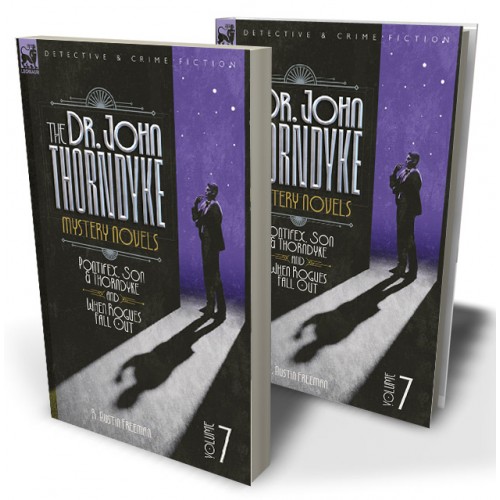
Volume 7 - The analytical Thorndyke solves two enthralling crimes
The author of this special Leonaur collection of the detective story novels, featuring Dr. John Thorndyke was, in fact, a physician himself, Dr. Richard Austin Freeman, (1862-1943). This eleven volume set of the longer stories of the 'Thorndyke' casebook has been introduced to complement the previously published Leonaur three volume collection of Thorndyke short stories. Shortly after Freeman qualified as a doctor, he volunteered for colonial service as a surgeon in West Africa and was involved in several dramatic incidents of the period. After he was invalided back to the UK he became a general medical practitioner, followed by a period in the Prison Service. Shortly afterwards his writing career accelerated until his literary output was, and remained for his entire life, prodigious. The first 'Thorndyke' story was published in 1907 and this Leonaur collection- featuring two novels per volume- has been collated chronologically. Although most modern readers are familiar with contemporary terms for the same activities, the pioneering Thorndyke is described as a medico-legal forensic investigator.Freeman's own background enabled him to ensure the scientific elements involved in his novels were authentic. Indeed, Freeman undertook verifying experiments to confirm their viability.Naturally, both Freeman and his most renowned character have become the focus of much attention by critics and enthusiasts of the detective fiction genre. Perhaps inevitably, comparisons, for several legitimate reasons, have been made to Sherlock Holmes. Some have observed that whilst Doyle was possibly the superior writer of entertaining tales,Thorndyke was-based on authentic science- the better detective. Be that as it may, readers may be assured that Thorndyke stories continue to be universally lauded as among the finest examples of the Edwardian detective fiction.
Volume seven includes,'Pontifex, Son & Thorndyke' and 'When Rogues Fall Out'
Leonaur editions are newly typeset and are not facsimiles; each title is available in softcover and hardback with dustjacket.
“The bearing of what we have ascertained about that lock is this; we are invited to believe that entrance was effected into the house by the window because the door was shut and locked. But the fact, which we have established, that the lock is one which can be opened with almost any key—or even with a piece of stiff wire—makes any such supposition unnecessary. The house was accessible to anybody by way of the door.”
“As far as Sir Edward was concerned,” said I, “you remember that he had no keys on him at all.”
“Yes. And that fact may have influenced the Superintendent. But it doesn’t influence us. If Sir Edward went into that house of his own free will it is of no concern to us whether he got in at the window or climbed down the chimney. But if we assume—as I take it we both do, without prejudice as to what may transpire at the inquest—that he was taken into that house forcibly, or in a state of unconsciousness, or actually dead, then the facility of access becomes a material fact. For the proceedings would necessarily be hurried. There would be no time for the manipulation of windows or picking of locks. Entry would have to be effected at once.”
“That means,” said I, “that the person or persons who entered knew what sort of lock was on the door.”
“Undoubtedly,” he agreed. “The house must have been known to at least one of the parties, and would, presumably, have been visited and explored. The plan must have been arranged and prepared in advance to enable it to be carried out quickly.”
“What do you suppose to have been the actual modus operandi?” I asked.
“From what we have seen, I should reconstruct events somewhat thus: First, a scout would come to the place, try the lock and ascertain that a particular key would open it, explore the house and select the place where the victim could be most conveniently hanged. Then, at the appointed time, the victim—who must almost necessarily have been either dead or insensible—would be put in the cart and covered up; the three men—possibly two, but much more probably three—would mount to the seat and the cart would be driven to the house pretty late at night, so as to secure complete darkness.
“On arriving at Number Five, one man would jump down and open the door. The victim and the rope would then be handed down and carried in and the door shut. The cart would then be driven off, possibly to wait at some rendezvous outside the immediate neighbourhood. The two men, having concluded the business, would come out and walk to the rendezvous and the whole party would then return whence they came.”
“Yes,” I said, “that sounds very complete and consistent. But aren’t we taking rather a lot for granted? I admit that the stopping of that cart opposite Number Five is a highly suspicious circumstance—and here we are, back at Abbey Lane and here are the cart-tracks back with us. So the cart must have made the round expressly to call at Number Five, which strongly supports your theory. But still, we are assuming that the cart made that very suspicious call on that particular night. Of course, it is extremely probable that it did; and if it did, it almost certainly conveyed Sir Edward, alive or dead. The fatal flaw in the evidence is that we can’t fix the date on which the cart called at the house.”
“But I think we can, Jervis. One doesn’t like to use the word certainty, but I think I can fix the date with the very highest degree of probability.”
“Then,” said I, “if you can do that, I accept your hypothetical reconstruction as almost certainly representing what actually happened. But I should like to hear the evidence.”
“The evidence,” he replied, “is based on two factors; one is the state of the road when the tracks were made; the other is the time at which the road could have been in that particular state. Let us consider factor one.

 your wishlist
 your account


 Click on image to enlarge
 Mouse over the image to zoom in