PAYMENT OPTIONS

​

Forthcoming titles

(Book titles are subject to change)

Air War: East Africa WW1

Raf Russia, 1940

The Asc In Africa

South African Gunners

The Supernatural Ludwig Tieck

Wellingtons Men

Shuttle Bury Cobb & Danby Croker

King William’s War

The Supernatural Jerome K. Jerome


The Collected Supernatural and Weird Fiction of Bernard Capes: Volume 3

enlarge Click on image to enlarge
enlarge Mouse over the image to zoom in
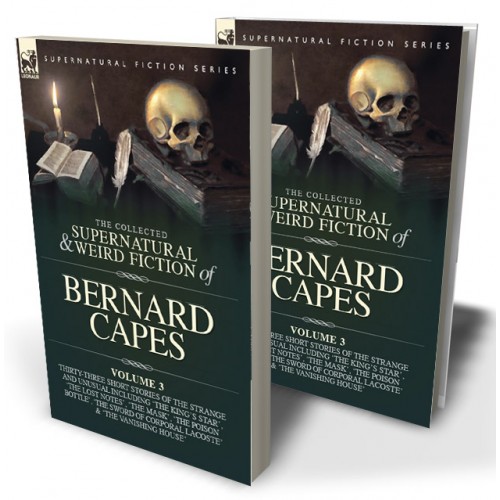
The Collected Supernatural and Weird Fiction of  Bernard Capes: Volume 3
Qty:     - OR -   Add to Wish List

Author(s): Bernard Capes
Date Published: 2026/08
Page Count: 276
Softcover ISBN-13: 978-1-918436-61-7
Hardcover ISBN-13: 978-1-918436-60-0

Thirty-Three Short Stories of the Strange and Unusual Including ‘The King’s Star’, ‘The Lost Notes’, ‘The Mask’, ‘The Poison Bottle’, ‘The Sword of Corporal Lacoste’ and ‘The Vanishing House’

The final volume in this special three volume set of writings from a master of dark fiction

Born in 1854, Bernard Capes was a prolific British author of the late Victorian fin-de-siècle era, renowned for his original, dark supernatural, weird, and horror fiction which earned encomiums from several worthy contemporaries including G.K. Chesterton. Living in London, he drifted through a series of clerical jobs before attending the Slade School of Fine Art. Capes eventually became a journalist and the editor of The Theatre magazine. A full-time industrious writer, he  released a new book every four months, though his work also appeared regularly in periodicals of the day, including Blackwood's Magazine, The Strand, and the Pall Mall Magazine. Rather than relying on sudden scares or spectral visitations,Capes injected a sense of growing threat and disturbing distress into his work which bears comparison with some of his genre contemporaries like Arthur Machen or Algernon Blackwood. He died during the post-war, 1918 influenza pandemic. Also 

Leonaur editions are newly typeset and are not facsimiles; each title is available in softcover and hardback with dustjacket.

The dealer made as if to bend, cleared his thin old throat and stood up again. “It’s unsigned,” he said.
“But don’t you know?”
“If you were to ask me,” he answered, “I should say—no more than that, mind you—that it was Urquhart’s work.” Then, in response to my mute inquiry, “He was a follower of John Constable, you know.”
I didn’t know; I knew nothing about the man; but whoever he was, his capacity was plain. I decided to risk it. “Well, how much?” I said.
“Twenty pounds,” said the dealer.
As a matter of principle, I protested—“Unsigned; of disputable origin; preposterous!”
“O yes!” he said, in his indifferent way. “Twenty pounds is the price. It’s a greatly admired piece. If you change your mind, I will take it back any time within a week, less ten per cent.”
That seemed a fair offer, and I ended by carrying the picture home with me in a cab. Alone, I cleared the mantelpiece of my sitting-room, and stood the treasure up on it. I thought it distinctly an admirable piece of work, and so far, rejoiced in my bargain. It seemed to reflect the very spirit of the twilight which was even now creeping over my room, to assimilate and conform to it.
As I gazed, I grew penetrated, possessed, by what I gazed on. I was on the wide, white road, standing or crouching somewhere down here out of the picture, and staring into its diminishing distances. The great oak was motionlessly alive; there seemed “a listening fear in its regard.” An expectation, an indescribable awe, held me amazedly entranced. And then my breath caught in a quick gasp. Round by the bend of the road, far away, there occurred a minute stirring, and something came into the picture that was not there before. The thing came on, increasing in regular progression as it advanced—and it was the figure of a young man, in a bygone costume, swinging airily towards me.
I sat petrified, dumb-stricken; and all in an instant there arose between me and the illusion, blotting it out, a vague, shadowy shape. That receded quickly, shrinking as it withdrew, until it also was the figure of a man going away from me along the road to meet the other. The two encountered, and had passed, when the second wheeled suddenly in his tracks, and struck the first on the neck, so that the young man fell into the road. I saw something—a running stain of red, and simultaneously broke, with a cry, from my stupefaction and, leaping to the mantelpiece, turned the horror with its face to the wall. As I did so I saw that the canvas was empty of figures.