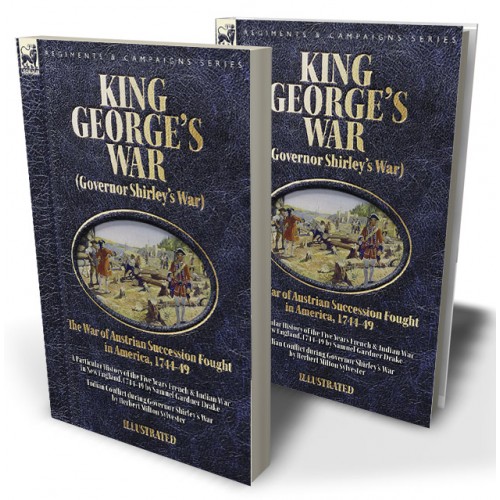
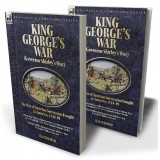
A Particular History of the Five Years French and Indian War in New England,1744-49 by Samuel Gardner Drake & Indian Conflict during Governor Shirley’s War by Herbert Milton Sylvester
The Struggle for Possession of America in the middle years of the 18th century
King George’s War (1744–48) was the North American theatre of the War of Austrian Succession and the third of four major colonial conflicts between Great Britain and France and their indigenous allies for control of the settled continent. The struggle embraced control of Nova Scotia, northern New England, and the Ohio River Valley which was destined to become an infamous bloody ground for decades. The besieging and capture of the allegedly 'impregnable' French fortress of Louisbourg by colonial forces supported by the Royal Navy was a significant victory, but brutal French and Indian retaliatory raids were launched on frontier settlements where homes were burned and their occupants put to the hatchet, whilst many British settlers were forced to flee to safety. This conflict ended inconclusively, to the frustration of the colonists, by the returning of all captured territory to its pre-war owners. Whilst the war demonstrated the competency of colonial militias, it also exposed the growing divide between the British Government and colonial interests. Very few years would elapse before the principal, 'French and Indian War', broke out which would in turn pave the way for the struggle to achieve American independence.
Leonaur editions are newly typeset and are not facsimiles; each title is available in softcover and hardback with dustjacket.
Early in the morning a few men went out, and near a nursery were fired upon by some Indians in ambush, by which Ebenezer Phillips is killed. Sometime after, as a company of men from the fort went to bring in the body of Phillips, the ambuscade rose and fired, as it was said, an hundred guns at them. The English returned the fire, retreating to the fort. The Indians besieged it till the next day, the men not being sufficiently strong to make a successful sally. Meantime the enemy killed all the cattle, burnt all the buildings, and drew off at leisure.
August 6. About thirty Indians came to Winchester, N. H., waylaid the road, and, as six of the white people were passing, fired upon them, killing and scalping Joseph Rawson, and slightly wounding Amasa Wright.
This depredation is thus circumstantially narrated by Deacon Wright:
“At Winchester, across the way, over against Benainon (?) meeting-house, lay an ambush, as is supposed of about twenty Indians; and several of our men had business to pass by, not knowing of the ambush, while the Indians fired on them and shot two of them. One of them, named Roger (Rawson) killed, the other, named Amasa Wright, being one leg shot through, (and) part of his neck; recovered himself, got up and made his escape with the rest of the men. The Indians fired thick after them, but they all got off alive only said Roger (Rawson).
“About the same time a small number of Indians ambushed the road at the Lower Ashuelot, and a number of our men were passing along that way. Just as they came near the Indians they turned out of the path, and the Indians seeing them, supposed they were discovered, and that the English were surrounding them, rose up and fled through thick and thin; and then our men saw them flying, gave them chase, but the Indians outran them and escaped; and there was no spile dunne on nary side.”
Joseph Rawson was son of John Rawson, of Uxbridge, grandson of the Rev. Grindal Rawson, the well-known preacher to the Indians, and great-grandson to the old secretary,
Edward Rawson Esq. Joseph’s Father received the wages due his son, the following March, from the treasurer of the colony.
The same day the attack was made upon Winchester, two men were made prisoners at Contocook and carried off.
August 9. Philip Greely is killed at North Yarmouth; some thirty Indians were seen secreted in a gully waiting an opportunity to surprise Wear’s garrison, but it was saved by the barking of the dogs.
August 11. At Northfield, as Benjamin Wright, a young man, was riding in the woods to bring the cows home, he was shot and mortally wounded. He kept on his horse, which brought him into the town, but he died the following night, about one o’clock. The ball passed through him, coming out of the opposite shoulder from the side where it entered.
The same day five soldiers fell into an ambush on the road between Concord and Hopkinton, and are all killed. There were about one hundred Indians it was said. The killed were Jonathan Bradley of Exeter; Samuel Bradley and Obadiah Peters, of Concord; John Mean, of Brentwood; John Lufkin, of Kingston; Alexander Roberts, of Brentwood, and William Stickney, of Concord, were made prisoners. Four Indians were killed, and two mortally wounded.

 your wishlist
 your account


 Click on image to enlarge
 Mouse over the image to zoom in