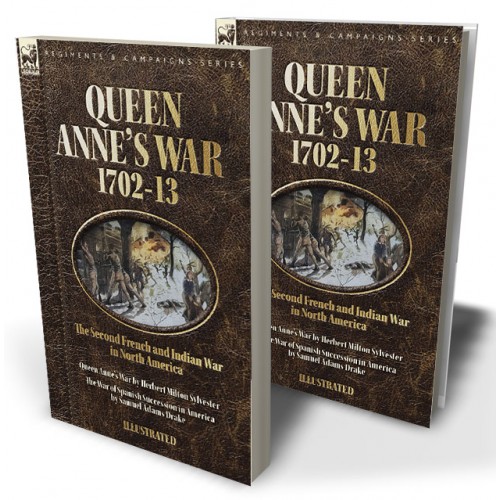
Queen Anne’s War by Herbert Milton Sylvester and The War of Spanish Succession in America by Samuel Adams Drake
An early 18th century collision between colonists and indigenous people in the New World
Queen Anne's War (1702–13) was the second of the four French and Indian Wars fought for control of North America as it was settled at the time. It was the American component of the War of Spanish Succession. Great Britain was supported by indigenous allies like the Iroquois Confederacy and the Creeks, whilst France and Spain, were supported by the Wabanaki Confederacy, Abenaki, and Apalachee tribes. As the violence escalated, English colonists attacked Spanish Florida, all but eradicating the Apalachees. New England experienced brutal frontier raids, most notably at Deerfield in 1704, where French and their native allies' forces killed dozens of residents and took many captives. In Newfoundland destructive raids fell upon fishing settlements and the French temporarily captured St. John's. French privateers captured numerous ships before Britain increased naval support to oppose them. France ceded Acadia ( Nova Scotia), Newfoundland, and the Hudson Bay region to Britain. Nevertheless, New France and New England, remained unreconciled, setting the stage for future conflicts.
Leonaur editions are newly typeset and are not facsimiles; each title is available in softcover and hardback with dustjacket.
In this raid the bell was secured, and was drawn all the way to Canada on a sledge, and there, in the Chapel St. Regis, it was used to call the Children of the Faith to the Jesuit services. The tradition, however, records that several times since its capture the Deerfield people have sent commissions upon various pilgrimages to St. Regis, to secure the return of the bell; but the French refuse to part with their treasure, saying that if it ever returns to Deerfield, it must be something after the fashion of its going—as one of the spoils of war.
It was on this bluff above the town the Indians lay in hiding as the night hours waned, until the first gray of the dawn. The stiff crust of snow furthered the design of the Indians, for it bore their weight readily. Leaving their snow-shoes bunched at the edge of the meadow that lay between the bluff and the village, they were able to make their advance unencumbered. The sentinel, wearying of his vigil, had left his post and turned in to sleep, so the village had no warning of the approach of the enemy, as De Rouville’s advance was made by short spurts and halts, to simulate the gusty winds as the crust cracked under their scuffing tread.
They were cold and hungry, and not unlike a pack of wolves. They were about to gorge their appetites with the glut of butchery and plunder. At the northwest corner of the palisades the winter winds had lifted the drifts high against the slight barrier, over which the Indians poured into the defenceless town. Distributing themselves among the houses, a war-whoop gave the signal, and the butchery began. Two garrisons made resistance, one inside the palisade and the other outside. Except for the inmates of one of these garrisons, and a few, possibly, who escaped into the woods, all the inhabitants of Deerfield were either killed or captured.
One of these garrison-houses was that of Ensign John Sheldon. From the first it was surrounded by the Indians, and those of the settlers outside who would have sought its safety were unable to get in. The door was so heavily barred the Indians were unable to break it open, but, cutting through it with their tomahawks, they pushed a musket into the opening, a shot from which killed the elder Mrs. Sheldon as she sat on the edge of her bed, which happened to be directly in range of the haphazard shot. Sheldon’s son dropped to the crust from a chamber window.
His wife Hannah followed him, but in striking on the hard and slippery crust she sprained her ankle and was unable to accompany him in their proposed flight. She urged him to make his way to Hatfield for aid, and, getting into the woods, half naked and his feet bound up in strips of an old coat which he had seized as he left the garrison, he made the journey. Hannah Sheldon was captured and taken to Canada.
The Indians, going to the rear of the Sheldon garrison, not being able to force the main entrance, found a door which yielded to their efforts. Breaking it down, they rushed into the garrison, after which its capture was quickly accomplished. Being one of the largest houses in the settlement, the Indians used it as a temporary jail, herding their prisoners within its walls while they finished their work of butchery and plunder elsewhere about the place. After they had completed their destruction of the houses by setting fire to them, they emptied the Sheldon garrison of its humanity, the captors singling out their human property in their preparations for a speedy retreat.

 your wishlist
 your account


 Click on image to enlarge
 Mouse over the image to zoom in