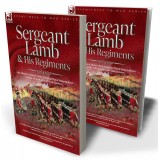
Roger Lamb's war in America plus two regimental histories
Every published recollection written by a soldier-irrespective of the time and conflict in which he served-is of inestimable value to posterity and to the historians and students that read them. Some achieve particular recognition . They may be particularly well written, some are especially rare in their subject material or particularly riveting in the tale they tell. Some, despite all of these considerations of quality being present, nevertheless, remain obscure. This account by Roger Lamb of his time serving as a British infantryman in America during the American War of Independence (American Revolution)may well be said to owe its enduring renown to the fact that the author and central character was adopted by the author and poet, Robert Graves ( 'I, Claudius') for two novels written during the early 1940's. The actual Roger Lamb's military career which inspired Graves and is recounted in these pages was certainly full of incident and interest. He served in the Saratoga Campaign of 1777 and The Campaign of 1781 in the Carolinas to Virginia. He was captured and escaped twice. What makes this Leonaur edition of note for readers of military history is that Lamb's account is accompanied by two regimental history extracts by Richard Cannon which cover the period of Lamb's service in the 9th Regiment of Foot and The Royal Welsh Fuzileers-as they were named at the time.
Leonaur editions are newly typeset and are not facsimiles; each title is available in softcover and hardback with dustjacket.
As the author belonged to Colonel Webster’s brigade, he is enabled, (and the reader will naturally expect it from him,) to state some circumstances unnoticed by any historian, from his own personal observation. After the brigade formed across the open ground, the colonel rode on to the front, and gave the word, “Charge.” Instantly the movement was made, in excellent order, in a smart run, with arms charged: when arrived within forty yards of the enemy’s line, it was perceived that their whole force had their arms presented, and resting on a rail fence, the common partitions in America. They were taking aim with the nicest precision.
Twixt host and host but narrow space was left,
A dreadful interval, and, front to front,
Presented, stood in terrible array.
At this awful period a general pause took place; both parties surveyed each other for the moment with the most anxious suspense. Nothing speaks, the general more than seizing on decisive moments: Colonel Webster rode forward in the front of the 23rd Regiment, and said, with more than even his usual commanding voice (which was well known to his brigade,) “Come on, my brave Fusiliers.” This operated like an inspiring voice, they rushed forward amidst the enemy’s fire; dreadful was the havoc on both sides,
Amazing scene!
What showers of mortal hail! What flaky fires!
At last, the Americans gave way, and the brigade advanced, to the attack of their second line. Here the conflict became still more fierce. Before it was completely routed, where I stood, (it is not from egotism, but to be the better understood, that I here, without breaking the thread of precision, assume the first person) I observed an American officer attempting to fly. I immediately darted after him, but he perceiving my intention to capture him, fled with the utmost speed. I pursued, and was gaining on him, when, hearing a confused noise on my left, I observed several bodies of Americans drawn up within the distance of a few yards. Whoever has been in an engagement well knows that, in such moments all fears of death are over. Seeing one of the guards among the slain, where I stood, I stopped and replenished my own pouch with the cartridges that remained in his; during the time I was thus employed, several shots were fired at me; but not one took effect.
Glancing my eye, the other way, I saw a company of the guards advancing to attack these parties. The reader may perhaps be surprised at the bravery of troops, thus with calm intrepidity attacking superior numbers, when formed into separate bodies, and all acting together; but I can assure him this instance was not peculiar; it frequently occurred in the British Army, during the American war. It was impossible to join this company, as several of the American parties lay between me and it. I had no time for deliberation. How to act I knew not.
On the instant, however, I saw Lord Cornwallis riding across the clear ground. His Lordship was mounted on a dragoon’s horse (his own having been shot;) the saddle-bags were under the creature’s belly, which much retarded his progress, owing to the vast quantity of underwood that was spread over the ground; His Lordship was evidently unconscious of his danger. I immediately laid hold of the bridle of his horse, and turned his head. I then mentioned to him, that if His Lordship had pursued the same direction, he would in a few moments have been surrounded by the enemy, and, perhaps, cut to pieces or captured.
I continued to run alongside of the horse, keeping the bridle in my hand, until His Lordship, gained the 23rd Regiment, which was at that time drawn up in the skirt of the woods.

 your wishlist
 your account


 Click on image to enlarge
 Mouse over the image to zoom in