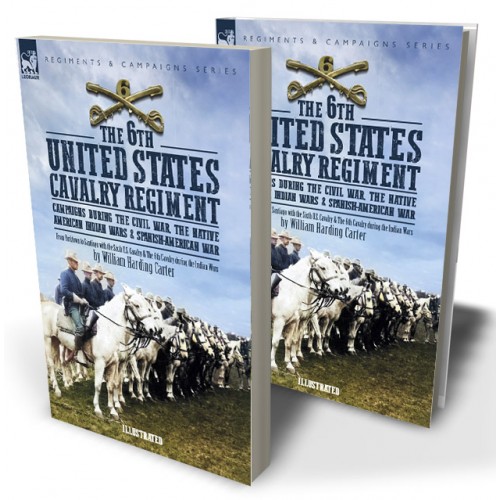
The story of the hard fighting horse soldiers of the 6th U.S Cavalry
Whilst this famous United States Cavalry regiment can trace its roots back to colonial times the principal history recounted in these pages begins in the Civil War. The regiment served during the Peninsular Campaign, the Maryland Campaign, about Fredericksburg and the Gettysburg Campaign. After the war the regiment was posted to Texas where it clashed with the warriors of the Comanche tribe and their allies and thereafter to Kansas and the Indian Territory there to serve against the Cheyennes, Kiowas and others. Another transfer to Arizona and New Mexico pitted this regiment against the perpetually hostile and fierce Apache tribe before it was transferred once more to the interior to the end of the wars with the tribes of the Great Plains. When the Spanish-American War broke out the regiment once more marched to the sound of the drums.This account has been paired in this edition by a detailed extract of the regiments time fighting Indians as seen from the perspective of one its most renowned officers,Lieutenant- General Chaffee.
Leonaur editions are newly typeset and are not facsimiles; each title is available in softcover and hardback with dustjacket.
Arizona is an immense expanse of country, much of it covered with rough and broken mountain chains—the southern spurs of the Rockies. The western part contains immense deserts, and neither Indians nor settlers undertook to extract a living from such parched and uninviting sand wastes.
The history of the Apaches is shrouded in much uncertainty. The whole face of the country is filled with the remains of villages occupied by a people of an entirely different nature, and, in all probability, akin to the scattered Pueblo Indians of today. The cliff-dwellers left many strange abodes in almost every watered cañon and the foundations and walls of many of their valley locations indicate a large population in olden times.
All settlers well acquainted with the habits of the various tribes, unite in the belief that the disappearance of the old dwellers in Arizona is traceable to the incessant warfare of the Apaches. It was against these absolutely wild Indians that the regiment was destined to be pitted for more than ten years.
The records of the War Department show that between January 1st, 1866, and May, 1875, when the Sixth was ordered to duty in Arizona, two hundred and seventeen fights had occurred between troops and Indians within the limits of the territory. The number of attacks made upon ranches, wagon trains, stage coaches and travellers, can only be conjectured.
The character of Arizona was entirely in favour of the Apaches, whose lives had been devoted to overcoming the natural obstacles of an inhospitable country. The Indians had learned to utilize much in nature that was unknown to the whites, and they were so accustomed to exposure that sudden changes from snow-covered mountains to parched sand deserts affected them but little, if at all. Travelling without baggage, and able to cover when hard pressed, from fifty to seventy miles on foot within twenty-four hours, they constituted most formidable enemies. Their food consisted of game, baked mescal root, which is very palatable and not unlike sweet potato, grass seed and other wild productions of that strange land.
With a supply of food which would not furnish a meal for a soldier, an Apache would go upon a distant raid, trusting to luck and his knowledge of nature’s foods that he might not suffer. His ability to crawl stealthily upon his enemy, to conceal himself with a few handfuls of grass, to deliver his fire and disappear as from the face of the earth, characterises him as an enemy who must be guarded against incessantly. Often the watchful traveller, with gun in hand, has been allowed to pass safely through an Apache ambuscade, for they rarely attacked unless they could do so without injury to themselves.
The manner in which Apaches concealed their rude “wickiups,” consisting of bent boughs covered with brush, together with their wary and watchful natures, made their capture almost impossible to white men. Success was only attained ordinarily when Indian scouts were sent out to locate the hiding places in advance. Then the scouts, with a detachment of soldiers and a pack train, would proceed by night marches to the vicinity. The train would be concealed and food prepared after dark when the smoke of fires would not rise in the usually clear atmosphere to give warning.
With rations on their backs, the scouts and dismounted cavalrymen would then walk and crawl to positions surrounding the rancheria and wait for daylight. On the approach of dawn, at the first sign of life, the firing would begin and be continued until every “buck” or warrior was killed. The scouts never took prisoners except women and children. As all Indians understood this there was always a break for cover and a fight for life.

 your wishlist
 your account


 Click on image to enlarge
 Mouse over the image to zoom in