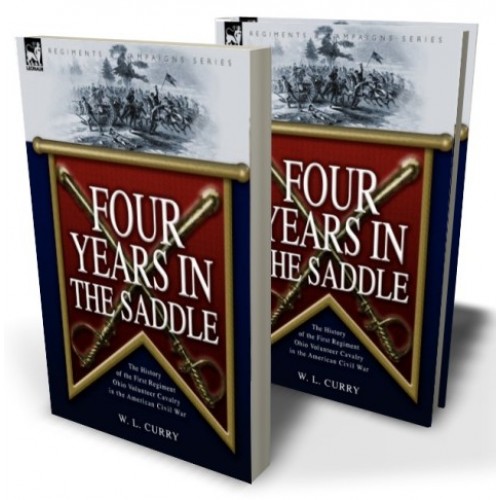
This is a rare, valuable and invaluable book in every way. Difficult to find on the antiquarian book market, it has been published by Leonaur to enable today's students and enthusiasts of the history of the American Civil War to access its text at a reasonable price. Encapsulated within the pages of this very substantial volume is the story of the First Ohio Volunteer Cavalry Regiment. It is, of course, a regimental history, but it is also much more than that. In common with many regiments of the Civil War, this regiment had an active 'old comrades' association and it was this organisation which determined that the history be written under the guidance of the principal author who was also a serving officer with the regiment throughout most of the events recounted. What makes this book particularly special is the inclusion of many additional, often riveting accounts penned by those who experienced them in their entirety, covering specific actions or aspects of life on campaign. Naturally, this book is essential for all those interested in the American Civil War, the Union Army and its cavalry arm and those interested in the genealogy of the State of Ohio since many roles of serving soldiers are also included.
On the twenty-ninth they attacked Wharton’s brigade with great vigour, driving them back to the main battle line, until a battery opened up on the brigade from the opposite side of Stone’s River.<br>
The same evening the brigade was put in position on the extreme right of our army and held this position until the close of the battle. On the thirtieth there was fighting all along the line, as both armies were manoeuvring for position, and the brigade was skirmishing and on the alert, watching the movements of the enemy all day.<br>
On the morning of the thirty-first Hardee made an impetuous attack on McCook’s right division, driving it back in great confusion and with heavy loss in both officers and soldiers. The pickets of the brigade were attacked about daybreak by Wheeler’s division of cavalry and a hot fight was kept up for two hours.<br>
When Johnson’s division was driven from the field, the brigade covered the retreat and fought stubbornly for every inch of ground. Colonel Millikin acted with great bravery and coolness, encouraging his officers and soldiers and handling his regiment with great skill to prevent them from partaking of the general panic on the right. But the brigade was pushed slowly until the rebel cavalry were so close that they were using their revolvers.<br>
The very acme of Colonel Millikin’s ambition had been to have the regiment make a sabre charge, and now the supreme opportunity had arrived. His officers and soldiers were falling around him rapidly, Major Moore had been mortally wounded early in the day by a shell while the regiment was manoeuvring for position, and Adjutant W. H. Scott had been severely wounded in attempting to capture a rebel flag, and Lieutenant Sam Fordyce, of Company B, was also wounded. Joel Harris, of Company H, and Wesley Poling, of Company D, were also among the killed.<br>
He must act at once, or his regiment would be stampeded and driven from the field, as they were being pushed and crushed by an overwhelming force of the enemy, flushed with victory. No officer of the brigade seemed to grasp the situation, no orders were given by the brigade commander, then Colonel Millikin, sending word to the commanders of the other regiments of the brigade to support his regiment in a charge, wheeled his regiment by fours to the rear giving the command, “Draw sabre.” There was no time to tighten girths or to look after the condition of revolvers, but tightening the reins on his noble bay “Archie” and raising in his stirrups, gave the command, “Charge!” which was repeated to right and left along the line.<br><br>
<I>With sharp ring of bugle the sabres all clank
And the spurs are pressed to each horse’s hot flank.</I><br><br>
“Commending their souls to God, they charged home.” Dashing forward under the spur, with a cheer they followed their brave and peerless leader to his death in that awful carnage.<br>
On, on they go, striking the rebel lines, cutting right and left, leaving a swathe behind of wounded and killed intermingled the blue and the gray. On they went, cutting a line the full length of the regiment, sweeping everything before them, penetrating clear through the rebel line, and there was a fearful struggle when the shock came and the mêlée was on, with its confusion, fighting, yelling, cursing, horses and men falling, sabres flashing, revolvers cracking, horses and men struggling in a confused mass and going down together.<br>
Colonel Millikin was in the midst of the fray, which lasted but a few minutes, and in a hand to hand fight he was shot through the neck with a revolver, fell from his horse with sabre in hand, and died without a struggle. General John A. Wharton, who commanded a brigade in Wheeler’s cavalry, claims in his report that a cavalryman of his command, a private named John Bowers, Company K, Texas Rangers, killed Colonel Millikin.<br>
The rebels soon rallied and commenced firing from both flanks and closed up the gap in the rear, and it was just at this critical moment that Colonel Millikin fell.<br>
The regiment at this time was completely surrounded, and they again cut their way back to our lines, with many wounded and killed and a loss of about one hundred taken prisoners. The Fourth U. S. Cavalry then charged the rebel line and a majority of the prisoners were recaptured.

 your wishlist
 your account


 Click on image to enlarge
 Mouse over the image to zoom in