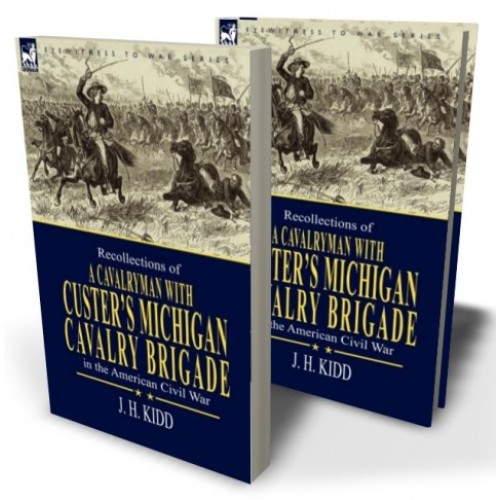
The Michigan Brigade—the Wolverines—was drawn from volunteer cavalry regiments of the Union Army. Comprised principally of the 1st, 5th, 6th and 7th Michigan Cavalry regiments it fought with distinction in every engagement undertaken by the Army of Potomac from Gettysburg to Appomattox. Despite the distinction of its service in its own right, perhaps what brought it the greatest fame was its association with its charismatic young leader— Brigadier General George Armstrong Custer. The Michigan horse soldiers are an essential part of the Custer legend and, perhaps, without their stalwart support in his early career his meteoric rise in rank and influence would not have been possible. Certainly several members of his Civil War command joined him after the war on his campaigns against the Indian tribes of the Western Plains—such was the measure of their mutual affection and confidence. This book was written by an officer of the brigade who was present throughout the war and it offers a thrilling, detailed and dynamic first hand account of Custer’s centaurs on campaign. A true classic for the Civil War library.
Arriving at his destination before daylight, Custer posted his troops so as to be ready to meet the expected attack. Two troops, one from the First Michigan the other from the Sixth, commanded by Captain George R. Maxwell and Captain Manning D. Birge, respectively, were sent well out on the Brock road to picket the front. The line of battle was formed in the woods, facing a cleared space, beyond which dense timber served as a screen to prevent the enemy’s approach from being discovered. The right was held by the First and Sixth Michigan, formed in two lines, regimental front, the Sixth in rear, the men standing “in place, rest” in front of their horses. It was prolonged to the left by the Fifth and Seventh Michigan and Devin’s brigade, composed of the Fourth, Sixth and Ninth New York and Seventeenth Pennsylvania regiments of cavalry. Devin, however, did not arrive on the ground until the battle was well under way. The right of the line was “in the air,” so far as was at that time known, the infantry not being in sight. <br>
The open field directly in front extended some 200 yards beyond our position, to the right, and it was, perhaps, 500 yards across it to the woods. The timber in which we formed extended from the rear clear around the right and across the front. In other words, the patch of open ground was enclosed on three sides, at least, by dense woods. The alignment faced in a westerly direction, and was back in the timber far enough to be hidden from the approaching foe. To the right and as it turned out, somewhat to the rear, lay the army of the Potomac, which had been battling with Lee all the previous day; and orders had been issued for the fighting to be resumed at five o’clock in the morning.<br>
Thus we stood, prepared, in a state of expectancy, awaiting the sounds that were to summon us to battle.<br>
The brigade band was posted near the left flank of the First Michigan.<br>
General Custer, alert and wary, with a portion of his staff and escort, was out inspecting the picket line.<br>
The horse artillery had not yet arrived.<br>
Every trooper was alert and ready for whatever might come.<br>
The field, of which mention has been made, was bisected by a ravine, nearly diagonally from left front to right rear, the ground sloping into it from front and rear. This ravine was to play a prominent part in the battle that ensued.<br>
Suddenly, the signal came. A picket shot was heard, then another, and another. Thicker and faster the spattering tones were borne to our ears from the woods in front. Then, it was the “rebel yell;” at first faint, but swelling in volume as it approached. A brigade of cavalry, led by the intrepid Rosser, was charging full tilt toward our position. He did not stop to skirmish with the pickets but, charging headlong, drove them pell-mell into the reserves, closely following, with intent to stampede the whole command.<br>
It was a bold and brilliant dash, but destined to fall short of complete success.<br>
Rosser had met his match.<br>
When the confederate charge was sounded, Custer was near his picket line and, scenting the first note of danger, turned his horse’s head toward the point where he had hidden his Wolverines in ambush and, bursting into view from the woods beyond the field, we saw him riding furiously in our direction. When he neared the edge of the woods, circling to the front and curbing the course of his charger as he rode, he bade the band to play and, with sabre arm extended, shouted to the command, already in the saddle:<br>
“Forward, by divisions!”<br>
As the band struck up the inspiriting strains of “Yankee Doodle,” the First Michigan broke by subdivisions from the right, the Sixth following in line, regimental front and the two regiments charged with a yell through the thick underbrush out into the open ground just as the confederate troopers emerged from the woods on the opposite side. Both commands kept on in full career, the First and Sixth inextricably intermingled, until they reached the edge of the ravine, when they stopped, the confederates surprised by the sudden appearance and audacity of the Michigan men and their gallant leader; Custer well content with checking Rosser’s vicious advance. Some of the foremost of either side kept on and crossed sabres in the middle of the ravine. Among these was Lieutenant Cortez P. Pendill, of the Sixth Michigan, who was severely wounded among the very foremost. One squadron of the confederates, possibly a small regiment, charging in column of fours, went past our right flank, and then, like the French army that marched up a hill and then marched down again, turned and charged back, without attempting to turn their head of column towards the place where Custer was standing at bay, with his Michiganders clustered thick about him. Pretty soon the confederates ran a battery into the field and opened on us with shell. Every attempt to break Custer’s line, however, ended in failure, the Spencer carbines proving too much of an obstacle to be overcome.<br>
Meanwhile, the Fifth and Seventh had been doing excellent service on the left, forging to the front and threatening the right of the confederate position. But it was evident that our own right was vulnerable, and Custer ordered Major Kidd to take the Sixth, move it by the rear to the woods on the right, dismount to fight on foot and, to use his own words: “Flank that battery.”

 your wishlist
 your account


 Click on image to enlarge
 Mouse over the image to zoom in