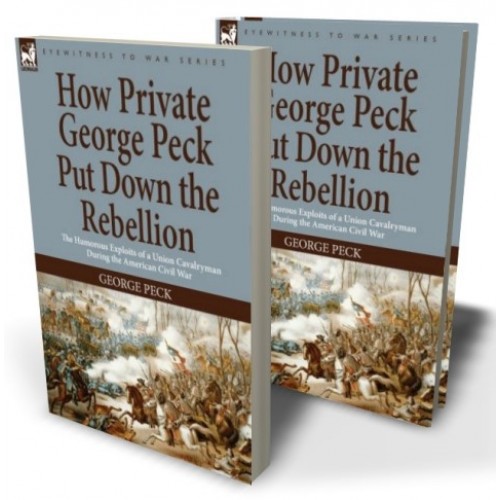
A different kind of eyewitness to war—with laughter!
The humorous military memoir is no new phenomenon. There is a rich heritage of this style of writing created by a natural tendency for men in adversity to seek humour at every opportunity and, indeed, to recall those moments in preference to memories of pain and misery. Inevitably, there are those soldiers whose sense of the comic soars above their comrades and so the 'military comedian' is born. The more acute this sense is, the more the tale parts company with reality and the straightforward reporting of actual events. This is one such book and all the more enjoyable for it. Is it fiction? It is certainly not all fact. Did the author know what it was to be a Union horse soldier? That certainly rings true because this book contains the depth of insight and knowledge that commonly comes only from first hand experience, and as the author comes in contact with the sharpest end and tragedy of war the humour is replaced—as it always is in such works—with a touching humanity. Behind the humour there is a real sense of the times—made the more poignant by exaggeration—and this creates a book filled with rewards of every kind.
What I wanted was a ‘middling’ horse, one that was not too confounded fast when after the enemy, and one not so all-fired slow when being pursued. The Johnnies were coming closer, but we were only half a mile from town. Would they chase us clear into town? At that critical moment the blasted mule stopped short, never to go again, and began to kick. What on earth possessed that fool mule to take a notion to stop right there and kick, is more than I shall ever know, but it simply kicked, and I felt that my time had come. The Union soldiers that were being chased by the Confederates passed me, and told me I better light out or I would be captured, but I couldn’t get the mule to budge an inch. It just kicked. The good Lord only knows, what that mule was kicking at, or why it should have been scheduled to stop and kick at that particular time, when every minute was precious.<br>
I saw the rebels very near me, and as it was impossible to get the mule to go a step farther, I raised the large, flat, white-washed picket which I had torn on the cemetery fence to maul the mule with, in token of surrender, and the Confederate boys surrounded me, though they kept a safe distance, after my mule had kicked in the ribs of one of their horses. The rebs had gone about as far towards the town as it was safe to go, and they knew the whole garrison would be out after them pretty soon, so they laughed at me for being armed with a whitewashed picket, and asked me if I expected to put down the rebellion by stabbing the enemy with such things. I told them I had been burying a nigger.<br>
One of my captors run the point of his sabre into my mule, to stop its kicking, and then he said to his comrades, “Boys, we came out here with the glorious prospect of capturing a Yankee general and his staff, and instead of getting him, we have broken up a nigger funeral and captured the gospel sharp, armed with a picket fence, and a kicking mule. Shall we hang him for engaging in uncivilized, warfare, by stabbing us with pickets poisoned with whitewash, or shall we take the red-headed slim-Jim back with us as a curiosity.” The boys all said not to hang me, but to take me along. I saw that it was all day with me this time. I felt that I was helping put down the rebellion rapidly, as I had been a soldier four weeks, been captured twice, and not a drop of blood had been spilled.<br>
The rebels started back, with me and my mule ahead of them, and they kept the mule ahead by jabbing it with a sabre occasionally. I felt humiliated and indignant at being called slim-Jim, sorrel-top, and elder. They seemed to think I was a preacher. I stood it all until a cuss reached into my pocket and took my meershaum pipe and a bag of tobacco, filled the pipe and lit it, then I was mad. I had paid eight dollars of my bounty for that pipe, and I said to the leader: “Boss, I can stand a joke as well as anybody, but when you capture me, in a fair fight, you have no right to jab my mule with a sabre, or call me names.<br>
I am a meek and lowly soldier of the army of the right, and want to so live that I can meet you all in the great hereafter, but by the gods I can whip the condemned galoot that stole my meershaum pipe. You think I am pious, and a non-combatant, but I am a fighter from away back, and don’t you forget it.” The young man who seemed to be in command told me to dry up, and he would get my pipe. He went and took it away from the one who had stolen it, filled it and lit it himself, and said it was a good pipe, and then he passed it around among them all. We moved on at a trot, and were getting far away from my regiment, and I realized that I was a captive, and that I should probably die in Andersonville prison. I looked at the dozen stalwart rebels that were riding behind me, and knew I could not whip them all with one picket off the cemetery fence, and so I resolved to remain a captive, and die for my country, of scurvy, if necessary.<br>
I turned around in my saddle to ask if it wasn’t about time for me to have a smoke out of my own pipe, and as I looked up the road we had come over I saw a large body of our own cavalry, coming like the wind toward us. I said nothing, but my face gave me away. I looked so tickled to see the boys coming that the rebels noticed it, and they looked back and saw the soldiers in pursuit, they yelled, “The Yanks are coming!” put spurs to their horses, stabbed my mule and told me to pound it with the picket, and hurry up, and then they passed me, and away they went, leaving me in the road alone between them and my own soldiers, I yelled to the leader to give me back my pipe, and I can hear his mocking laugh to this day, as he told me to “go to hell.”<br>
This made me mad, and drawing my picket I dashed after the retreating rebels, knowing that the men of my regiment would soon overtake me, and they would think I had chased the rebels three miles from town, armed only with a picket off the fence, and saved the garrison from capture. The thing worked to perfection, and when our command came up, the horses panting and perspiring, and the boys looking wild, the captain in command asked me how many there was of ’em, and I told him about forty, and he said I had done well to drive them so far, and he charged by me after them. I yelled to the captain to try and kill that long-legged rebel on the sorrel horse, and get my meershaum pipe, but he didn’t hear me. I hurried along as fast as I could, but before I caught up, there was a good deal of firing, and when I got there flankers were out in the woods, and there was sorrow, for three or four boys in blue had been killed in an ambush, and the rebels had got away across a bayou.<br>
As I rode up on my mule, with the picket still in my hand, I saw the three soldiers of my regiment lying dead under a tree, two others were wounded and had bandages around their heads, and for the first time since I had been a soldier, I realized that war was not a picnic. I could not keep my eyes off the faces of my dead comrades, the best and bravest boys in the regiment, boys who always got to the front when there was a skirmish. To think that I had been riding right amongst the rebels who had done this thing but a few minutes before, and never thought that death would claim anybody so soon. I wondered if those rebels were not sorry they had killed such good boys. I wondered, as I thought of the fathers and mothers, and sisters of my dead companions, whether the rebels would not sympathize with them, and then I thought suppose our fellows had not been killed, and we had killed some of the Confederates, wouldn’t it have been just as sorrowful, wouldn’t their fathers, mothers and sisters have mourned the same.

 your wishlist
 your account


 Click on image to enlarge
 Mouse over the image to zoom in