Author(s):
Albert G. Brackett & J. Frost Date Published:
2025/07 Page Count:
252 Softcover ISBN-13:
978-1-917666-21-3 Hardcover ISBN-13:
978-1-917666-20-6
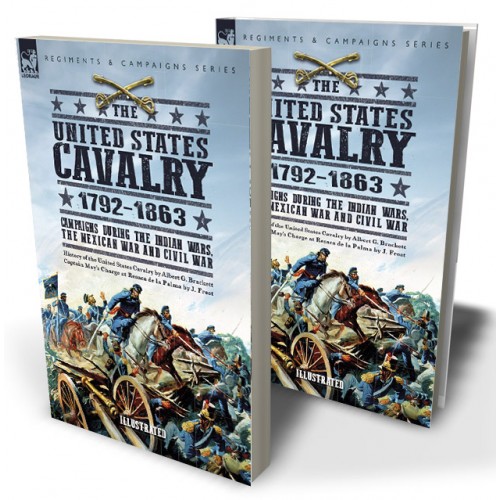
The early years of the United States Cavalry to 1863
This book commences with the campaigns of United States mounted troops during the pre-Civil War period and thereafter within the conflagration which threatened to split the Union. The revolutionary period is only briefly considered, so the first service recorded is in the Black Hawk War followed by the Mexican War and thereafter the various thrilling and enthralling campaigns fought against the Native American Indian tribes of the interior. During the Civil War numbers of regiments associated to the participating states,including cavalry, increased enormously. Given the scale of the conflict the author, whose views reflect the period during which this text was published (1865), has concentrated on those actions he considered most noteworthy within his terms of reference. The book concludes with a useful list of all the cavalry regiments in service. During the Mexican War one cavalry action in particular inspired the nation- May's charge at Resaca de la Palma. An eye witness account of the event is included for reader's interest. Contains illustrations which did not appear in the original edition
Leonaur editions are newly typeset and are not facsimiles; each title is available in softcover and hardback with dustjacket.
The only man who made his escape at the time Borland’s party was taken was Captain Dan Drake Henrie, of Texas, acting as interpreter, who had previously been a prisoner in the hands of the Mexicans, and who believed he would be murdered as soon as he became known to them. When the Americans found they were surrounded, Henrie made known his fears to Major Gaines, and asked him to let him mount his mare, which was known to be very fleet, and a most excellent animal. As the Mexican lancers crowded round, Henrie pretended to be trying to hold the mare, but was, in reality, pressing her against them.
They gave way a little for her, which he, discovering, sprang upon her back and darted off. Several volleys were fired after him, but the mare was true as steel, and away she went to the mountains. They both escaped, but, having no water, this beautiful animal fell dead, and Henrie was obliged to make the best of his way alone. He dared not visit any of the farmhouses along the route, and, after almost unheard-of sufferings, reached our army three days after his escape, having had nothing to eat except a mouse or two which he had caught while far off the main road. When found by our people he was almost deranged, and it was a long time before he recovered from the effects of his trials. His escape was one of the most remarkable ever known.
General Taylor arrived at Saltillo, and, after staying a short time, moved his force past the rancho of Buena Vista and the pass of L’Angostura to Agua Nueva, where he had a better drill-ground for his volunteers than he could find elsewhere. In going forward, he had made up his mind, in case of an action coming on, to fall back to the pass of L’Angostura, which was narrow and easily defended, and there give battle to the enemy. Up to this time it was uncertain what the Mexicans intended to do, and no knowledge of the force in front was in Taylor’s possession. To make everything secure, and learn as much as possible of the enemy, he sent Brevet Lieutenant-Colonel May, with one squadron of the 1st, one squadron of the 2nd Dragoons, and some volunteer cavalry, to the rancho of La Hedionda and beyond, to try and discover the enemy.
He reached that place on the afternoon of the 20th of February, and thence sent out several parties to scour the country in all directions. In the distance signal fires were seen rising up from the tops of the hills, and to the east clouds of dust indicated the movement of a large body of troops. Second Lieutenant Samuel D. Sturgis, of the dragoons, was sent to the top of a hill to obtain a better view, accompanied by only one dragoon, when both were captured by the enemy and carried off.
May remained out all night, and next morning returned to General Taylor, and announced that the enemy was advancing in force. Upon the receipt of this information his soldiers fell back, as had been his intention before, from Agua Nueva, to a position in front of the rancho of Buena Vista. Leaving his army for a short time, Taylor, with a squadron of the 2nd Dragoons and a, regiment of volunteers, went back to Saltillo to satisfy himself that all was right there, and to keep the garrison of that place, which was very small, in as good spirits as possible. This was on the night of the 21st of February. The next morning, he returned to the field, but, in the meantime, the battle had commenced under orders of Generals Wool and Lane.
The attack was made by a heavy column of Mexican lancers and infantry, who pushed a portion of our volunteer infantry back, and then attacked the cavalry regiments of Kentucky and Arkansas in the most determined manner; but they with stood the shock, and night put an end to the first day’s conflict. On the 23rd another and the final battle was fought, and Santa Anna was forced back, with his Mexican hordes, never to appear again on the northern frontier in any very considerable numbers. The fight on this day between our cavalry and the Mexican lancers was most deadly, and several of our cavalry officers fell. Colonel Yell and Captain Porter, of the 1st Arkansas Cavalry, were killed, and Lieutenant Reeder was wounded. Adjutant Vaughan was killed, and Captain Shawhan, and Lieutenants Brown, Merrifield, and Conn, of the 1st Kentucky Cavalry, were wounded.
In the 1st Regiment of Dragoons Captain Steen was wounded, and was made a brevet Major for gallantry; Captains Chilton, Rucker, and Carleton were made brevet Majors; Lieutenant Abram Buford, brevet Captain; and Second Lieutenants Whittlesey and Evans, brevet First Lieutenants.
In the 2nd Dragoons Brevet Lieutenant-Colonel May was made a brevet Colonel; First Lieutenant Reuben P. Campbell, brevet Captain; and Second Lieutenants Givens and Wood, brevet First Lieutenants.
This battle, particularly in the West, has been always looked upon as the most severe one ever fought on American soil, and no doubt it was true until the breaking out of the Rebellion; still, officers differed in opinion, and many considered Molino del Rey a much more severely contested action. The cavalry made one most gallant charge against the enemy on the 23rd of February, and cut their way through them; but the Mexican lancers were far from being a contemptible enemy, and many of them were admirable horsemen.

 your wishlist
 your account


 Click on image to enlarge
 Mouse over the image to zoom in