Author(s):
Charles H. Clarke & Alfred J. Hill Date Published:
2010/04 Page Count:
120 Softcover ISBN-13:
978-0-85706-105-8 Hardcover ISBN-13:
978-0-85706-106-5
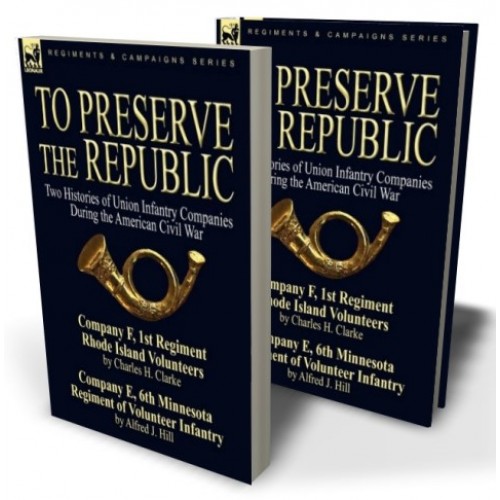
Company F, 1st Regiment Rhode Island Volunteersby Charles H. Clarke Company E, 6th Minnesota Regiment of Volunteer Infantry by Alfred J. Hill
Two bands of brothers in blue
The American Civil War was fought in the middle of the nineteenth century between a common English speaking people who were often literate to a standard unknown to previous generations. Most of the participants—on both sides—were deeply committed to their respective causes and were fiercely proud of the units in which they served by virtue of their close connections to their own states, counties and towns. Nothing could be more guaranteed to provide posterity—in a time before technological communication—with a plethora of books chronicling the event from every perspective. Histories of Civil War units abound as do personal accounts. The subjects of this book concern the activities of companies of men—the most intimate of military histories. They have been brought together because of their comparatively short lengths and for reasons of good value. Nevertheless, those interested in the conflict from a Union perspective and those especially interested in the doings of the forces from Rhode Island and Minnesota will find much to engage them within these pages. Available in soft cover and hard cover with dust jacket.
On the 20th, all the arrangements having been completed, the expedition began a more rapid advance in pursuit of the enemy, and on the 24th of July, 89 miles from Camp Atchison was fought the battle of “Big Hills” or “Big Mound.” As soon as it was known that the Indians were in force, the train was corralled on the margin of a small lake, Big Mound being directly to the eastward and distant about one and one-quarter miles. The Sixth Regiment with one company of Mounted Rangers and a section of artillery occupied the east front, and threw up a line of earthworks for protection.<br>
As soon as the attack began, Colonel Crooks at once deployed Companies E, I, and K of the Sixth and A of the Ninth, under Major McLaren, as skirmishers, and they pursued the Indians two and one-half miles. Three companies of the Sixth were also deployed on the left flank, and the Indians were repulsed at that point. Major McLaren with companies A, B, D, I, and K advanced four miles at a double-quick, having been ordered to support the troops already at the front, but on their arrival they were ordered to return to camp.<br>
On the 25th the expedition moved only about five miles to a better camping place and remained there on account of the jaded horses. On the 26th, with the Sixth Regiment in advance, the march was resumed. On arriving at Dead Buffalo Lake, some 15 miles from the last camp, the Indians again appeared in force and commenced an attack. Colonel Crooks immediately deployed a part of the Sixth, including Company E, as skirmishers, under Lieutenant Colonel Averill, and they advanced steadily, driving the enemy as they went; the remainder of the regiment under Major McLaren being held in reserve.<br>
After an advance of about one and one-half miles Major McLaren with five companies of the Sixth was ordered to return to the camp at the lake, three companies remaining at the front. Desultory firing was kept up until about 3 p.m., when the Indians made a final assault, which was repulsed in fine style by the troops under command of Major McLaren. The Indians, having been defeated at every point, now withdrew from the field.<br>
On the morning of the 27th the advance was again resumed, and in the afternoon a camp was formed on Stony Lake. On the 28th, as the troops were forming in column, the Indians again appeared and made their last charge. About one mile beyond the lake the Sixth Regiment was deployed to skirmish on the right of the train, and they repelled the attack of the Indians who threatened it. The firing continued for a time, the Indians finally making a rapid retreat in the face of the advancing expedition. The pursuit was continued until Apple River was reached, where a camp was formed for the night.<br>
On the 29th the army crossed Apple River, continuing the pursuit, and in the afternoon the Missouri River was reached, the regiment, under the immediate command of Colonel Crooks, skirmishing nearly two miles through the woods to it. The Indians having crossed to the west bank and hoisted white flags, the battery which had been advanced, and was in good position for shelling, was moved away, as the policy seemed to be to kill Indians only when they made an attack. Many of the skirmishers ventured to the river bank and began filling their canteens, when suddenly the enemy fired at them from the other side and the men were forced back, but not without sending a volley in return.<br>
A camp was formed on the banks of the Missouri River near the mouth of Apple River. The point on the river struck was in about 46 deg. 40’ north latitude, 600 miles from Fort Snelling by the route followed, 6 miles above the mouth of Apple River, and 85 miles from the Big Mound.<br>
On the 30th Colonel Crooks with Companies A, I, and K and details of men from other regiments, proceeded to the Indian crossing, and destroyed all the wagons and such other property as would be of service to the Indians, and then returned to camp.<br>
The return march began on the 2nd of August. The 5th and 9th of the month were spent in camp. Passed to the southward of the outward journey, shortening the route some thirty miles, and arrived at Camp Atchison on the 10th. Rested on the 11th. Reached Sheyenne River on the 13th, and camped three miles beyond it.<br>
At this last place the nightly entrenching, commenced on departure from Camp Pope, was abandoned, the impulse of discontinuance coming from Company E. It had been the custom, both in the campaign of 1862 and this, to throw up every evening light exterior mounds and ditches for defence, a work necessarily irksome and unpopular with men fatigued with hard marching, and in the presence of an enemy (and sometimes not) they neither respected nor feared.

 your wishlist
 your account


 Click on image to enlarge
 Mouse over the image to zoom in