Author(s):
Edgar C. Middleton & E. W. Walters Date Published:
2023/06 Page Count:
204 Softcover ISBN-13:
978-1-916535-43-5 Hardcover ISBN-13:
978-1-916535-42-8
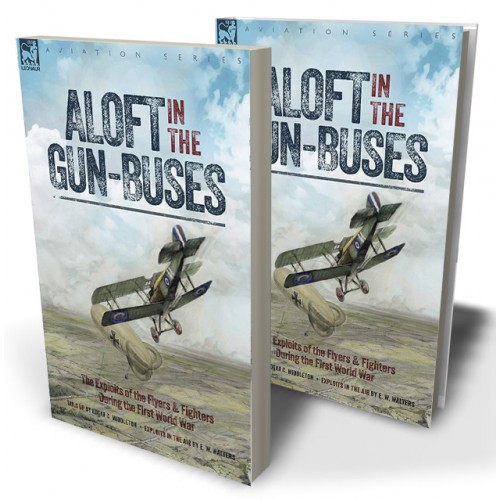
The author of this book was a prolific writer on the subject of early aviation. As most students of the subject know, only eight years had passed since the Wright brothers had taken to the air before Italy used aircraft in warfare in Libya and less than a further three years before the great nations of Europe began fighting the conflict which became known as the Great War. So, inevitably, Middleton's focus was drawn to activities of the RFC, RAF and RNAS as its airmen fought their German and Turkish counterparts in the skies over the continent and the wider world. The principal book in this Leonaur edition was first published in 1918 and is essentially a collection of word 'sketches' describing the routines,adventures and battles of allied airmen during the war. Whilst it is decidedly partisan in its perspectives, Middleton was able to rely of first-hand experiences and access to recent records, so his work has become part of the invaluable record of that short lived period of aerial warfare fought in simple craft of timber, canvas and wire. The nineteen 'sketches' in the principal book are supported in this Leonaur edition by an extract from E. W Walters book, 'Heroic Airmen and their Exploits', which offers a host of other engaging reports on the fight for the skies from other sources.
Leonaur editions are newly typeset and are not facsimiles; each title is available in softcover and hardback with dustjacket.
By this time all that was humanly possible had been done to meet the coming offensive. The British Army and the Flying Corps in particular were ready at every point, and awaited the event with calm deliberation. Those who could read between the lines of the official communiqués realised that the long-advertised Push was imminent. With Thursday’s renewed and desperate aerial activity, this realisation waxed a certainty. Away up in the North Sea, in the Bight of Heligoland, British seaplanes were patrolling constantly, watching for any attempt on the enemy’s side of a concerted movement on the part of his fleet.
The mist of Thursday morning cleared towards midday, but only in certain localities. In most places the light was only suitable for low flying. Nevertheless, the British airmen succeeded in locating great bodies of enemy reinforcements, and pouring many thousands of rounds into them, causing innumerable casualties. At first the antiaircraft defences were unusually violent. Then the Germans, apparently with the idea that any further attempt at concealment was useless, ceased fire, or kept up only a pretence. The bombing machines dropped no fewer than 900 bombs on railway stations immediately behind the lines, causing the enemy reinforcements and supplies of ammunition a delay of at least twelve hours.
Even at the low altitude at which flying was possible on this day, the air fighting was tremendous. Sixteen Hun aeroplanes were brought down, and six driven down. One of these was flying so low as to be shot down by British infantry within their own lines. Bombs were dropped on further large bodies of German reinforcements, rather to the north-west of Tournai. And here for the next twenty-four hours—and many twenty-four afterwards—all aerial activity was centred.
Came the night before the battle. At sundown, clouds and mist hung low over the face of the sky. Behind the mist, beneath the low clouds, a few miles to the west was the incessant jog-jog-jog of armed men; on high roads, and by-roads, across the fields, and by the railway tracks. But the Flying Corps missed nothing of all these preparations. Whenever there came a break, a reconnaissance machine would go speeding westwards. An hour later the pilot would return, the observer with a bulky report. From another aerodrome, farther down the line, other machines would go out, and other machines return with fresh enemy dispositions, fresh enemy ammunition dumps, fresh enemy gun positions; here a concentration of tanks, there a railway being run up to the trenches.
The fight was grim and merciless, from the moment they left the ground until they came winging home again, with perhaps a broken strut, or a wing barely hinging on the supports, and sometimes with the pilot or the observer mortally wounded. The enemy were determined they should not gain information. They were out to get it at all costs. The staff alone knew the result of this long unequal combat; and they benefited thereby, to a very considerable degree. As observer after observer handed in fresh returns, the wires got busy behind the British lines, half-way across the North of France, calling for reinforcements from all parts.
Through the long night of waiting, and in the teeth of the storm and gales, every available night-flying squadron in the battle area was turned out into the skies. Haig himself reports that:
Our bombing squadrons dropped 300 bombs alone on a hostile aerodrome south-west of Tournai, used by the enemy’s night-flying squadrons, and also on a large ammunition depot north-east of St. Quentin.
At the dawn, with the mist still hanging over the surface of the ground—almost like a sea fog, before the pallid grey light broke through the faint glimmer of the sinking moon—the R.F.C. had carried out a score and one reconnaissances. They had seen the great masses waiting, grimly silent, behind the enemy trenches; they had seen the gleaming muzzles of the giant howitzers and smaller field guns in every hole and corner. The story of their report sheets, when—and if ever—it is written, will beggar credulity. Towards the dawn a terrific artillery bombardment opened by the enemy’s guns. Shortly after a pilot landed at an aerodrome behind the British positions—barely beyond shellfire; frightened, white countenanced, but yet unafraid, he managed to blurt out: “There are thousands of them—thousands! The whole countryside is alive with advancing infantry.” Then they came racing across the devastated patch of No Man’s Land.
From all corners of the heavens, British airmen came swooping down on to them like avenging angels, firing and bombing as they dived. But the Germans appeared to ignore them. Men fell on all sides. Still they marched on. No power on earth could have stopped that living tide! Back went the airmen for more ammunition. Down they swooped through the mist again. Still the enemy came marching on. Shattered for all time was the theory that aircraft would be the deciding factor in modern war. But they demonstrated most admirably that they could hold up reinforcements until either the enemy rushed up a battery of machine guns, or the ’plane fell to earth, a shattered wreck.
When the enemy endeavoured to snatch a brief rest that night, they were at them again, bombing and killing. Three and a half tons of bombs they dropped on villages and camps to the north-west of Tournai.

 your wishlist
 your account


 Click on image to enlarge
 Mouse over the image to zoom in