Author(s):
Leo Walmsley & W. T. Shorthose Date Published:
2026/10 Page Count:
184 Softcover ISBN-13:
978-1-918436-71-6 Hardcover ISBN-13:
978-1-918436-70-9
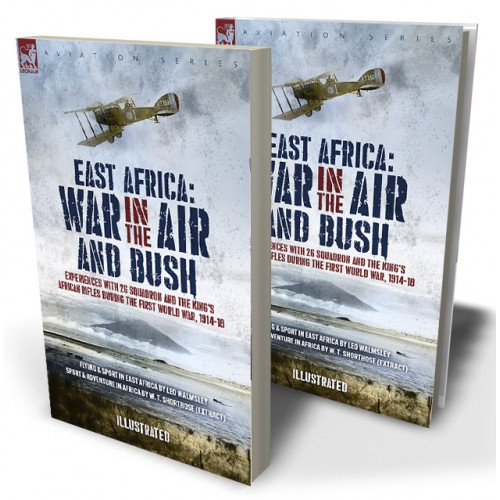
Flying and Sport in East Africa and Sport & Adventure in Africa
Two essential first-hands accounts of the Great War in Africa
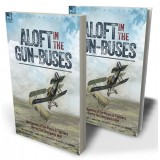
Leo Walmsley's personal experiences serving as a reconnaissance observer for the Royal Flying Corps (RFC) chronicles an under-documented aspect of the war in the so-called East African "side show" campaign against German colonial forces during the First World War. As a member of the largely South African, No 26 Squadron, flying de Havilland designed, B.E 2, bi-plane aircraft, he describes early aerial warfare under extreme tropical conditions, frequently flying over remote bush and even uncharted terrain. This contribution by military aircraft has long been accepted as an essential component of modern warfare, but at this time, the General Staff, routinely dismissed intelligence derived from this source as unreliable. Flying over Mount Kilimanjaro, the Rufiji River, and Lake Nyasa.Walmsley's narrative also describes the natural beauty of the region in which he operated with its savannahs teeming with wildlife. This first account of this Leonaur two- books- in one- edition curiously segues with the second as Walmsley in due course makes contact with the author of 'Sport and Adventure in Africa', Captain (Lieutenant-Colonel) William Shorthose (D.S.O) of the 1st Battalion, 4th King's African Rifles. During this period he was operating in the vicinity of Lake Victoria and commanding a column to Tunduru following an action at the Mohesi River. Shorthose's original work included much on big game hunting and his post war activities which have been edited from this edition in the interest of cohesion. Contains illustrations and photographs.
Leonaur editions are newly typeset and are not facsimiles; each title is available in softcover and hardback with dustjacket.
Two other machines were to be expected at intervals of fifteen minutes, and I returned to the aerodrome in time to see the first one land safely. It was Jansen, and there still remained Clowe. A quarter of an hour passed and no sign came: in half an hour we began to feel worried, for the sun was sinking rapidly—and yet no familiar hum in the sky. We should have had a wire from Daresalam had he returned. When six o’clock struck we knew that he must have come down, for his petrol could only last 34 hours, and we resigned ourselves to the inevitable.
They say that war has made soldiers callous to the horrors of death. Perhaps this is true, but in a little Flight like ours, one could never really shake off that terrible feeling of despondency when one of the mess was “missing.” Although experience had taught us that “missing” usually meant a few days wandering in the bush and a happy return to camp, yet there was always that disturbing sensation of uncertainty; and although at dinner that night we had all the outward appearances of being a moderately cheerful party, I’ll guarantee there was not one in whose mind thoughts of our comrade were not uppermost.
Late in the evening, orders came down from General Hoskins, who was now in command of the Kilwa force, that we were to attempt a reconnaissance as soon as possible over Kibata, a military post some forty miles north-west, in which our infantry at that time were more or less surrounded by a powerful force of the enemy. The map of this section was particularly inaccurate, and very little information could be given as to how we should find our way to the place. We were simply told that it was a big white fort on the top of a hill, and that several native roads converged upon it.
Carey-Thomas and I left at daybreak next morning. The wind was blowing from the sea, and we took off in the direction of the town, which we skimmed over at 200 feet. The quaint, flat-roofed, white Arab houses gleaming amongst the rich green foliage of the cocoanut palms made a thoroughly delightful picture. A broad yellow beach of sparkling sand, patched here and there with mangroves, divided the town from the sea, whose great monsoon rollers broke on the shore in scintillating lines of foam. Sunken coral-reefs and green sea-gardens were revealed as through a magic mirror as we flew outward over the water. Soon we banked steeply and turned towards the land.
Above the town the ground rises gently in a series of hills, covered with cocoanuts, native cultivation, and exquisitely-tinted mango-trees. Ten miles north the mighty silver coils of the Matandu River were discernible, and we set our course in that direction. Although the sun was shining brilliantly, heavy patches of cloud hung over the hills Kibata way, and soon we had to commence dodging. There is something very fascinating about cloud dodging.
The way is blocked by a dense bank of cumulus; to fly through this is not dangerous but uncomfortable, and of course the ground may be hidden for many minutes—a fatal thing when one has to find one’s way by tracing a narrow native path through the jungle. To climb above this cloud is perhaps possible, but obviously possesses no advantage: to fly below means being ‘‘bumped” in a most disagreeable manner.
Therefore, the only thing to do is to find a clear gap or “pass,” and at this game we quickly became expert. It was usually the observer’s task to stand up from his seat, choose the way, and wave his hands to right or left as a guide to the pilot. Sometimes we would fly through wonderful cloud caves, ornamented with airy stalactites and stalagmites, or pass under frowning cliffs and over yawning chasms. It was all very nice on the homeward journey, when there was no need to worry about finding the way, but going out it kept us in a perpetual state of anxiety.

 your wishlist
 your account


 Click on image to enlarge
 Mouse over the image to zoom in