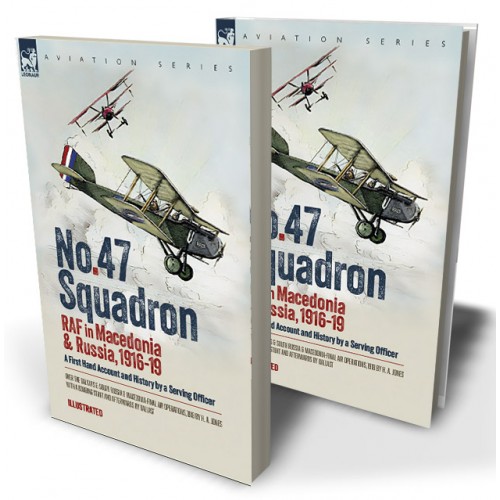
War in air on several fronts in the Great War and after
Students of the history of the RFC/RAF during the First World War may recognise the author of this book as the person responsible for the majority of an authoritative multi-volume history of the British air forces during that conflict. However, he was also a serving flying officer observer during that war, with No 47 Squadron a,'typical Middle East Squadron', which operated on the Salonika front, the Monastir front and was also notable in that it took part in the attack on the battle cruiser Goeben off the Dardenelles. The squadron was later transferred to Russia in support of loyalist forces under Denikin against Bolshevik armies. The first account in this book offers the reader the immediacy of first-hand experience and recollection, whereas the second is an historical overview. The final piece, which originally appeared as an article within Blackwood's magazine is a retelling of one the author's most notable wartime adventures.
Leonaur editions are newly typeset and are not facsimiles; each title is available in softcover and hardback with dustjacket.
The formation was well kept, despite this attempt and others to break it, and all our machines returned safely.
The raid on Prilep was repeated on the morning of the 20th at the same hour. The aeroplanes left the aerodrome before dawn, before the tops of the mountains were touched by the first rays of the sun, and when mists hung about the valleys. But this time there were mishaps, for, in addition to engine trouble which prevented some of the machines from starting, the French escort never found our small formation. The leader on this occasion was Lieutenant A. Maxwell of No. 17 Squadron, and No. 47 was represented by Lieutenants Scales, Thomas, and H. A. Jones, the former on a B.E.12 and the latter two on the Armstrong-Whitworth. There were three escorting Nieuports. The formation was attacked as soon as the line was reached, and the Nieuports drew off to engage the hostile machines. The remaining three machines flew on and were joined over Prilep by Lieutenants Bamford and Lee of 17 Squadron on Nieuports.
Over the objective, the British machines were fiercely attacked just as the last bombs were released. Lieutenant J. L. Bamford of 17, after a short but gallant fight, went spinning down and was later reported by the enemy to be killed. The leader of the formation which dived on Bamford fell to the observer of the Armstrong-Whitworth, which was now in rear of the other three machines. The enemy formation then turned on to the A.W., and a running fight between the British and German machines ensued, lasting some forty minutes. Lieutenant F. W. H. Thomas, the pilot of the A.W., received a wound in the back as soon as the fight opened, and the observer, Lieutenant H. A. Jones, a hit in the stomach which mostly spent itself on his Sam Browne belt. During the course of the further fighting, Jones received a hit in the mouth, and an explosive bullet in the left hand. Before his Lewis gun was shot out of action, two further enemy machines were sent down, apparently out of control.
Lieutenant Thomas fainted twice in the machine from loss of blood, and the A.W. fell some thousands of feet, but by a superhuman effort Thomas regained control at about 200 feet, many miles behind the enemy’s lines, and, encouraged by his observer, succeeded in crossing the trenches at this height despite a heavy fire. He then hung on doggedly and eventually arrived at the aerodrome, where he made a perfect landing. It was his last. His wound, a painful one, which would have crippled him for life had he lived, he bore stoically.