Author(s):
Edgar C. Middleton & E. W. Walters Date Published:
2023/06 Page Count:
200 Softcover ISBN-13:
978-1-916535-41-1 Hardcover ISBN-13:
978-1-916535-40-4
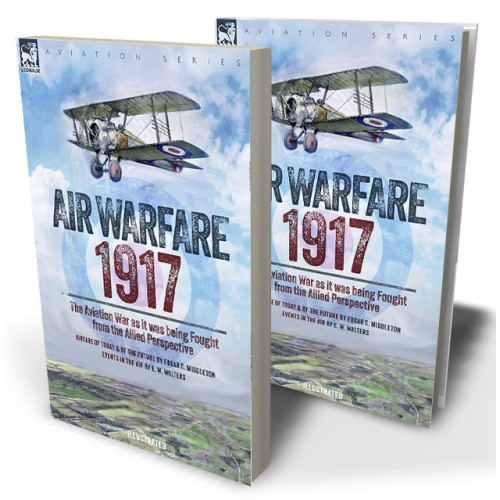
The organisation and tactics of the air war fought by the allies
Middleton was a well regarded author on the subject of aviation during the first decades of the 20th Century, so it was inevitable that much of his writings would concern the war in the air that was a new, but vital component of the First World War, 1914-18. The principal work in this Leonaur edition is the text of his book titled,'Airfare of Today and of the Future'. It is important to note that 'the future' in this book is covered in one chapter and concerns the immediate future from the writer's perspective. The main text concerns itself with the introduction of the 'air' as a constituent part of the battlefield and how the warring powers came to terms with it. Those early experiments are considered as is the initial role of aircraft in their reconnaissance role including intelligence gathering utilising aerial photography. Wireless and the direction of artillery fire is also described. Strategy and tactics as regarded bombing raids and aerial combat are considered including dealing with balloons and airships. This Leonaur edition is enhanced by an extract from E. W Walters book, 'Heroic Airmen and their Exploits', which offers further insightful information on the fight for the skies from other sources.
Leonaur editions are newly typeset and are not facsimiles; each title is available in softcover and hardback with dustjacket.
The principal methods of aerial attack are the dropping of incendiary and explosive bombs, the use of firearms, as a Remington or Winchester repeater—now almost extinct—the dropping of hand-grenades, and, more effective than any, the use of the Lewis machine-gun.
This gun fires through the blades of the propeller, which deflect at least 5 per cent of the bullets; thus, firing is a one-man job, The difficulty for a man to pilot and fire at the same time is beyond comprehension; two men at least are required, the one to direct the course of the craft on to the object, the other to fire the gun.
Another important matter is to obtain a suitable mounting for the gun, namely, one that allows the largest possible angle of elevation and depression. The advantage accruing to a machine with an area of gunfire that includes every position and angle is enormous. The best direction to fire the gun depends largely on the type of machine. Suiting the machine to the gun, the “pusher,” with propeller in the rear, offers a clear bow. The “tractor” is impeded by the propeller blades and the limited space in which the gunner has to work.
Next in importance is the matter of manoeuvring. When giving chase to another machine the pilot must always keep his enemy in view; his own machine, as much as possible, out of sight. Once he takes his eyes off the enemy in mid-air, he is apt to lose sight of him altogether. He must always endeavour to place himself between the enemy and the sun, and always keep him on the gunner’s left hand. Finally, he must always turn toward the enemy, never away from him.
Entering into the actual combat is, by nature, more of a tactical manoeuvre. As yet it is on too minor a scale to be classed as strategical. That is with the exception of the one great fight of March, 1917, when five British aeroplanes fought twenty-seven Germans, and sent eight to earth, crippled or in flames.
It was a day of great heat. There was a haze so thick that the ground was barely visible. Our men started late in the afternoon, and at five o’clock were well over the enemy country when, with the sun at their backs, they saw two enemy machines ahead. They endeavoured to close, the enemy making some show of fighting. However, it was only a show, for as our leading machines drew near the Germans turned and made with all speed for home. Our machines gave chase and were led into a decoy. Out of the haze and void on all sides new fleets came closing in. The new arrivals flew in three formations, two of which contained eight machines, the other nine, making twenty-five craft in all, to whom the other two, which now ceased to run away, joined themselves, making a minimum of twenty-seven machines in all.
One of the enemy fleets, taking advantage of the thick air, had passed behind our little squadron and came at it, as from the direction of our own lines, straight between it and the sun an awkward direction. The other fleets came from the north and south-east. As they approached, they spread out so that our men were ringed around with enemies on every side.
The order to attack, though given, was hardly needed. Each one of our five turned at once for the enemy who was nearest. The fight began at about 11,000 feet, but in the course of the things that followed it ranged anywhere from 3,000 to 12,000 up and down the ladders of heaven. And an extraordinary fact is that, all the while that it went on, the German anti-aircraft guns below kept at work. Usually, as soon as aeroplanes engage overhead, the “Archies” are silent for fear of hitting the wrong man.

 your wishlist
 your account


 Click on image to enlarge
 Mouse over the image to zoom in