Author(s):
Official Sources & John H. Lewis Date Published:
2026/6 Page Count:
296 Softcover ISBN-13:
978-1-918436-37-2 Hardcover ISBN-13:
978-1-918436-36-5
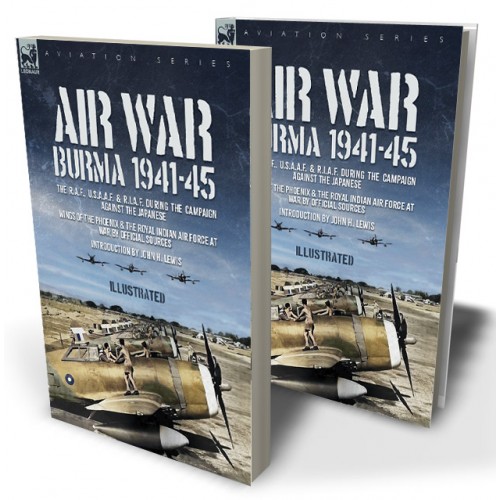
Wings of the Phoenix and The Royal Indian Air Force at War
Two accounts of the Allied Air Forces in the Far East during the Second World War
This is an outstanding book concerning the air war during the Burma, Arakan and North East India campaign. Japanese aerial dominance in 1942 was a major factor in the early Allied setbacks. The Allies were heavily outnumbered in the air and reliant on obsolete aircraft. However, the arrival of newly developed aircraft in late 1943 finally enabled Allied pilots to out perform their Japanese opponents. However, this war fought over savage terrain and subject to extreme weather conditions which were perpetually difficult for air and ground crews alike. The fundamental and virtually unique contribution to Allied victory was the airborne logistical lifeline for ground forces. During the Battle of the Admin Box, an isolated division was sustained by air, whilst at Imphal and Kohima,when the Japanese severed conventional resupply, the Allie crews daily flew in hundreds of tons of materiel. The legendary Dakota among other aircraft-large and small- were used to rapidly airlift men into battle and remove casualties. This Leonaur edition contains two perspectives of the campaign fought by the British, Commonwealth, Indian and American services, Includes riveting first-hand accounts. This republication has been made possible by the release into the public domain of officially produced publications and will be essential reading for every student of the period. Liberally illustrated with maps and photographs.
Leonaur editions are newly typeset and are not facsimiles; each title is available in softcover and hardback with dustjacket.
Rudling, already distinguished for his work in Hurricanes, was pointing his new Spitfire to base when in the distance he at last sighted the enemy bombers. He immediately turned towards them, although his fuel was then down to ten gallons.
His Boxing Day report to his Intelligence Officer stated: ‘‘I observed strikes on the enemy’s wings when I suddenly realised, I was going to collide. I broke sharply away above, feeling my aircraft hit the rudder of the bomber. I then proceeded down, thinking I had damaged my aircraft for any further attack, but it was all right, so I pulled up under another vic of bombers, firing from underneath at the leader”. During this attack a fighter was on his tail and put five shells through his wings and oil tanks before he broke the attack. John Rudling watched the bomber with which he had collided hit the sea and then he himself force-landed on the nearest strip, without flaps or brakes. His Spitfire ended up on its nose, but the aircraft did not catch fire—possibly because when Rudling landed there was no petrol left in its tanks.
The incident gave Rudling a taste for collision, and thereafter he used the method as a tactic for downing bombers when his ammunition was spent; not until his third collision was he killed, and many thought that anyone so resolute was lucky to live so long.
Others of that Arakan Christmas who were no less brave were soon to lose their lives. When the battle for air superiority was finally won the Spitfire men would observe the empty places in the mess and talk of the cost of victory. Yet the losses they were inflicting were eight times heavier than those they suffered, and they were accomplishing the supreme task.
On Old Year’s Day and into the New Year there came at last the real trial of strength between the British and Japanese fighter forces. From these Spitfire battles there would stem almost every subsequent success in Burma, for without the air supremacy which was then achieved the skies would not have been free for that astonishing flow of unarmed transport aircraft which in the next few weeks was twice to save our ground forces from disaster. Nor could the Fourteenth Army, almost completely air supplied, ultimately have gone forward.
On December 31st, 1943, heartened by their good fortune at Calcutta, the Japanese made a determined attack on Royal Navy forces off the Arakan coast, using bombers with fighter escort. Twelve Spitfires were scrambled and, after breaking through the fighter force, came upon the bombers still flying true and level in large V formation.
With perfect air discipline the Japanese kept this design while the Spitfires shot them down one by one on each leg of the flight. The V became smaller until only one aircraft was left, and then there were none. Fighters were dealt with in a less formal but equally effective manner. In Japanese style some of the fighters were brilliant silver with a mirror finish, some were jet black and some were sprayed with wavy lines of green, like moss on a bright stone, but without exception all were destroyed by the twelve Spitfires or sent home either broken or burning.

 your wishlist
 your account


 Click on image to enlarge
 Mouse over the image to zoom in