An account of the Front Line from the Guards Brigade
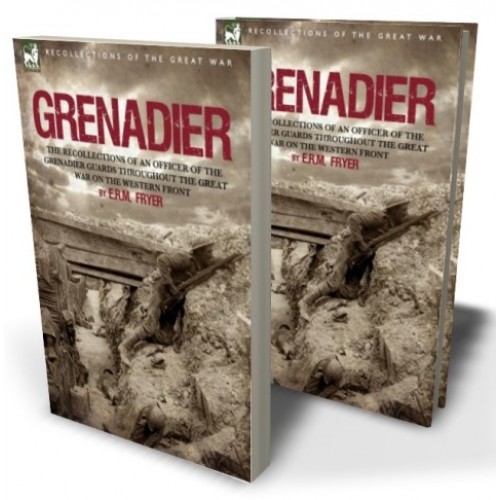
The Guards have always been known as 'The Gentlemen's Sons' and it seems that the author of this book was no exception. At work in 'the City' when war broke out and he managed initially to be elected to that other gentleman's club of the time—The Honourable Artillery Company. It was with the HAC that he went to the continent and saw action in the early engagements of the war before selection for cadet school and a commission. Upon returning to the Front, Fryer embarked on a wartime career that would keep him in action almost constantly throughout the hostilities and which he would report with nothing less than the casual savoir faire one would expect of him. Despite his style Fryer clearly saw hard campaigning at Givenchy, Loos, the Hohenzollern Redoubt, Ypres, the Somme and many other brutal and significant actions until the final offensives of 1918.
The shelling at this time was severe, but worse in front, and our front companies found no trenches to hold; they had all been blown in, and very few men to relieve; they had all been killed or wounded: but they took up a position among the shell holes, and started reconsolidating. <br>
The shelling eased off a bit, and eventually we only got a quarter of an hour intense in every hour, starting punctually at the hour, so we knew what and when to expect it. At 4.15 it stopped altogether, and our guns, which had been strangely silent, began and fired hard for an hour and a half. Their previous silence was explained by the fact that they were waiting to deal with the attack which certainly seemed to be coming; all the gunners were “standing to” ready all night.<br>
It was a bad night, and we wondered if it was a typical Ypres night or merely a welcome from the Boche; mercifully it proved to be the latter, and we found after that the welcome had been extended to the whole of the Guards' divisional front. We had many dirty nights in the Salient later on, but never one as dirty as this one.<br>
We spent the quieter moments digging out the trenches, and getting the dead and wounded Scotsmen away. We had a good many casualties, too; I had been ordered to bring the ration party up in the rear of the company, and on getting to the trench I found most of my platoon lying in the road groaning; a big shell had pitched right in the middle of them just as they were going to turn into the trench, and all three sergeants of the platoon were hit, one eventually dying.<br>
Two days later we moved to the front line; this was still in a dreadful state, though our No. 4 Company, under Alfred Yorke, had done wonders, and it, at any rate, looked like a defensive position. It was very wet and muddy, and altogether bad.
Next morning, while I was having a bit of rest in the so-called dugout, a piece of corrugated iron stretched across sandbags, what was known as the Pilkem gun started firing; it fired at us enfilade, and slap down our trench; the first shot missed our H.Q. by inches, and made an enormous hole exactly where Dick Stanhope had been having a wash a few minutes before, and where he had left his soap and towels. On hearing the explosion he came rushing back to rescue, not his young officers, but his towel!—or so we always told him afterwards. He was wonderful all this time, quite unconcerned, and seemed to be enjoying it all; he and Worsley were the other officers in the company; they were both killed later in the war.<br>
The system in this part of the line was sixteen days in the forwards area (two in front and two in Ypres, and so on), and then eight in reserve at Poperinghe, and then back into the next sector. Thus we stayed up till the 11th, when the 1st Brigade relieved us.<br>
We had had a fairly quiet time after our start, and had been busy draining and digging out the trenches, and had got them more or less inhabitable again.<br>
Just before we were relieved by the 3rd Battalion Coldstream, trouble broke out on our left, the Germans doing a daylight raid on the 20th Division under a very heavy barrage of trench mortars and artillery. Things looked rather bad there, and one wondered if it would spread to us, but by dark all was quiet, and our relief went off peacefully enough.<br>
We had eight days in Poperinghe, and enjoyed them thoroughly; what those periods of rest meant to us in those days no one can imagine who has not had a bad time in the front line; they were invaluable, and just kept one going. There were cinemas and pierrot shows to go to; among the latter the 6th Division “Fancies” were quite excellent, and played to a crowded house every evening; then we used to have dinner parties, and generally tried to be as civilised as we could.<br>
On the 19th we were due to return to Ypres. Just before we were to leave Poperinghe a heavy bombardment started in front, and the relief was postponed for a time, but we “stood by” ready for any emergency. Late at night we went off, and reached our cellars in Ypres without calamity. The noise of the evening of the 19th was the Germans doing an attack at the junction of the Guards' Division and the 6th Division at Wieltje; our 4th Battalion and the 2nd Battalion Scots Guards were involved in this, and the net result was that the 6th Division lost a small piece of trench, which, however, they regained by a counter attack on the night of the 22nd-23rd

 your wishlist
 your account


 Click on image to enlarge
 Mouse over the image to zoom in