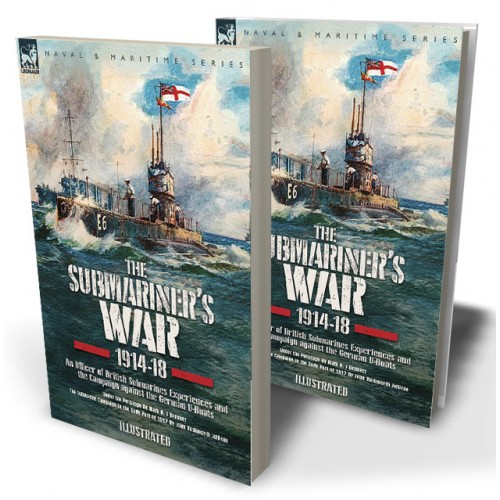
Under the Periscope By Mark H. J Bennett & The Submarine Campaign in the Early Part of 1917 By John Rushworth Jellicoe
An authentic and detailed account of the war British submariners knew
The principal work in this book is a naval memoir and historical account, written by an officer who had served in the Royal Naval Reserve. Published in 1919, it provides the reader with an evocative first-hand perspective of the daily operations and challenges of the British Submarine Service during the First World War . Whilst it is apparent that the author is writing about his own experiences, he frames his narrative from the perspective of 'Lieutenant Commander John Raymond', his fellow officers and the crew of H.M. Submarine '123'. Bennett's narrative style humanises underwater warfare and provides an excellent insight into the realities of cramped, claustrophobic living conditions and the camaraderie of men who fought their war under the seas. Unusually, the account contains detailed descriptions of submarine mechanics, steering, and other engineering issues of early 20th-century submersible vessels. The reader joins Submarine,'123', on patrol missions with the tensions involved in action and waiting for enemy contact. The immediacy and detail of Bennett's account has resulted in his book being acknowledged as a culturally important text . This Leonaur edition also includes an account of undersea warfare from a strategic and tactical level during the latter stages of the Great War written by Admiral of the Fleet, Jellicoe.
Leonaur editions are newly typeset and are not facsimiles; each title is available in softcover and hardback with dustjacket.
There was no particular haste and no noise at all. Few of the crew, with the exception of the coxswain and one or two old campaigners who had been with Raymond up the Marmora, had ever made a serious attack before, but for all that there was no excitement: this was what they had been waiting and training for for years, and now it had come.
Rather there was an atmosphere of pleasurable anticipation and quiet confidence that the captain would do the right thing. They knew their lives were in his hands. He was the only man who could see the enemy, and if he made a single mistake . . . but then he wouldn’t make a mistake, and it was their job to carry out his orders and see that others did so. In two minutes, the crew were at diving stations, the L.T.O.’s at the motor-boards, Seagrave and the T.I. at the tubes, the coxswains at the diving wheels, and the remainder at their various posts of Kingstons and vents. Forward a couple were whispering together about some previous experience, another man grinned sheepishly, and then Raymond’s voice broke the silence.
‘Destroyers. Three of them. German all right. Flood the tubes.’
The order was passed forward by Boyd and echoed by Seagrave from the electric lit recesses of the fore-end. They were in earnest now, and this was the real thing.
‘Up periscope,’ came Raymond’s voice again, and as the instrument slipped upwards, he bent down and slowly straightened himself with his eye at the lens.
‘Boyd,’ he cried from the control room, ‘they’re steering nor’west and bearing 160 deg. Time 1.10 p.m.’
‘Ay, ay, sir,’ replied the navigator, notebook in hand.
With the air-manifold Hoskins was blowing water from the fore-trim into the tubes, and forward they were watching the gauges. A hiss and a spurt of water and the E.R.A. shut off the blow and mopped his brow with a piece of dirty waste.
‘Down periscope. Steer south-west,’ in the incisive tones of the captain.
‘Firing tanks charged, sir,’ came Seagrave’s voice from forward. ‘Tubes flooded.’
‘Ay, ay,’ called Raymond.
It was all so sudden. Ten minutes ago, and they had all been sleeping peacefully or keeping a monotonous and familiar watch. And now, in another ten minutes? Well, rats in a trap might have a better chance . . . if anything went wrong.
‘Up periscope,’ came the captain’s voice again. ‘Keep a steady course. Bearing 215 deg., Boyd. Stand by.’
‘Stand by,’ called Seagrave from forward. Then, as the valves and cocks were opened, ‘All ready, sir.’
All eyes were glued on the gauges and meters.
‘When I fire dive to sixty feet,’ broke in Raymond. ‘What’s her depth? Keep her down, man. Steady. Oh, damn! he’s seen me. Fire!’
As the boat shook to the release of the torpedo, the coxswains buzzed their wheels round, but owing to the sudden alteration in weight the boat wouldn’t answer quickly.
‘Saw the wake of the periscope in this flat calm,’ went on Raymond, more to himself than the crew. ‘Oughtn’t to have attacked. Take her down, I tell you. They’ve altered course to ram, and they’re firing at us. Oh, hell! Flood the auxiliary. Quick, now. Down periscope.’
As the auxiliary Kingston and vent came open the boat began to feel it, and dived quickly. At fifty feet a roaring noise overhead like a train passing through a tunnel announced that one of the Destroyers was passing over them, and at eighty feet an explosion, which shook the boat to her internals, announced that the enemy had dropped a depth-charge above them, and that they had gone down none too quickly.
The lights went out. Somewhere the shock had parted a lead, and for two horrible moments they went in pitch darkness plunging down to the bottom of the sea.
‘What water is there, Boyd?’ came the captain’s steady voice from the control room.
‘Twenty-five fathoms, sir,’ the navigator answered out of the darkness.
‘All right. Hold her up, coxswain.’
‘Ay, ay, sir. Can’t see the depth-gauge.’
Then they struck. Struck the bottom at 150 feet, with a slight cant downwards at a speed of five knots.
Mercifully the L.T.O., groping through the darkness, got to the emergency switch, and the spare lights came on just in time.
‘Stop the motors,’ called Raymond. ‘Is the bow-cap closed?’
‘Closed it as soon as we fired, sir, and drained the tubes,’ answered Seagrave.
‘Good. I fired as the leading Destroyer turned to ram. Missed, of course, but she was firing at us, and she’d have rammed us if we hadn’t got the mouldies off. She had to alter course for them, and as it was that depth-charge was pretty close.’
‘Depth-gauge jammed, sir.’ reported the coxswain. ‘68 lb. pressure on the periscope gauge.’
Raymond frowned. His quick dive to avoid destruction, coupled with the sudden obscuring of the lights, had landed him in an awkward situation. The boat had struck bottom with her motors under weigh, and had stuck her nose in the mud with 150 feet of water above her. The external pressure was 68 lb. to the square inch, and three watchful Destroyers were up above.

 your wishlist
 your account


 Click on image to enlarge
 Mouse over the image to zoom in