Author(s):
E. Howard Gorges & Sir W. G. Macpherson Date Published:
2025/07 Page Count:
284 Softcover ISBN-13:
978-1-917666-17-6 Hardcover ISBN-13:
978-1-917666-16-9
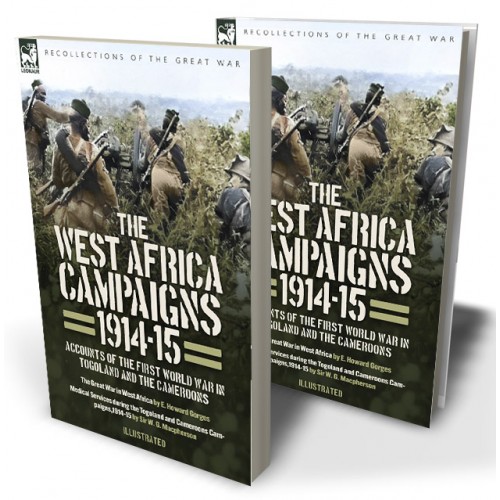
First rate accounts of two rarely covered campaigns of the Great War
The First World War broke out shortly after the empires forged by nations of the developed west had reached their zenith. Britain had been notable in its success in that endeavour, whilst Germany (a late arrival in actual statehood) had done its best given the short time available to it and the paucity of worthy dominions not already claimed by its competitors. This state of affairs, indeed, significantly contributed to this war and guaranteed it could be prefixed, 'World'. Both Britain and Germany possessed colonies in East Africa, South Africa and West Africa in 1914. France too had territories it could claim as its own. Though the principal battles would be fought far away in Europe, there was no consideration which would allow these far away neighbours to co-exist peacefully. There are several books readily available on the East African campaigns, but less on the struggles on West Africa-an often entirely different terrain of dense, hostile pestilential jungles and swamps which favoured no one. These were short campaigns prosecuted against a determined, but under resourced enemy.The outcome was certain. Nevertheless, they make fascinating reading for every reader fascinated by the 'side-show' theatres of the Great War. Contains many photographs and illustrations.
Leonaur editions are newly typeset and are not facsimiles; each title is available in softcover and hardback with dustjacket.
So it happened that on 6th October, when the French had with difficulty stormed the Yapoma bridge, an expedition composed of a small mixed naval and military force, the command of which General Dobell entrusted to me, was in readiness to strike at Jabassi The naval detachment under Lieutenant Commander the Hon. B. T. C. O. Freeman-Mitford of H.M.S. Challenger, who also commanded the flotilla, consisted of 100 seamen and marines, two 6-inch naval guns, and a 12 pdr. field gun with the gun crews. The military detachment under Lieut. Col. Vaughan included four mountain guns, six companies West Africans, two companies 1st Nigerians, the Pioneer Company Gold Coast Regiment, and some 600 carriers.
The flotilla in which this force was stowed away was made up of all manner of light craft (many of them captured), including a small coasting vessel, a dredger, six steam-launches of various shapes and sizes, two 100-feet motor-launches, a steam-tug, a stern-wheeler, eight steel lighters, eight surf-boats, a motor-pinnace, a steam ditto, and the Cumberland’s picket-boat (The Red Devil). Two of this motley assemblage deserve special mention, viz. the dredger Mole and one of the steel lighters, for on these were mounted the 6-inch guns from the Challenger, the former being semi-officially christened the Iron Duke, the latter, Dreadnought, by the Senior Service. This tickled the fancy of the soldiers, who perceived in these craft an ingenious innovation, indicating intelligence in the inventor. They were, in fact, river monitors.
The orders were to seize Jabassi and attack any hostile force in its vicinity. The embarkation was completed at Duala by the evening of the 6th, and at 5.30 a.m., on 7th October, the flotilla, like some huge sea monster moving in from the deep, forged its way up the winding and swiftly-running Wuri, its pilot fish the picket-boat. The river on both banks was nothing but an impenetrable tangle of dense Bush and high elephant grass. Just before sundown we were fired on from Nsake Hill, about ten miles below Jabassi on the left bank.
This fire was quickly silenced by the 3 pdrs. and Maxims of the leading craft, and Nsake was occupied by a company of the West Africans; a detachment was also landed on the opposite bank and the flotilla, covered by these troops, anchored for the night in midstream. We weighed at dawn on the 8th, and moving slowly onward at 7 a.m., reached a point in the bend of the river about three miles below and in view of Jabassi, perched on high ground on the right bank.
The expediency of advancing up both banks of the river was now carefully considered, but in the absence of definite information as to the enemy’s strength, and in view of the denseness of the undergrowth on the left bank, which in places was intersected by impassable swamps, I decided to keep the troops intact on the right until the situation became more clearly defined. I was, in fact, very loath to throw a portion of my small force into such a blind piece of unknown country—cut off as it would have been by the river, and liable to be trapped by superior numbers. Consequently, we drew up alongside the right bank, and completing the disembarkation by 9 a.m., the force moved forward with two companies as advance and left flank guards, five companies and a section of mountain guns main body, while two companies, the naval detachment and 12 pdr. gun, were held in reserve.
A muddy pathway through dense elephant grass running parallel with and close to the river was followed, and our right was protected by the armed flotilla. By 10.30 a.m. the main body had reached a hillock (A) about three-quarters of a mile from the town. This hillock had been prepared for defence and strongly entrenched, but had been recently evacuated by the Germans, and at this point, on information gathered from scouts, three companies were detached to the left to try a turning movement against the enemy main position, which had been located on what they called Government Hill, just above the town, but the country was so dense that cohesion was practically impossible. The moment troops were launched forth they were lost to sight. It was a case of “Follow my leader and trust to luck!” Whilst this flank movement was in progress, Lieut. Col. Vaughan advanced up the river bank to attack the position in front. At 11.30 a.m. the reserve with the 12 pdr. gun was ordered up to the hillock (A) on which we had now established Headquarters.
As these troops were closing on the hill, a sudden burst of machine-gun and rifle-fire was opened upon them and on the flotilla, which was steaming slowly up stream, conforming to the general movement. This fire, directed from the Bush on the left bank, though heavy, was a bit wild, and did little damage to the troops, but it was remarkable that at such close range the boats’ crews were not wiped out, for bullets were literally rained upon them. The fire was replied to by every gun and rifle that could bear, but as the enemy was invisible no effect could be observed, and at about 1 p.m., the boats, being in a somewhat critical position, were ordered to drop down to a bend in the river.
Unfortunately, the tug Balbus, towing the Dreadnought, ran aground on a small island and had to be abandoned. The coolness displayed by Commander Mitford and the crews of the various craft under this hail of bullets, which we soldiers witnessed from the bank, was most heartening to all.
Lieut. Col. Vaughan, with the main body, had now (1.30 p.m.) reached a clearing in the Bush and occupied some tin buildings on the river bank about eight hundred yards from the enemy main position. Here, however, he was subjected to a most severe cross fire from concealed machine-guns, and finding an unfordable swamp in his immediate front, he evacuated the buildings and moved to an opening to his left, hoping to find a way through, but here also he was confronted with a similar situation and could make no progress. At about 2 p.m. I went forward with my Staff officers. We found the troops suffering from the effects of the terrific heat, tactical unity completely lost in the dense elephant grass through which officers were trying to lead the men, many of whom showed signs of hanging back under the constant bursts of machine-gun fire, of which this was their first experience.

 your wishlist
 your account


 Click on image to enlarge
 Mouse over the image to zoom in