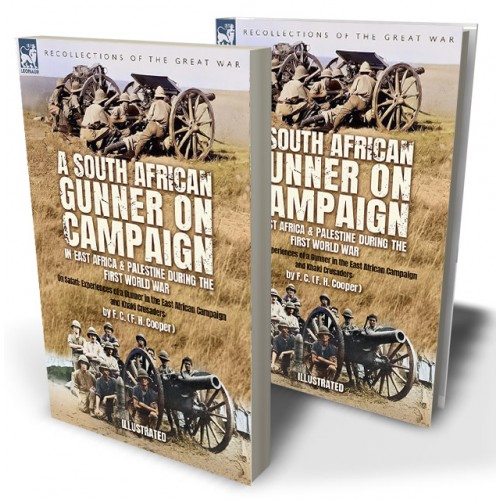
'On Safari: Experiences of a Gunner in the East African Campaign' and 'Khaki Crusaders'
Serving with the Guns in two theatres of the Great War
Both personal accounts in this two book Leonaur edition of the East African Campaign and Sinai Palestine Campaign of the First World War were written by the same author, who was an artillery signaller in the South African Army. The setting in the first account is the 1914–16 advance through the Pangani Valley and Central Railway region against German colonial forces. Cooper describes the difficulties of operations against a competent and elusive enemy through thick bush. His force perpetually suffered from lack of transport and essential supplies and he and his comrades were further incapacitated by diseases including malaria and dysentery. Having survived the rigours of war in East Africa ,Cooper was dispatched to the Middle East where he served during the Sinai and Palestine Campaign of 1916-18, as part of Allenby’s Egyptian Expeditionary Force charged with expelling Ottoman Turkish forces from the Holy Land. Once again the environment of the battlefield could be as harrowing as the campaign itself, as the demands of operating in desert conditions with its extremes of heat and poor weather, creating cloying mud took their toll. The reader will also accompany Cooper onto the field of battle, under bombardment, as he struggled to keep essential lines of communication open between observers and their gunners. This book unusually offers an insight into two 'side-shoe' theatres of the war from the perspective a single reporter and so recommended to every student of the period.
Leonaur editions are newly typeset and are not facsimiles; each title is available in softcover and hardback with dustjacket.
Certainly, none of us, as we lay peacefully smoking around the bright camp fires, making pictures in the flames, had sufficient imagination to suggest the surprise that the morning would bring. But by some curious semi-presentiment, as D. and I chose our camping spot under one of the little shade-trees the Germans so sensibly plant, even along the country roads, I made a mental note that there was a shallow gutter running down the side, which might befriend a man in an hour when publicity was to be shunned.
From the tragic note my pen has been sounding you will possibly be preparing for a horrible massacre in the light of dawn. Heaven alone knows why there was not: only a miracle—assisted by extraordinarily bad shooting —can explain the mystery. But we anticipate. At 11 p.m. all fires were as a matter of form extinguished, and we lay for that comfortable half-hour before sleep wondering how many dozen miles separated us from the Germans and the excitement attendant, we hoped, on our first meeting.
Dawn broke cool and peaceful. D. was into the river while I started the fire. On his return I went down to the bridge and had an exhilarating ablution on the rocks. As I finished drying myself, I noticed some commotion among the Indian guards—gesticulations and weird noises directed towards myself. Indians are an excitable race, and I wondered whether I was merely shocking them by displaying over much of my person during their hour of prayer, or whether perchance the odour of frying portions of the sanctified ox had offended their high caste noses.
And my own senses finding nought unacceptable in that scent, I hastened back to our fire, observing on the way some trifling morning manoeuvres being conducted by a few infantry sections from our escort. Otherwise, the camp appeared very peaceful, some of the lazier spirits still lying comfortably wrapped in their blankets. We were just wondering what might be the meaning of the liveliness exhibited by the Indians at the river and by the other energetic riflemen, when clear and unhesitating came the answer. From the summit of the wooded kopje that rose above our outspan broke on our incredulous ears the sustained rattle of machine-guns and rifles.
In a moment the air was thick with bullets; and the popular sporting piece among the German native levies is an elephant-gun that fires a large, flat-headed, leaden bullet, whose scream, so an Irishman told me, is strongly reminiscent of the Banshee’s wail on a stormy night. As we flung ourselves down on the open ground (and one envies a pancake its dimensions on such occasions), I involuntarily compared the old days of cadet corps and volunteer training camps, when even on the most realistic field-days one could always find time to select a soft and thornless spot on which to drop, with our present indifference to aught save flatness.
And lying there, spread over the smooth sand, we felt we must surely appear in the eyes of the enemy as a black bulls-eye on a new white target. Then I bethought me of the little ditch that had caught my eye the previous evening, and apprising D. of the fact, we hurriedly crept into its scanty shelter. Now we two, with half a dozen others, were of the artillery—pilgrims searching the country for our batteries—and to us no rifles had been issued. Although ours was the privilege of lying quietly in a slight depression while a hail of bullets passed harmlessly, but seemingly about nine inches, over our heads, yet the inability to attempt hitting back is a most exasperating sensation.
After a few minutes of this fusillade, we cocked a cautious and inquisitive eye over our bank, prepared to find dead and dying mules kicking their heels up in every direction. We were vastly surprised to see all two dozen spans standing up, calmly flicking their tails, with only here and there a tell-tale leg, dangling limp and red, to show there was a war on. The machineguns and rifles persevered, however, and presently a pompom and a four-pounder joined in the fray, evidently with the idea of showing the others how it should be done. With the South African Field Artillery, the usual practice is to find the range by sending the first two shells respectively a hundred yards beyond and in front of the estimated distance of the target.
The German method of ranging was wonderful; their “bracket” was one of something like two thousand yards. First a shell would fall with a stodgy flop in the bog well to our front. This would be followed by a shriek overhead and a muffled explosion somewhere back among the rocky peaks of the Usambara Mountains. Although their fire could hardly be called effective, the forces of the Hun were producing a horrid din, which was altogether too much for some of our native drivers, who straightway dived for the nearest clump of bush, where they disappear from our story.

 your wishlist
 your account


 Click on image to enlarge
 Mouse over the image to zoom in