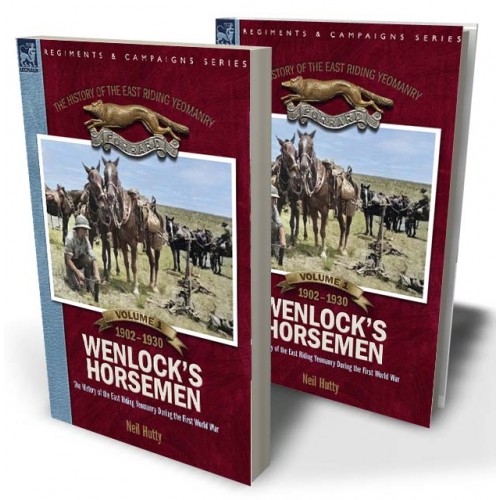
Wenlock’s Horse & the First World War Egypt, Palestine and on the Western Front
The East Riding of Yorkshire Yeomanry was formed in the aftermath of the Boer War by Beilby Lawley, Lord Wenlock, and henceforth known unoffi cially as ‘Wenlock’s Horse’. This is the story, told largely through eyewitness accounts never before published, of a British Territorial Army cavalry regiment thrust into the maelstrom of the First World War. Despatched to Egypt, the Regiment saw active service against the Turks in the Palestine campaign of 1917, participating in some of the fi nal cavalry charges of the British Army, and leading to the fall of Jerusalem. In response to the German Spring Offensives of 1918, the Regiment was rushed to France as machine gunners, where they experienced fi rst-hand the realities of trench warfare on the Western Front as they took part in the fi nal Allied offensives of the war. The Great War signalled the beginning of the end of horses in modern warfare, and the East Riding Yeomanry was amongst the fi rst units in the British Army to mechanise, becoming an armoured car company of the Royal Tank Corps in the 1920s. Leonaur editions are newly typeset and are not facsimiles; each title is available in softcover and hardback with dustjacket.
Chetwode’s orders were issued at 1pm but before the attack could be mounted the Imperial Mounted Division, who were positioned to the south, would have to move up and relieve the units of the ANZAC Mounted Division. This took time and consequently there was a considerable delay before the attack could begin; the ANZAC Mounted Division finally moved off at about 3:30pm, by which time the infantry had succeeded in reaching the top of the hill at Ali Muntar.
The East Ridings and the Lincolnshire Yeomanry left their forming up point 1½ miles east of Ali Muntar at around 3:30pm and advanced at the gallop through machine gun fire and shrapnel towards a hill on the outskirts of Gaza. Frank Wood wrote:
“our orders were ‘attack’, so we went in fine order, in line of troop columns at the canter. Oh, that ride, under heavy & what appeared to us well directed shell fire & over about two miles of rough plain, was as good as a fox hunt, quite a few came to grief, not so much through enemy shrapnel as through their horses falling”. 21
The East Ridings managed to get within a few hundred yards of the hill before being forced to dismount by thick cactus hedges. Leaving ‘A’ Squadron in reserve and one man for every four horses behind, the rest of the regiment carried out a dismounted attack under fire, capturing a Turkish redoubt along with 50 prisoners. According to Lieutenant Wood:
“we dismounted to attack the hill on which we could already see the Jackos (Turks) running, evidently our galloping advance had put the fear of something into them. As we advanced our RHA did some very good shooting, for their shrapnel was sweeping the ground only 30 yards in front of us. We took this hill, afterwards called Fryer’s Hill after our Brigadier, at the same time as some of the infantry arrived on it – taking some 50 or 60 prisoners. A perfect hail of machine gun bullets greeted us on the ridge. It has always been a mystery to me why I did not lose more than one man at this time, when my troop was in front; we could not locate the enemy guns among the dense prickly pear hedges, nor could we advance, as there was a steep descent or a kind of cliff in front of us”. 22
With their hill secured, the East Ridings sent out a patrol towards Ali Muntar which found that hill already in the possession of the infantry. The cost to the East Ridings of their first action was 1 OR killed (Private Robert Butler Throssel was killed by shrapnel), 2 wounded and 9 horses killed or wounded.
The entire Ali Muntar position had been secured and the ANZAC Mounted Division, including the East Ridings, was now in the suburbs of Gaza. To those on the ground it seemed that victory was theirs and this opinion was shared by the defenders. In Gaza the garrison commander destroyed his wireless and prepared to surrender. Outside the city the Turkish commander, General von Kressenstein, halted his reinforcements fearing it had already fallen.