Author(s):
Gordon S. Maxwell & William Washburn Nutting Date Published:
06/2023 Page Count:
232 Softcover ISBN-13:
978-1-916535-49-7 Hardcover ISBN-13:
978-1-916535-48-0
Adventures in the fast moving small motor boats of the Royal Navy
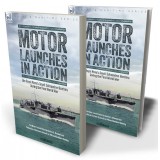
The Great War may well have seen the zenith of the huge battleship fleets, but was also the creation of new kinds of vessels for naval warfare. The Germans had refined the submarine and the U-Boat menace represented a severe threat for the sea-borne transportation of men and materiel across the Atlantic Ocean. Clearly counter-measures were required and among several suggested and adopted was the creation of a 'mosquito fleet' of small fast moving motor launches focussed on harbour defence and patrolling comparatively coastal waters, armed with quick firing guns and able to speed at 19 knots. In April 1915 work began on fifty 75ft motor launches fitted with 2200 HP engines. The days of the 'submarine chasers', of theRNVR had arrived. 'Motor Launch Patrol' is a creatively written book by a motor launch officer which combines his first hand experiences on patrol, his reveries and anecdotes, the everyday workings of the 'mosquito fleet' and its notable battles and services. The role the little boats played in the daring Zeebrugge and Ostend Raids is well covered as is perilous duty at Dunkirk and off the Belgian coast. The activities of the M.L.'s in the Mediterranean Sea off the coasts of Turkey and Palestine is also covered in some detail. The second piece in this book is an extract from ,'The Cinderellas of the Fleet' which provides an overview ofthe launches in Royal Navy service from design to manufacture and their time in action.
Leonaur editions are newly typeset and are not facsimiles; each title is available in softcover and hardback with dustjacket.
Meantime she had been seen by some of the shore batteries, and a heavy fire was opened up on her and the attendant M.L.s. M.L. 254 was hit by several projectiles, and Lieut. Drummond was wounded by a piece of shell in the right leg. Lieut. Ross, who was working the Lewis gun, was unfortunately killed outright, together with one of the crew. A moment later the coxswain was hit and Lieut. Drummond was again wounded in the shoulder and right arm by machine-gun bullets, but, undeterred by this, he followed in between the piers and brought his ship alongside Vindictive as soon as she came to rest in the spot where she now lies.
Two officers and thirty-eight men were got on board despite the continual heavy fire, and, as no one else could be seen, Lieut. Drummond backed his vessel out of the inferno and turned seawards. It was then found that she was badly holed forward, but the pump was got to work, and with the aid of the rescued men bailing with buckets she was kept afloat until she was picked up by Warwick half an hour later. It was found necessary to abandon the M.L., and the Admiral gave orders for the gallant little boat to be sunk to avoid any possibility of her falling into the hands of the enemy before she took her final plunge.
Lieut. Ross died in a gallant way and one, I’m sure, he would have chosen, for he was by nature one of the most glad-hearted men I have ever met and always ready to take his share in any adventure. He was the first Canadian to join the R.N.A.S, which he did early in 1915, subsequently transferring to the R. N.V.R.
In the meantime, Lieut. Bourke in M.L. 276 had sustained considerable damage while waiting off the harbour, and two of the crew had been killed. When he saw M.L. 254 backing out, Lieut. Bourke decided to go in to Vindictive and look for any survivors that might have been left behind. After considerable search, Lieut. Sir John Alleyne and two seamen were found in the water alongside the blockship and rescued. All three were badly wounded and would undoubtedly have perished but for the opportune arrival of the M.L. Sub-Lieut. J. Petrie managed to get the three men out of the water at great risk to himself.
The M.L. was under very heavy fire all the time, and her dinghy was hit by a six-inch shell, which fortunately went right through without exploding; the steering-wheel was badly damaged and the hull hit in more than fifty places by machine-gun bullets. The engines were hit several times, but the boat was successfully got out of the more immediate danger-zone under her own power before she had to be taken in tow by another M.L. and the wounded men transferred to a monitor. M.L. 276 presented a singular appearance in Dunkirk harbour the next day, with part of her mast shot away and her many scars. Of machine-gun bullet marks alone, she had fifty-five.
All the time that these rescues were taking place Captain Benn was in ignorance of what was happening inside the harbour, and, being in doubt whether M.L.s 254 and 276 had succeeded in taking off Vindictive’s crew and fearing that they might have come to grief, sent in M.L. 283 under Lieut.-Commander Hoare and M.L. 128 under Lieut.-Commander Saunders to see if further assistance was required, and followed them with Commander Watson in M.L. 105. The rescue work was done, however, but all three boats came under heavy fire; but, with the exception of M.L. 128, they were lucky enough to escape casualties.
The escape of M.L. 128 under Lieut.-Commander R. Saunders deserves more than a passing reference, for it was certainly one of the most thrilling during two actions filled with thrills. As this launch was approaching Ostend piers she suddenly emerged from the smoke-screen to find herself almost on the beach, not more than two or three hundred yards away. By the houses on the front Lieut.-Commander Saunders knew he was to the westward of the piers, and turned to make for them at full speed, but it was too late to escape attention from the shore, for up went a succession of star shells and a hail of bullets from machine-guns clattered on to the deck. One man standing just behind the C.O. was killed instantly, but the rest of those on board seemed to bear charmed lives.

 your wishlist
 your account


 Click on image to enlarge
 Mouse over the image to zoom in