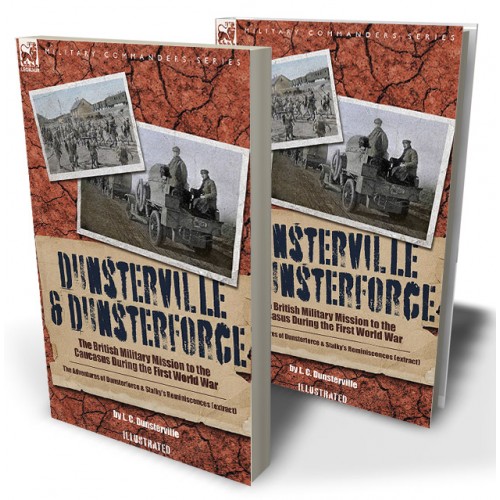
Most readers know that the principal adolescent who appeared in Rudyard Kipling's tale,'Stalky and Co', was based on an actual person, Lionel Dunsterville, who was a school friend of the author. Stalky, the ring-leader of a roguish trio, was destined for a military career in India and so it was for Dunsterville. He served on the North-western Frontier and during the Boxer Rebellion in China. In 1917, during the First World War, Dunsterville was a major-general put in command of a small allied force originally of less than 500 effectives (including British, Australian, Canadian and New Zealand troops- later joined by the 39th Infantry Brigade ) together with 500 vans and armoured cars. The mission of this unit was to advance 350 km from Hamdan in the Zagros Mountains across Qajar Persia to gather intelligence and train local forces to replace Tsarist troops following the Russian revolution. In fact,the force actually came into action itself againstJingali rebels at Manjil. Dunsterville was subsequently instructed to assist in the defence of the important oil fields and port of Baku, though compelled to withdraw in September 1918 in the face massively superior advancing Ottoman Turkish forces. This Leonaur edition contains two linked accounts by Dunsterville. The first is his own account of the Dunsterforce mission whilst the second is a more intimate view of the affair extracted from his autobiography 'Stalky's Reminiscences'.This is a little reported aspect of the Great War, so fascinating to students of the conflict's 'side-show' theatres.
Leonaur editions are newly typeset and are not facsimiles; each title is available in softcover and hardback with dustjacket.
At dawn rifle fire was heard from the direction of Binagadi Hill, occupied by one company 7th North Staffords, strength eighty all ranks, under Lieutenant R. L. Petty, M.C., who reported an encounter with a strong enemy patrol. At 6 a.m. a second report was received to the effect that the enemy, strength about 500 rifles, was massing for an attack at the foot of the western slopes of Binagadi Hill. Information received from various sources confirmed the report, and it became obvious that an enemy attack was about to take place.
I accordingly ordered headquarters and one company Royal Warwicks at Diga to move to the centre of Binagadi oil derricks and remain there in reserve. At the same time, I asked Colonel Kazarov, commanding Right Section to move the armoured train to Baladjari and there create a diversion against Mud Volcano. At 6 a.m. the attack developed, supported by machine-guns and about twelve field and mountain guns. The machine-guns had been brought under cover of darkness to within 600 yards of our position, and so placed as to enfilade our trenches. These machine-guns were placed in the open behind large shields, without any attempt at concealment. The hill was swept with intense machine-gun fire and the defences considerably weakened by casualties, and the necessity of withdrawal, unless the hill could be reinforced, became probable.
The Russian commander was asked for support which was eventually given, but the reinforcing troops only reached the eastern slopes of the position after the evacuation. At about 7.50 a.m. Binagadi Hill became untenable. Lieutenant Petty, the company commander, had been killed, and to avoid complete annihilation our troops at 8.30 a.m. were compelled to withdraw, and fell back steadily to the right of Warwick Castle. The Royal Warwick Company from Diga arrived too late to save the position. At 11.5 a.m. an attack against Warwick Castle developed.
The loss of Binagadi Hill, together with the failure of the Armenian battalions in reserve in Binagadi village to support the right, exposed that flank, and the retirement of an Armenian battalion on the left of Warwick Castle left both flanks of the position in the air, a weakness of which the enemy took full advantage, and he soon began working through the rough ground round the position to within forty yards of it, compelling the withdrawal of the garrison to avoid complete isolation and capture.
The Royal Warwicks then fell back steadily to the line of Binagadi derricks, thence turning north-east through the western end of the derricks. Our line roughly was then from Baladjari—running north towards the eastern end of Binagadi derricks, and then to Diga, with large gaps at intervals.
I then ordered the company of the Royal Warwicks in reserve to occupy the line of Binagadi derricks, but they only succeeded in obtaining possession of the southern edge of the line, and considering the line unsatisfactory I withdrew them to a more southerly position about 200 yards clear of the derricks. Having no further reserves at my disposal, I decided that it was impossible to hold the line with the troops then occupying it, and consequently asked permission to withdraw to the line Baladjari village along the forward railway embankment to the western edge of the Darnagul salt lake. Sanction having been obtained, the withdrawal took place after dusk, and the new line established. Two companies of the Royal Warwicks at Diga having been placed under the order of Major Dayrell, remained at Diga, which place was attacked the same evening, for which operations I am submitting a separate report.

 your wishlist
 your account


 Click on image to enlarge
 Mouse over the image to zoom in