Author(s):
William O’Connor Morris & Henry William Herbert Date Published:
2025/11 Page Count:
284 Softcover ISBN-13:
978-1-916535-79-4 Hardcover ISBN-13:
978-1-916535-78-7
An expert and erudite analysis of one of history's greatest generals
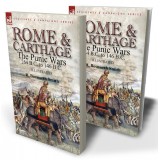
The military genius of Hannibal, much like that of the Emperor Napoleon in later centuries, towered over all the fi gures of his notable age of warfare. This Leonaur edition describes, in learned detail, the Punic Wars and the rise of Hannibal which led to the crossing of the Alps and the victories of Trebia, Trasimenus,Cannae and other engagements to the eventual defeat of Carthaginian forces at Zama by Scipio Africanus. No other Carthaginian could credibly claim the greatness of Hannibal. He was, in fact, pre-eminent among the soldiers and statesmen of his enemy, the Roman Empire and, for a time, the very spirit of the Mediterranean World. Nothing that occurred in the period of the Second Punic War can be compared to Hannibal, with the exception of the collective greatness of the people which at last utterly destroyed his nation in the Third and fi nal Punic War. Hannibal was a consummate warrior, and statesman; a patriot, whose career was defined by a total devotion to his country, without a thought of ambition and self- aggrandisement, and an intense hatred of its implacable foe. Hannibal's reputation as a strategist and tactician today stands untrammelled, to the degree that his memory remains in perpetuity greater than his own ultimate failure. Hannibal & the Second Punic War & the Second Punic War
Leonaur editions are newly typeset and are not facsimiles; each title is available in softcover and hardback with dustjacket.
After entering the “Island,” Hannibal was in the land of the Allobroges, a powerful tribe of the Gauls; he conciliated a leading chief, at feud with his brother; and he obtained from his grateful client an ample supply of food, clothing, and other necessaries for his men. He appears to have skirted the Rhone, nearly as far as Vienne; avoiding there the great bend of the river, he struck across the country until he nearly reached it again; and here he found himself on the spurs of the mountain barrier, like a rampart in front of the main chain of the Alps, which stretches from Belley, by Montmélian, to Grenoble.
The friendly chief by this time had bade him farewell; and as his army drew near a pass in the range, probably the Chevelu, just north of the Mont du Chât, it was challenged by the Allobroges of another clan, who, jealous of their wild freedom, like all mountaineers, checked the advanced guard, and crowding the neighbouring heights, assumed a menacing aspect, and seemed eager to attack. Hannibal deceived the barbarians by a skilful feint; he moved his army towards the mouth of the pass, but kept it in its camp for some hours, as if hesitating what step he was to take; and then, having ascertained that the Gauls returned to their villages at night, and kept no watch, he pushed forward a body of picked men in the darkness, seized the defile, and the highlands above, and gradually drew the mass of his troops onwards, under the cover, so to speak, of huge fires, which would make the enemy believe that the camp was still fully occupied.
The autumn morning found the Carthaginian Army in possession of the pass, and making its way, by a descent of extreme difficulty, towards the open plains leading from Chambéry, to the valley of the Isère. The Gauls had been baffled, and paused for a time; but their chiefs, who had probably sent their commands far and near, ordered their clansmen to fall in force on the enemy. Hannibal’s columns were toiling along a mere track, formed in the side of the range above, and often meeting precipices that, steep as walls, went down hundreds of feet, into torrents below; the barbarians, swarming by mountain paths in their way, attacked them at these dangerous points; and as the numbers of the assailants increased, the army was beset in front, flank, and rear, and a terrible scene of disaster followed.
Horses, beasts of burden, carriages, and trains were hurled in confusion into the yawning depths beneath; hundreds of the soldiers were slain, or made captives by the Gauls; thousands perished as they were forced over the cliffs; the air rang for leagues with the savage yells of the Celts; the whole enterprise, in a word, was gravely endangered. But Hannibal’s picked men had kept the crest of the heights; they moved rapidly along, at their leader’s command, overlooking from above the Gaulish onset; they doubtless were accompanied by the renowned Balearic slingers, and they poured such a storm of missiles on the enemies below that an immense number of these was killed and the barbarians were compelled to abandon the prey that seemed in their grasp.
The Carthaginian Army, extricated, but with enormous loss, made its way, molested no longer, into the plain that extends to the great lake of Bourget; it seems to have made a halt for a time; and it avenged itself on its defeated enemy. Hannibal destroyed the principal town of the Gauls; laid in an ample store of provisions; and made booty of large herds of cattle. He was rejoined, probably near Chambéry, by a considerable number of wounded men and stragglers.

 your wishlist
 your account


 Click on image to enlarge
 Mouse over the image to zoom in