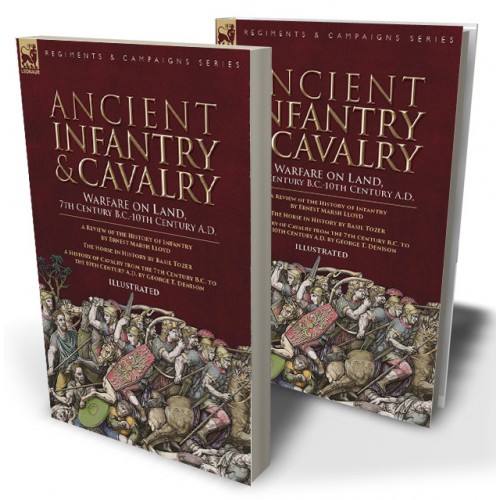
A Review of the History of Infantry by Ernest Marsh Lloyd
The Horse in History by Basil Tozer
A History of Cavalry from the 7th Century B.C. to the 10th Century A.D. by George T. Denison
The foot soldiers and horse-back warriors of the ancient armies
This useful, thorough academic, work contains three overviews of the armies of the ancient world. Infantry formed the core of military forces throughout antiquity, evolving from loosely organised groups into highly disciplined tactical units. Heavy infantry in armour, carrying shields and close-combat weapons fought in formations which anchored the battle line, whilst mobile light infantry, often unarmoured, equipped with javelins, bows, or slings harassed the enemy prior to the main battle clash. Greek and Macedonian Phalanxes were comprised of disciplined hoplites, creating a virtual fighting wall. Roman Legions employed flexible maniples and cohorts which could manoeuvre independently to exploit gaps in enemy lines, whilst Persian 'Immortals' combined spear-fighting with archery. Ancient cavalry, a later development, became a decisive battlefield component as chariot warfare diminished. The Assyrians were among the first to use mounted troops in significant numbers. The Macedonians, innovated the first true "shock" cavalry, employing massed charges to break enemy formations,whilst the Parthians perfected fully armoured Cataphracts and light horse-archery tactics where riders fired backwards while feigning retreat. The Romans, always intuitively infantry recruited 'auxilia' from subject nations renowned for their equestrian abilities. This is a worthwhile collected assessment from three notable historians .
Leonaur editions are newly typeset and are not facsimiles; each title is available in softcover and hardback with dustjacket.
It has been suggested that the long spear and long sword were not given to the same men; that there were two classes of peltasts, one armed with spears and the other with javelins and swords for hand-to-hand fighting. But there is no positive evidence of this distinction. They seem to have formed a medium infantry, available as light troops or as infantry of the line, and they may have chosen their weapons according to the occasion.
As light troops came to play a more important part, so also did cavalry. Greek horsemen had no stirrups and were easily unhorsed. They could do nothing against unbroken hoplites except annoy them with darts. They fought in loose order and made little use of shock, but tried to fall unawares upon a flank. Thessaly and Boeotia with their more open valleys furnished the best cavalry; that of the Lacedaemonians was the worst. The Boeotians attached a footman to each horseman, and the intermixture of horse and foot by placing small parties of light-armed men in the intervals between the troops was a recognised practice. The strength of a troop was about sixty men. The best weapons for horsemen, according to Xenophon, were a short stabbing sword and a pair of cornel-wood spears, one of which might be hurled as a javelin.
However serviceable the new type of infantry might be for minor warfare, the Lacedaemonian hoplite retained his supremacy in pitched battles in the open field. Even to repulse him was reckoned a great achievement. The Athenians put up a statue to Chabrias to celebrate such a success. In 378 B.C. their troops in concert with the Thebans awaited the attack of the Lacedaemonian phalanx. The front ranks dropped on the right knee and propped their shields against the left, and such a hedge of spearpoints was presented by the long spears that Agesilaus thought it prudent to draw off his men. But seven years afterwards, at Leuctra, Thebes won a very different sort of victory, and robbed the Spartans of their pre-eminence.
A well-fed race, with rich pastures and no commerce, the Boeotians had always shown themselves strong and stubborn soldiers. Three hundred of them had turned the scale at Syracuse. Thebans were Boeotians and something more. They were “a conquering caste in an alien land,” with an infusion of Phoenician, or at all events non-Hellenic blood. The military organisation of Sparta is said to have owed much to Timomachus, who came from Thebes, and claimed descent from Cadmus. There was perhaps some far-off kinship between Hannibal and Epaminondas.
It was a Theban custom, of which the origin is unexplained, to fight in deep formation. At Delium (424 B.C.) their phalanx was formed in twenty-five ranks, and this massive column broke through the Athenian left, while the Athenian right got the better of the other Boeotians. The timely appearance of some cavalry, which the Theban commander had sent round a hill unperceived to support the left wing, decided the day. At Corinth and at Coronea (394 B.C.) the Thebans had to deal with the Lacedaemonians. Placed on the right of the army, in each case they defeated the allies of Sparta, but were themselves defeated by the Lacedaemonians, who had been equally successful on the other wing, and whose discipline enabled them to wheel promptly and attack their enemies in succession. At Coronea the Thebans, abandoned by their allies and hard pressed by Agesilaus, succeeded in cutting their way through, though with heavy loss.
After the recovery of the Cadmea the Sacred Band was formed, a military brotherhood of 300 chosen Thebans, quartered there and maintained at the public expense, that they might devote themselves to military exercises. In 375 B.C. Pelopidas at the head of this band encountered two Lacedaemonian battalions, as he was marching along the shore of the Copais Lake. Forming his men in column, he boldly charged them, though they were three times his own number, and not content with breaking through, he completely routed them.

 your wishlist
 your account


 Click on image to enlarge
 Mouse over the image to zoom in