Author(s):
Sir Reginald Custance, Gabriel Darrieus & George C. V. Holmes Date Published:
2026/08 Page Count:
176 Softcover ISBN-13:
978-1-918436-45-7 Hardcover ISBN-13:
978-1-918436-44-0
Three erudite and academic examinations of warfare afloat in the ancient world
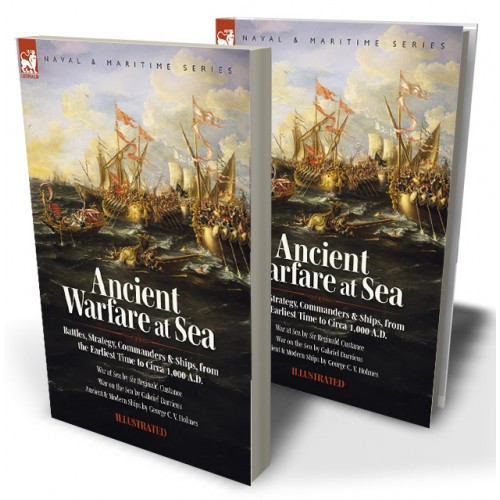
Naval warfare in the ancient world evolved from troop transportation to highly specialized ramming tactics, eventually becoming missile hurling vessels. The Battle of the Delta (c. 1175 BC) saw Egypt using archers and grappling hooks. Phoenician penteconters were long, open galleys powered by oars and sails. The Greeks and Persians mastered the naval tactics of their day, developing the Trireme galley which featured three tiers of oars, for speed and ramming impact. Massive warships like "quadriremes" appeared which carried catapults and boarding towers. The Romans naval combat became floating infantry battles in which spiked boarding bridges allowed marines to board and capture Carthaginian ships. The Byzantine, Dromen warship, was an oared galley featuring lateen sails and a fully decked hull. Incendiary liquid pumped through bronze tubes that burned on water,'Greek Fire' secured the empire's naval supremacy. In northern waters, the Longships, shallow-draft vessels capable of navigating both open oceans and shallow rivers for surprise raids, appeared. This special Leonaur edition offers three academic perspectives of the changing nature of war at sea throughout 2,000 years of history. Contains many useful illustrations.
Leonaur editions are newly typeset and are not facsimiles; each title is available in softcover and hardback with dustjacket.
here is nothing to show that the two wings were attacked at the same time, or that Nicostratus divided his small force. It is probable that he did not make such a mistake, but that with his whole force he turned one wing and then the other. We are to picture the thirty-three Lacedaemonians advancing in single line abreast on a front extending upwards of three thousand yards, and the twelve Athenians in single line ahead moving at higher speed, perhaps obliquely across their front, to outflank them.
A long line cannot change front readily, and therefore, to prevent the wing—say the right—being turned and enveloped and the rear then threatened, the ships on that wing would turn outwards into single line and be gradually headed off by the faster squadron; those in the centre and on the further wing would either follow or, uncertain what to do, would perhaps stop rowing until threatened in their turn from the rear by the encircling enemy.
Finally, we are to see the whole fleet rounded up in a circle with the Athenians rowing round them as at Naupactus. Alcidas was only saved from a repetition of that defeat by the return of the twenty ships detached. Their arrival compelled Nicostratus to withdraw. The picture thus drawn depicts the possible and the probable, but whether it correctly represents the actual facts can never be known for certain. The assumed Athenian tactics are similar in principle to those of the Japanese in the action with the Chinese off the Yalu in September 1904.
The successes of Phormio off Naupactus and of Nicostratus off Corcyra were due to superior mobility. The speeds attained by the well-trained Athenian standing crews may have exceeded those reached by the unpractised Peloponnesian levies in the ratio of five to four—say two knots. This highspeed ratio made the ram more effective, but hand weapons were sacrificed in that the number of epibatai or marines carried was reduced, which weakened the Athenians when hand-to-hand fighting was forced on them. Here is seen the earliest example of the rival demands of fighting power and speed.
Furthermore, the flexible line ahead gave better manoeuvring power against the rigid line abreast, and the high-speed ratio, coupled with the short distance between the fleets, made the “rounding up” of the slow fleet easy, although the absolute speeds were low. In fact, Phormio and Nicostratus proved that against superior numbers the ram as a weapon, coupled with higher mobility, gave as great an advantage in the open sea as was given by superior hand weapons alone in the narrow waters of Salamis. It is important to note that this result was attained by skill in manoeuvring a fleet and not in handling a single ship—i.e., in ramming, as has usually been assumed.