Author(s):
Charles Oman & John H. Lewis Date Published:
2026/6 Page Count:
196 Softcover ISBN-13:
978-1-918436-43-3 Hardcover ISBN-13:
978-1-918436-42-6
The great clash of culture and faith between the East and the West
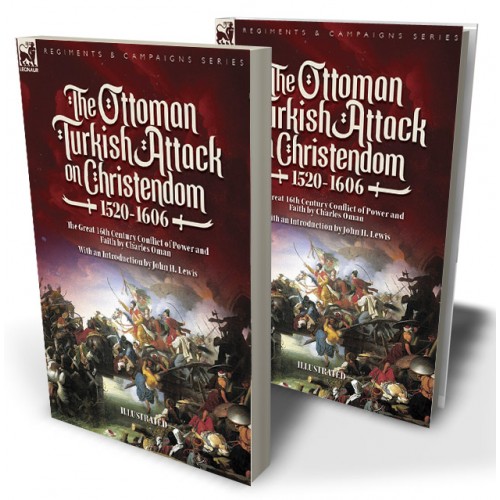
This Leonaur edition,written by one of Britain's most outstanding historians, brilliantly and compellingly recounts the activities of the Ottoman Empire as it reached its territorial and military zenith during the 16th century to become a primary threat to Europe. However, the Sultan was often forced to divide his resources to wage wars in the east against Safavid Persia and the Mameluke Sultanate of Syria and Egypt and these campaigns constitute the opening accounts in this history. Notably, under the leadership of Sultan Suleiman ' The Magnificent', the Turks were engaged in near-constant warfare on both land and sea. In 1522 the Knights of St. John were expelled from their stronghold on Rhodes. The Sultan's army then swept into continental Europe, assaulting Hungary and the empire of Habsburgs. The Battle of Mohács, was a decisive Ottoman victory that led to the collapse of Hungary and heralded a long occupation. The Ottomans then besieged Vienna in 1529. Here they were repelled, the action marking the high watermark of their expansion to the west. Control of the Mediterranean, however remained an essential objective for Ottoman expansion and their ships became the terror of the seas, raiding and taking thousands of prisoners into slavery. The Great Siege of Malta, failed to secure the central sea and in the Battle of Lepanto, the Christian allies' fleet destroyed the Ottoman navy. By the end of the 1500s, the Ottoman Empire's rapid, unchecked territorial expansion into Europe had largely become a strategic stalemate.
Leonaur editions are newly typeset and are not facsimiles; each title is available in softcover and hardback with dustjacket.
On the 7th of August an attack in great force was made on the Borgo front, which lasted for five hours before the last stormers were thrust down. Between the 18th to the 23rd, four similar assaults were made, after a heavy bombardment had brought down considerable sections of the wall: on one occasion the Turks made a lodgement in the Borgo ditch, and stockaded themselves in it, from which they had to be expelled by a costly sally. By this time Mustafa’s army was terribly reduced—he is said to have had only 14,000 fighting men left, and 10,000 sick and wounded in his camps. He had heard that the Viceroy of Sicily had now a large fleet in hand, and might arrive at any moment, while forty of his own galleys in the Marsa Muscetto harbour could not take the sea, because their crews had been used up in the land operations.
But he resolved to make one final assault, which was accordingly delivered on September 1, but without the dash or confidence shown in earlier attempts, and repelled as usual. After this he made up his mind that the enterprise must be abandoned. The tardy appearance of the Spanish fleet only hastened his departure.
Garcia de Toledo had set sail from Messina on August 20 with 70 galleys and a landing force of 10,000 men, and after a short stay at Syracuse made for Malta, but was caught by an east wind off Cape Passaro, and driven 200 miles toward the Straits of Gibraltar. The ships were much scattered and only reassembled once more at Trapani on September 3, from which they at last made their much-delayed crossing to Malta, and anchored off Gozo on September 5. On the 6th the army disembarked and marched to Citta Vecchia, while the fleet rounded the south end of the island and appeared in the open sea, only three miles from the harbour mouth, and exchanged salutes with the wearied garrison.
The Turks then hurried to their ships and fled, abandoning 24 great guns in their batteries, burning masses of stores and munitions, and many disabled and unmanned vessels in the port of Marsa Muscetto. Why the Spanish fleet did not attack them as they moved off is difficult to understand—but the viceroy showed as great a timidity in these days as he showed torpidity during the last three months. So cautious was he that Mustafa, on a false rumour that the army of relief was only 3,000 strong, disembarked his troops in St. Paul’s Bay, on the north side of the island, and only drew back after a skirmish which showed that the Spaniards were in great force. Over a thousand Turks were driven into the sea as they made a hasty re-embarkation, after which Mustafa made off as best he could, with a shattered armament, and returned in disgrace to Constantinople.
It is said that the total Turkish loss during the expedition amounted to 24,000 men, including no doubt the dead among the galley crews. The gallant defenders of Malta, who could count up their casualties with greater accuracy, made up a list of 240 knights who had fallen—no less than 130 of them in the operation at St. Elmo—and nearly 5,000 of the rank and file and volunteers. This must have represented a 50 per cent. loss, as the original garrison was only 9,000 strong, and the one reinforcement received on July 29 was under 1,000 of all ranks.

 your wishlist
 your account


 Click on image to enlarge
 Mouse over the image to zoom in