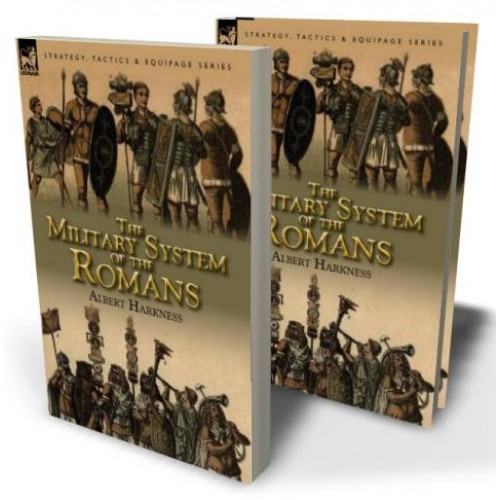
This concise book is an essential handbook to the Roman Army of the Gallic War period. Its compact nature belies the wealth of information contained within its pages which is delivered by the author with the objective of imparting the most information with least pre-amble. This makes this book ideal for all students of the period, re-enactors, war gamers, modellers, theatre production and costumiers etc. It is full of illustrations of dress, uniforms, weapons, military engines etc as well as layouts for military camps of various sizes, lines of march and battle and cross section diagrams for military works and defensive positions. Also included are several battle maps which demonstrate the Roman Army on campaign and on the battlefield. Virtually every aspect of Caesar's military machine is considered in the pages of this thorough book making it a fine and easily accessible reference tool. Recommended. Available in soft cover and hard cover with dust jacket.
Order of March in Advancing.<br>
55. In advance movements in the Gallic campaigns, the vanguard of Caesar’s army ordinarily consisted of cavalry and light-armed infantry, together with the tribunes, centurions, and legionaries entrusted with the duty of selecting and measuring off the ground for the camp. It was its special duty to reconnoitre the country, to take note of all hostile preparations, to gain tidings of the enemy, and in due time to select a suitable place for the camp. From the van, detachments of cavalry were sent out in various directions, sometimes to great distances. It was by means of such reconnoitring parties that Caesar obtained tidings of the movements of Ariovistus, while he was yet twenty-four miles distant.<br>
56. The main body of the army followed the van at a convenient distance. It marched in column of centuries, each legion with its baggage directly behind it; but the last legion probably detailed a few cohorts to protect its baggage, and in that event the cohorts thus detailed formed the rearguard of the army. In this order of march, the legions, thus separated by their baggage, were exposed in case of an attack to great peril; they were accordingly said to be impeditae, entangled or impeded by baggage, impedimentum.<br>
57. In advancing in the presence of the enemy the legions marched either in column of centuries, with collected baggage, or in order of battle. With the first arrangement, the main body, consisting of three-fourths of all the legions, followed close upon the advance-guard, and was itself immediately followed by the collected baggage-train of the army. The few remaining legions formed the rearguard of the column.<br>
In this order of march, the legions were comparatively ready for action, and were said to be expeditae, disentangled, or free from encumbrance; but the individual soldiers were still impediti, and in case of an attack, they required time to dispose of their personal baggage, to remove the coverings from their shields, to put on their helmets, to adjust their field-badges, and, in a word, to prepare for action. In such an emergency, it was the special duty of the advance-guard to secure for them the needful time by engaging the enemy, and thus retarding his movements.<br>
58. Sometimes in advancing in the immediate presence of the enemy, if the ground permitted, the several legions marched abreast, each in three parallel columns in order of battle. For the special formation and arrangement of the columns, see 51. In this order of march, every soldier, free from his baggage, and fully armed and equipped, was expeditus, ready for immediate action.<br>
Order of March in Retreat.<br>
59. The order of march in retreat was usually the simple column of centuries with collected baggage. The vanguard, consisting of a legion or more, started in advance, with the entire baggage-train of the army; at a suitable distance behind marched the other legions, followed by the rearguard, consisting of cavalry, archers, and slingers.<br>
60. In cases of extreme peril, the agmen quadratum, already explained (52), was adopted in retreat. In such an emergency, all the legions of the army were sometimes massed around their baggage in a single square or rectangle, and sometimes each legion enclosed its own baggage, as explained in 52. The cavalry, archers, and slingers, remaining outside of the squares, served as skirmishers.<br>
Order of March in Flank Movements.<br>
61. Flank marches were always made in order of battle. An army is said to make a flank movement when it passes near the flank of the enemy or marches in a direction parallel to his line of march The legions generally marched in three columns of maniples. For the formation of these columns, see 51, 1. In an open country, the cavalry, archers, and slingers, marched on the flank toward the enemy, while the baggage-train was stationed on the other flank. In special cases, each legion was followed by its own baggage.<br>
62. The day’s march of a Roman army in the field began at four or five o’clock in the morning and continued till about midday. Most of the afternoon was occupied in fortifying the camp and in attending to various duties connected with camp-life. The distance usually accomplished in a day does not seem to have differed much from an ordinary day’s march of modern armies. The average distance was probably about fifteen or sixteen miles. Forced marches (magna itinera) were, of course, much longer. In one instance, Caesar marched about fifty miles in a little more than twenty-four hours; but this was an exceptional achievement, accomplished under the pressure of a military necessity.

 your wishlist
 your account


 Click on image to enlarge
 Mouse over the image to zoom in