PAYMENT OPTIONS

​

Forthcoming titles

(Book titles are subject to change)

Air War: East Africa WW1

Raf Russia, 1940

The Asc In Africa

South African Gunners

The Supernatural Ludwig Tieck

Wellingtons Men

Shuttle Bury Cobb & Danby Croker

King William’s War

The Supernatural Jerome K. Jerome


The History of the East Riding Yeomanry: Volume 2: Armoured Yeomen - The East Riding Yeomanry in the Opening Phase of the Second World War 1930–1943

enlarge Click on image to enlarge
enlarge Mouse over the image to zoom in
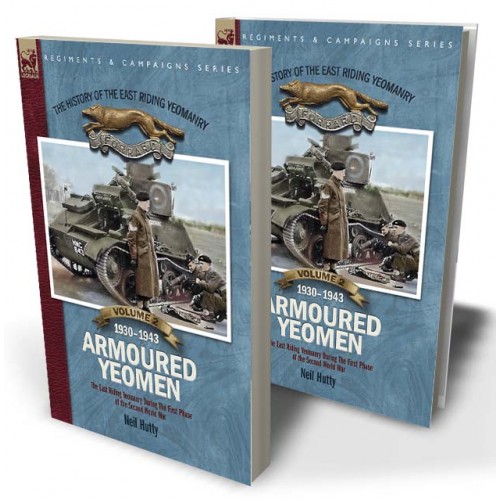
The History of the East Riding Yeomanry: Volume 2: Armoured Yeomen - The East Riding Yeomanry in the Opening Phase of the Second World War 1930–1943
Leonaur Original
Qty:     - OR -   Add to Wish List

Author(s): Neil Hutty
Date Published: 2025/03
Page Count: 236
Softcover ISBN-13: 978-1-917666-03-9
Hardcover ISBN-13: 978-1-917666-02-2

The Battle of France, Defeat, Retreat & Evacuation from Dunkirk

The dawn of the 1930s saw the East Riding Yeomanry, ‘Wenlock’s Horse’, having lost its horses after the end of the First World War, fifi rmly established in the guise of the 26th (East Riding Yeomanry) Armoured Car Company, Royal Tank Corps, one of the earliest British Army cavalry units to mechanise. But as the decade wore on, increasing tensions with Germany saw the company enlarged to two full regiments in 1939, once again as the East Riding Yeomanry. This is the story, told largely through eyewitness accounts, of the 1st East Riding Yeomanry, dispatched to France in February 1940 and given the unenviable task of holding back the German Blitzkrieg to buy time for the rest of the British Army to escape via Dunkirk. It is the story of desperate rearguard actions fought before Regiment was surrounded and overwhelmed at Cassel on the night of 29th/30th May 1940 and of the fifi ve long years of captivity as Prisoners of War that followed. It is the story too of those few who escaped from Dunkirk and who, bolstered by men from the 2nd East Riding Yeomanry, formed the nucleus of an almost entirely new Regiment, licking their wounds and preparing for a return to Europe. Leonaur editions are newly typeset and are not facsimiles; each title is available in softcover and hardback with dustjacket.
Cassel
Once ‘B’ Echelon, 1st ARB and the Welsh Guards had withdrawn from the Mont des Recollets, the ERY began their move into Cassel itself, now mostly in ruins from bombing and artillery fire. Destroyed and abandoned vehicles, debris from the bombed houses, and fallen telegraph poles blocked the roads. Tom Carmichael, who preceded the regiment into the town to visit the headquarters of the new command, 145th Brigade, wrote:
“The journey into Cassel had not been reassuring. The road at ‘A’ Squadron’s fork showed signs of shelling and the men that Mike’s troop found at first light sleeping near their gun pits would never be awakened.
The ascent into Cassel was the last place I should have cared to take up a position. There was every evidence that the enemy guns were ranged accurately on the road–the trees were shattered, two 25 pounders showed signs of direct hits and a little heap huddled under a ground sheet marked the remains of one of the crew.
But this was not the worst as coming into the town a 3 tonner apparently carrying personnel had suffered a direct hit. The result in the mangled remains was ghastly, the tortuous positions of the dead was evidence that very few had escaped and then they sat exactly as death had overtaken them, made more terrible by the cold and the rain”. 77
The regiment was to take up positions to the east of Cassel, on the lower slopes of the Mont de Cassel, with ‘A’ Squadron remaining in their positions defending the main road. Lieutenant Dixon, with ‘C’ Squadron, recalled:
“At 1500 we moved into Cassel and took up positions alongside the main road which ran up to the top of the hill and facing down the valley. The town was devastated. Dead bodies lay about all over the place and burnt-out trucks and debris covered the side of the road. Behind our position was a small hovel in which the Troop slept while a guard was kept in the weapon pit facing down the valley. We were all soaking wet and managed to get a fire going. It was very difficult to keep awake when on guard”. 78
Information as to the whereabouts of the enemy was as vague as ever, but from the high ground of the Mont de Cassel it was possible to see German armoured cars moving north towards Dunkirk, confirming that the Germans had bypassed the hilltop defences and were pushing around behind Cassel. The shells and rain continued to fall and there was little food or sleep. One OR was badly wounded by the shelling of ‘A’ Squadron’s positions on the main road.