PAYMENT OPTIONS

​

Forthcoming titles

(Book titles are subject to change)

Air War: East Africa WW1

Raf Russia, 1940

The Asc In Africa

South African Gunners

The Supernatural Ludwig Tieck

Wellingtons Men

Shuttle Bury Cobb & Danby Croker

King William’s War

The Supernatural Jerome K. Jerome


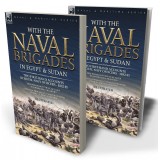
With the Naval Brigades in Egypt & Sudan: Two First-Hand Accounts by Royal Navy Officers, 1882-85

enlarge Click on image to enlarge
enlarge Mouse over the image to zoom in
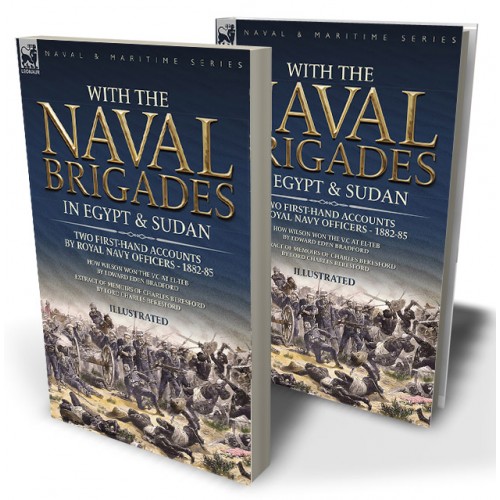
With the Naval Brigades in Egypt & Sudan: Two First-Hand Accounts by Royal Navy Officers, 1882-85
Qty:     - OR -   Add to Wish List

Author(s): Edward Eden Bradford & Lord Charles Beresford
Date Published: 2023/10
Page Count: 200
Softcover ISBN-13: 978-1-916535-61-9
Hardcover ISBN-13: 978-1-916535-60-2

The 'Jack Tars' at war in the Mediterranean, the desert and along the River Nile

There is an abiding interest among historians and students of the military campaigns of the Victorian era in the activities of the Naval Brigades of the Royal Navy. There had been comparatively few occasions since Trafalgar and until the First World War when battle fleets could be engaged. However, the crews of the navy could be always be depended upon to perform on land in a manner equal to their reputation afloat. Accordingly, Naval Brigades were deployed in many of  Britain's small imperial wars of the 19th century. The special Leonaur book offers the reader virtually everything that could be wished for in that respect, because it covers the activities of sailors on land during the Egyptian War of 1882 and in the later battles against the Mahdists and the attempt to relieve Khartoum in the Sudan. Wilson's account, as told by Bradford, includes a riveting  description of the first stages of the campaign in the desert and the fierce fighting which almost resulted in destruction for the British force at El-Teb. Wilson was,of course, central to this action as the Gardner gun failed and the courageous enemy broke into the British square. Beresford's riveting recollection includes the action of his ship,'Condor' at Alexandria, fierce conflict in the beleaguered squares at Abu Klea, the march across the desert and astonishing performance, misadventures and escape of the Nile river steamer commanded by Beresford as it attempted to rescue Gordon. This Leonaur edition contains illustrations, maps and photographs which did not accompany the original texts.

Leonaur editions are newly typeset and are not facsimiles; each title is available in softcover and hardback with dustjacket.
Before the square was completely formed on the top of the knoll at the foot of which it had been halted when the thousands of Arabs sprang into view on the left front, the Arabs reappeared on the left rear, about 500 yards distant. They were formed into three phalanxes joined together, the points of the three wedges being headed by emirs or sheikhs, riding with banners. The horsemen came on at a hand-gallop, the masses of footmen keeping up with them. Our skirmishers were racing in for their lives. The last man was overtaken and speared.
At this moment the left rear angle of the square was still unformed. The camels were still struggling into it. Several camels, laden with wounded, had lain down at the foot of the slope and their drivers had fled into the square; and these animals were being dragged in by soldiers. The appalling danger of this open corner was instantly evident. I told the bugler to sound the halt, and having forced my way through the press to the front of the square, and reported the case to Sir Herbert Stewart, who said, “Quite right,” I struggled back to the rear.
Then I ordered the crew of the Gardner gun to run it outside the square to the left flank. At the same time, Colonel Burnaby wheeled Number 3 Company (4th and 5th Dragoon Guards) from the rear face to the left flank. Number 4 Company (Scots Greys and Royals) had already wheeled from the rear to the left flank, so that they were just behind me. Five or six paces outside the square we dropped the trail of the gun. So swiftly did these things happen that the leading ranks of the enemy were still 400 yards away.
They were tearing down upon us with a roar like the roar of the sea, an immense surging wave of white-slashed black forms brandishing bright spears and long flashing swords; and all were chanting, as they leaped and ran, the war-song of their faith, “La ilaha ill’ Allah Mohammedu rasul Allah”; and the terrible rain of bullets poured into them by the Mounted Infantry and the Guards stayed them not. They wore the loose white robe of the Mahdi’s uniform, looped over the left shoulder, and the straw skullcap. These things we heard and saw in a flash, as the formidable wave swept steadily nearer.
I laid the Gardner gun myself to make sure. As I fired, I saw the enemy mown down in rows, dropping like ninepins; but as the men killed were in rear of the front rank, after firing about forty rounds (eight turns of the lever), I lowered the elevation. I was putting in most effective work on the leading ranks and had fired about thirty rounds when the gun jammed. The extraction had pulled the head from a discharged cartridge, leaving the empty cylinder in the barrel. William Rhodes, chief boatswain’s mate, and myself immediately set to work to unscrew the feed-plate in order to clear the barrel or to take out its lock.
The next moment the enemy were on top of us. The feed-plate dropped on my head, knocking me under the gun and across its trail. Simultaneously a spear was thrust right through poor Rhodes, who was instantly killed at my side.
You may also like