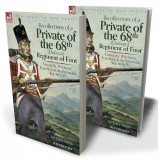
An essential eyewitness account of the later battles of the Peninsular War
Originally titled,' Vicissitudes of a Soldier's Life: Or a series of Occurrences from 1806 to 1815', this book is sometimes confused with another book of 'vicissitudes' penned by a Scottish soldier of this period. There have been, of course, several eyewitness accounts penned by soldiers from the ranks of the British Army serving during the wars against Napoleon's French Empire that have been republished and which-for one reason or another-have been rightly well regarded. Some, including those by Morris,Wheeler, Harris and Lawrence have also become well-known. This account by John Green of the 68th regimentmay not be so familiar to many readers, though it is without doubt one of the most engaging narratives of its kind. Green's is a candid, educated and-perhaps-surprisingly modern voice as he graphically recounts his experiences and sufferings on campaign with the 68th. His first experience of war was during the disastrous Walcheren Expedition of 1809 before the regiment embarked for Spain. Green's descriptions transport the reader in time and place ensuring that his account joins the ranks ofthe finest military memoirs. His descriptions of hard campaigning and his opinions of the lot of the ordinary soldier are invaluable. The battles of Salamanca and Vittoria are described from the sharp-end of the conflict, but Green's later recollections of the fighting in borderlands with France until the time of his serious wound and beyond are essential. Contains illustrations original to this edition.
Leonaur editions are newly typeset and are not facsimiles; each title is available in softcover and hardback with dustjacket.
Our regiment was now ordered forward, and extended all along the front of the brigade We loaded our pieces, and waited for the enemy, who were advancing, having taken our stand about four hundred yards from the summit of the hill, directly in front of the 82nd Regiment. When they came within two hundred yards, we began to fire upon them, every man being directed, to take deliberate aim. The enemy having approached within one hundred yards of us, we retreated deliberately, keeping up a most destructive fire. When we nearly reached the summit of the mountain, we formed, and waited till they arrived within twenty yards. We then fired a volley, gave three cheers, and rushed upon them with fixed bayonets. This caused them to give way, and we pursued them exultingly to the bottom of the hill, calling them in the Spanish language, “Malditos ladrones!” and other opprobrious names.
One of our men, who it was said, had wounded himself at the Battle of Vittoria, ran in front of most of the skirmishers to redeem his character: I followed him until he received a ball in his belly: he then turned round, and made what haste he could to the top of the hill, crying and groaning in the bitterest manner. He afterwards recovered, and was able to do his duty. The enemy having obtained a strong reinforcement, now advanced in close column, their drums beating in order to keep them together. We again retreated, and I narrowly escaped being taken prisoner; for I was almost exhausted with running. As we retreated, we kept up a steady and well-directed fire, and gained the summit of the hill in good order, not having a single man taken prisoner.
It was now thought prudent to retire before this column to the next range of hills. We kept up a constant fire as we retired, and took up a position on a hill; at the extremity of which I and about twenty more were stationed: there being several trees, each man posted himself behind one, and began to discharge his piece. With firing so often, my flint became worn out, and I retired about fifteen yards to the rear, and fixed a new one into my musket. While thus employed, Lieutenant Skene told me that George Noble and two others of our company were wounded: I said, I was sorry for it, and immediately resumed my place; but had only fired one shot, when a ball struck me, entering my left side, a little below my heart.
At first, I felt nothing; in about ten seconds, however, I fell to the ground, turned sick and faint, and expected every moment to expire, having an intolerable burning pain in my left side. I thought it was all over with me, being confident that I had received a mortal wound. I lay on the ground about five minutes, when the sergeant-major, who was near the spot; ordered two of the men to take me to the rear. They attempted to lift me up; but I begged of them to let me alone, saying, “For God’s, sake, let me die in peace!” the men then let me drop on the ground again, no doubt thinking I was actually dying.
The sergeant-major seeing what they had done, said, in a loud tone, “Take him away to the rear, for he is not dead.” They then raised me up, loosed the straps of my knapsacks, and took off my belts: I opened my coat and waistcoat, and putting my hand, against my side, found a lump occasioned by the ball nearly as large as a hen’s egg. My shirt and trowsers were drenched with blood. In this condition I started to the rear, assisted by the men above mentioned: I had not proceeded more than fifty yards, before I was deserted by them. The shots from the enemy, at this period flew so exceedingly fast, that the men were afraid of being killed, so that I was left to take care of myself, but Captain Gledstanes being near the spot, I said, “Sir, am I to be left in this condition, to be killed or taken by, the enemy?”

 your wishlist
 your account


 Click on image to enlarge
 Mouse over the image to zoom in