A voice from the ranks of the Scottish light infantry
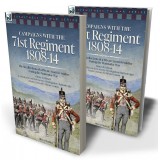
The principal work in this special Leonaur edition was originally titled,'Vicissitudes in the Life of a Scottish Soldier' which was written anonymously and has, perhaps, suffered confusion by the existence of another autobiographical work also written by a British soldier (John Green of the 68th regiment) who also wrote his recollections of the Peninsular War under the title of 'Vicissitudes'. Written following another first hand account written anonymously by a soldier of the same regiment -the 71st regiment of foot-then known as the Glasgow Regiment, the author first experienced action at the Battle of Rolica (Roleia) followed by the Battle of Vimeiro, 1808 in Portugal. Following evacuation of the British Army from Coruna the 71st took part in the disastrous Walcheren Expedition of 1809 before returning, once again, to the Peninsular War. The author fought at Fuentes de Onoro, Arroyo dos Monlinos, Almarez, Vittoria, the Pyrenees, Orthez and Toulouse. Although the regiment fought atWaterloo the author's account concludes on his return home where we are told he was just one of four survivors of his company of over 100 men.Possibly because the author remained anonymous his account is extraordinarily candid as he reveals the horrors of the battlefield, the hardships of life on campaign and the failings of the army including several severe criticisms of those in command. This edition has been enhanced by the inclusion of Richard Cannon's history of the 71st covering the period of the author's account, but also for added interest its services during the Waterloo Campaign of 1815.
Leonaur editions are newly typeset and are not facsimiles; each title is available in softcover and hardback with dustjacket.
On the following morning, orders came from Wellington that we should abandon the post, the enemy having crossed the river unperceived the preceding evening; and they would have probably surrounded us had we not retired, leaving 300 Spaniards in the castle: after blowing up a bridge in the course of the retreat, we joined the grand army in safety. It was afterwards reported, that these Spaniards had held their station courageously for seven days before surrendering.
The whole army now moved off, taking its way by a road leading through an immense forest: a pretty long march brought us to its edge. We then found ourselves on the field of Salamanca, where we formed immediately on the ridge which had been the position of the French on that bloody occasion. The ground everywhere betrayed symptoms of the late death-game, by the legs and arms which stuck out in full view: these were also convincing proofs of the manifold toils of the military sextons.
Our ruminations, were soon cut short by the enemy emerging from the wood—instantly, therefore, a company of the 60th rifle corps were detached to skirmish with them; but scarcely had they left us, when a body of French cavalry were seen advancing at a gallop for the purpose of charging—they perhaps would have made short work with the riflemen, if our artillerymen had not, by a well-timed discharge, compelled them to wheel round and return as quick as they came. I observed one fellow in particular: he was lifted up from his saddle by a cannonball, and fell to the ground seemingly unhurt; for the next instant he rose and ran off: his horse also took to flight, but in a different direction.
The cannon being placed in a position admirably adapted for committing mischief, they were opened upon the enemy’s columns with terrible effect: at every discharge, a space was seen in their ranks which would admit a waggon! Lord Wellington and his staff remained for some time stationary in front of our regiment: as several of them had telescopes, a more particular estimation of the enemy’s loss could thus be obtained, at almost every shot. Someone of those spectators who had glasses encouraged the artillery, by crying out—“That is a good one!”
The enemy at length sheltered themselves in the wood, thinking, probably, that affairs were taking a too tragical turn: an aide-de-camp, in my hearing, said that their loss could not be less than 1,000—this is a round number, to be sure, but in my opinion not far from the truth. Strange it is, however, that the minds of men have been so perverted as to exult according to the number of their slain opponents!
We entered the wood while it was getting dark, and were obliged to stretch ourselves on the ground supperless—water, that requisite for cooking, not being at hand. Next morning the whole army formed upon the same ground as before: the French Army was also drawn up in formidable array. Every appearance of a bloody battle was in prospect; but on the enemy’s attempting to turn our right. Lord Wellington gave the order to retreat in the direction of Portugal. Thus had the Spanish campaign come to nought again.
Our regiment was left by itself on a height, for the purpose of amusing the enemy while the British Army was filing off. We stood a full hour shivering in a storm of rain, till the last of them had passed by, when a general officer rode back from the rear, and cried to Cadogan—“If you do not move from that station, your men will be prisoners in less than ten minutes.” We waited not for a second invitation, but set off through some ploughed, fields, which, as usual, clogged our feet—the heavy rain still continuing, and reducing the earth to a pulp.
For a further precaution against the pursuers, we formed a square: one of the companies performing its part awkwardly in this evolution, the colonel threatened to leave the men behind to the enemy: such a menace was perhaps less terrific than he imagined. By the time we reached the road, the rain had increased to such a degree that the water was up to our knees: in the midst of this interesting scene, a number of soldiers’ wives and children, mounted on asses, finding it impossible to keep up with us, began a concert, of cries and tears; but as no assistance could be afforded, they fell into the enemy’s hands.
All the while, our cavalry and the enemy’s kept firing at each other—being muffled up in cloaks, they loaded their carbines under these coverings in perfect security from the rain: the skirmishing would have had a very picturesque appearance to an unconcerned spectator. We were nearly out of breath when a junction was effected with the rest of the brigade—a very hasty trot having been resorted to latterly. Colonel Stewart called to Cadogan, that he had never expected to see us again. I believe, in this instance, we kept the old precept well in mind; to wit, “a good pair of heels is worth two pair of hands.”

 your wishlist
 your account


 Click on image to enlarge
 Mouse over the image to zoom in