Author(s):
William Stothert & William Hamilton Maxwell Date Published:
2023/10 Page Count:
140 Softcover ISBN-13:
978-1-916535-67-1 Hardcover ISBN-13:
978-1-916535-66-4
The Correspondence of a Scottish officer in Spain and Portugal
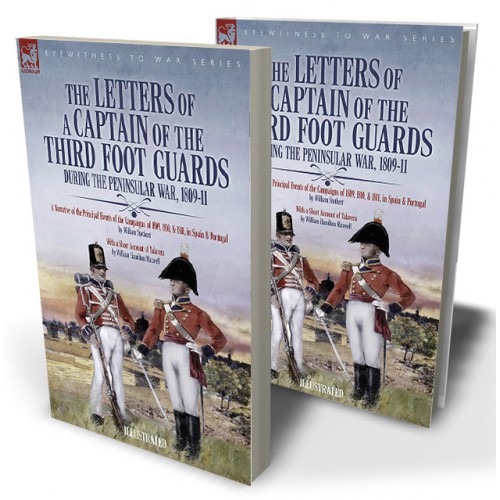
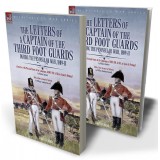
Accounts of the activities of the Third Foot Guards of the British Army ( later the The Scots Guards) during the wars against Napoleonic France are quite rare, so these letters by one of its serving officers,William Stothert- though comparatively small-are invaluable and an essential component of any library of the conflict from a British perspective. This was a very early published account of the war (1812) comprised of letters to the author's family. His experiences begin in 1809 and cover the ensuing three years. Several engagements are referenced including Talavera, Ciudad Rodrigo, Busaco, the retreat to the Lines at Torres Vedras, Fuentes d'Onoro, Albuera and Badajoz. Captain Stothert ( Brigade- Major of the 2nd Brigade of Guards) survived the campaign in the Iberian peninsula, but was, of course, once more called to action during the Hundred Days Campaign of 1815 and was killed serving with his regiment at the Battle of Waterloo. Stothert gives particular attention to the Battle of Talavera in his correspondence so this Leonaur edition contains Maxwell's account of that engagement. This book contains illustrations and maps that did not accompany the original edition.
Leonaur editions are newly typeset and are not facsimiles; each title is available in softcover and hardback with dustjacket.
May the 11th.—Much depending on the rapidity of movement, the Guards were again under arms at an early hour; and having halted to refresh themselves from, ten o’clock until noon in the small town of Penheiros, about five in the evening they arrived at St. Antonia, de Arifana, the headquarters of the reserve for the night—twenty-four miles from Oporto. The pursuit of the enemy had been continued by General Payne to a position, the heights of Grigon, about three leagues from that city, whence a reinforcement was sent by Marshal Soult, making their numbers amount to nearly five thousand men.
Upon this body a spirited attack was made by Brigadier-General R. Stewart, and Major-General Murray, by a well conducted movement with a brigade of the King’s German Legion, turned the left flank of the enemy; who, in retreating, was charged by two squadrons of the 16th and 20th Dragoons under Major Blake, led on by Brigadier-General the Honourable C. Stewart, assisted by Lieutenant-Colonel Delancey, Captain Mellish, and Captain Dashwood. The advance of the British took up a position on the hill beyond Carvalhos, within two short leagues of Oporto.
The Brigade of Generals A. Campbell and Sontag, which halted yesterday in Albeguria Velha, were this evening quartered in Penheiros. The faintest tints of dawn appeared in the horizon as the Guards quitted their cantonments yesterday to advance. The intelligence of the preceding evening had led the troops to expect an immediate meeting with the enemy; but it was now learnt that he had retired with considerable precipitation during the night, and destroyed the bridge of boats across the Douro. The troops continued to advance, and entered Villa Nova da Porto about two o’clock, when they had the satisfaction of finding that a part of the army had already crossed the river in boats, assisted by the Portuguese, notwithstanding the vigilance of the French sentries, and were at that moment engaged with the enemy.
From the Sierra Convent, situated on the south bank of the Douro, the Commander of the forces had observed the French retiring to a height immediately above the city, and, with the intention of cutting off their rear-guard, he pushed three companies of the Buffs across the river, under Lieutenant-General Paget, who was directed, in the event of being pressed, to throw himself into a convent, which the enemy could not approach without being exposed to a destructive fire from some guns advantageously placed in the gardens of the convent.
The result happened as Sir Arthur Wellesley had foreseen. The enemy’s columns, on observing the movements of the British, descended from the height to re-enter Oporto; but by this time Major-General Hill had crossed the Douro with his brigade, which he was enabled to effect with great celerity by the unremitting and voluntary exertions of the Portuguese in navigating the boats. Nearly at the same moment a squadron of the 14th Light Dragoons, under Major Hervey, and two pieces of artillery, were got over, and Major-General Murray, who had passed the river, a few miles above, with a battalion of the King’s German Legion, appeared on the left flank of the enemy, who found himself compelled to retire, but took up a more advantageous position, where he seemed determined to make a stand.
The Guards now received orders to advance, and were embarked as they reached the Douro, under the superintendence of Colonel Donkin, with the most perfect regularity. Although harassed by a fatiguing march of upwards of eighty miles in four days, over a most difficult country, yet no sooner were they formed on the opposite shore, than the whole began to run up the steep streets of Oporto, and continued their exertions until the head of the column was ordered to halt. In passing along, the brigade was cheered with repeated shouts of Viva Inglezes, by the inhabitants, who hailed the British as their deliverers. The smiles of the young ladies at the balconies, their white handkerchiefs waving as the troops approached, and the prayers of the aged, accompanied with tears, for their success, formed a most interesting scene.

 your wishlist
 your account


 Click on image to enlarge
 Mouse over the image to zoom in