The voice of an ordinary English infantryman during the Napoleonic Wars
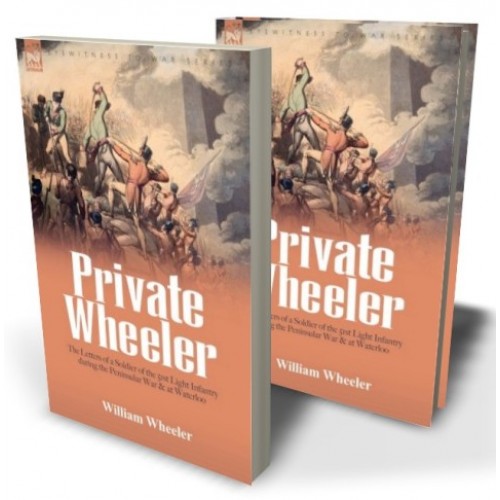
Young William Wheeler's first experience of military life was within the ranks of the Surrey Militia, but he found peace time soldiering too tame and transferred to the 51st—a 'light bobs' regiment from the West Riding of Yorkshire. This famous account of the British Army at war against Napoleon's French forces has been made possible by the survival Wheeler's letters directly telling of his experiences on campaign and on the battlefield—written throughout his military career which included the hard campaigns in Spain and the bloody field of Waterloo in 1815. Wheeler's letters continue after peace has been declared and the reader is able to understand the nature of the British Army as it policed the empire's Mediterranean possessions. Available in soft cover and—for the first time in several years—in hard cover for collectors.
We advanced up the glacis close to the walls. Not a head was to be seen above the walls, and we began to think the enemy had retired into the town. We entered the trench and fixed our ladders, when sudden as a flash of lightening the whole place was in a blaze. It will be impossible for me to describe to you what followed. You can better conceive it by figuring to your mind’s eye a deep trench or ditch filled with men who are endeavouring to mount the wall by means of ladders.<br>
The top of this wall crowded with men hurling down shells and hand grenades on the heads of them below, and when all these are expended they have each six or seven loaded firelocks which they discharge into the trench as quick as possible. Add to this some half dozen cannon scouring the trench with grape. This will immediately present to your imagination the following frightful picture. Heaps of brave fellows killed and wounded, ladders shot to pieces, and falling together with the men down upon the living and the dead. Then ever and anon would fall upon us the body of some brave Frenchman whose zeal had led him to the edge of the wall in its defence, and had been killed by their own missiles or by the fire of our covering party.<br>
But in the midst of all these difficulties, great as they were, we should have taken the fort but for an unforeseen accident that could not be remedied—it was the ladders were too short. Several men who had gained the top of the ladders could not reach the top of the wall with their firelocks. As soon as this was discovered all hopes of gaining possession was abandoned, and the order was given to retire.<br>
The next morning our little party of hundred were reduced to between twenty and thirty, a cessation of arms for two hours took place to remove our killed and wounded. All the day of the 9th our guns were battering away at the fort, more ladders were prepared and another party consisting of double the numbers from the same corps were formed. Ensign Dyas again volunteered to lead the ‘forlorn hope.’ This party was commanded by Major McGeechy, 18th Portuguese Regiment. (Wellington’s Despatches say 17th.)<br>
This second attempt was attended with the same ill success as the first. It is true we had profited by the discovery of the ladder being too short, but the old fox inside was too deep for us. He had caused all the rubbish to be cleared out of the trench. This again placed us just in the same predicament, our ladders were again too short and if possible we received a warmer reception then before.<br>
The ladder I was on was broken and down we all came together, men, firelocks, bayonets, in one confused mass, and with us a portion of the wall. After some time the fire slackened, as if the enemy were tired of slaughter, when an officer Lieutenant Westropp came running from the western angle of the fort calling out to retire— the enemy were entering the trench by the sally port. We then began to leave the trench. Poor Mr. Westropp was assisting a wounded man in getting out, when he was shot dead just as he had effected his purpose.<br>
I now saw Ensign Dyas calling to the men to leave the trench and retire to our rallying post. As we were retreating down the glacis, a misfortune befell me and I had a very narrow escape of being made prisoner, being cut off from my comrades by the party who sallied. There were eight or nine in the same mess. These the enemy obliged to go into the fort. However, I hit upon an expedient that answered well. I threw myself down by a man who was shot through the head and daubed my white haversack with his blood. I shewed this to the enemy when they ordered me to get up and go into the fort. From the appearance of the blood they must have thought I had a very bad wound in the hip, so they all left me—except one who searched my pockets, took off my shirt, boots and stockings. But more of this in my next, let it suffice that I am safe and was never in better health and spirits

 your wishlist
 your account


 Click on image to enlarge
 Mouse over the image to zoom in