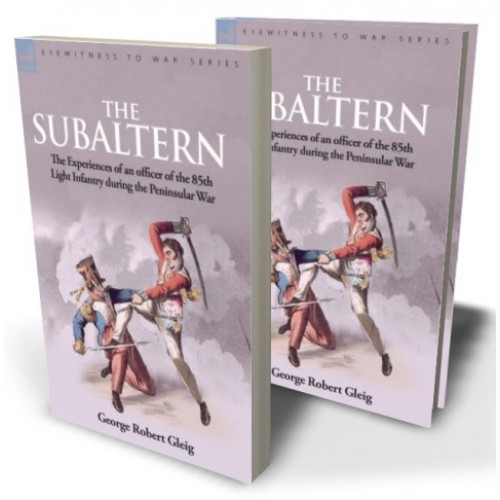
A young officer at war against the Napoleonic French Army
Gleig is a well known author of military works on the Napoleonic era and after. He has left us several histories—all well written—and most notably he was responsible for publication of the stories of several ordinary soldiers who—without his support and penmanship—would not have been able to tell their stories in print; such a loss would have been great for history. Gleig's interest was not simply academic. however. He served in a British regiment of light infantry under Wellington and saw action in the latter stages of the Peninsular campaign including the crossing of the Pyrenees and the final battles of the war in the south of France. Every first hand account is worthwhile, but Gleig brings a talent to his writing which makes his own experiences both informative and a pleasure to read. His further adventures in the War of 1812, some of his histories and his 'ghost written' accounts of soldiers’ experiences are also published by Leonaur.
Every man whom they met, no matter whether an English or a Portuguese soldier, they drove back, beating him with the flats of their swords over the head and shoulders; and then, suddenly rushing past a projecting copse which concealed their motions, they spread death and dismay among the French infantry. But we had not much time given to watch the others. we were ourselves in line in a moment, and advancing to the charge.<br>
It was a tremendous and an overwhelming rush. The enemy stood nobly, and fought with desperate resolution, but we bore them back, as I have seen one bull borne back by another, into the wood. And then again began the same ceaseless roar of musketry which had sounded in our ears last evening; whilst four or five pieces of cannon sent showers of grape and canister amongst us, which, but for the shelter afforded by the trees, must have swept us all into eternity.<br>
As soon as we were fairly in the wood, our compact order was, in spite of every effort, lost. We fought, however, with the same spirit as before, in detached parties, and pressed the enemy on all hands,’ who became as much divided as ourselves,—till not only was the ground recovered which had at first been abandoned, but we were considerably in advance of our original position. Nor was it practicable, even then, to check the ardour of the men. As fast as the enemy retired, our soldiers pushed on, till, at length, we found ourselves on the margin of a little lake, round the extremity of which the French were flying in great confusion. Such a sight added fuel to the fire of our eagerness; and we pursued in a state of little less confusion than that which prevailed among the fugitives.<br>
We had already reached the farther end of the lake, and were in hot and heedless chase of a couple of field-pieces, when a cry was suddenly raised of “The cavalry! the cavalry!” Several troops of French dragoons were advancing. Their horses were already in speed,—there was no time to collect or form a square; so we threw ourselves as we best could into compact circles, and stood to receive them. They came on with the noise of thunder; one circle wavered—some of the men abandoned their ranks—the cavalry rode through it in an instant. That in which I was stood more firm.<br>
We permitted them to approach, till the breasts of the horses almost touched our bayonets, when a close and well-directed volley was poured in, and numbers fell beneath it. But we knew that we had no business to remain where we were. Having, therefore, repelled this charge, we slowly retraced our steps, the cavalry hovering around us as we retired, till we had gained, once more, the shelter of the wood, and were safe from further molestation. There we stood fast, till a bugle sounding the recall, warned us to retire still farther, and we again united ourselves with the rest of the brigade.<br>
The attack upon our post being thus defeated, we were commanded to lie down in a ditch, for the purpose of sheltering ourselves against a heavy cannonade with which the enemy still entertained us. A couple of brigades were, at the same time, marched towards the right, to support the light division, which had been very sorely pressed in its position at Arcanques. The French column had come on at a moment when a regiment of caçadores, which held the church, were in the act of cleaning their rifles, and hence one-half of the troops were virtually unarmed. But, though driven through the village and gardens, our people maintained themselves in the church, and the rising ground on which it stood; nor did the French succeed in making any lasting impression on that point.<br>
The loss, however, had on our part been so great, and the enemy still continued his exertions with so much ardour, that it was deemed requisite to send fresh regiments to relieve those which had been so long engaged; and hence five or six battalions were withdrawn from our rear, and the post which they had hitherto assisted in maintaining was left entirely to our protection.<br>
Whether it was the intention of Soult to cause this movement, or whether he only hoped to avail himself of it, as soon as it had been made, I know not; but just as the bayonets of our detached troops began to glitter in the wood behind Arcanques, another most determined charge was made upon the corps in our immediate front. This corps was not only weak in point of numbers, but was absolutely worn out with hard fighting and want of food. It gave way almost immediately.

 your wishlist
 your account


 Click on image to enlarge
 Mouse over the image to zoom in