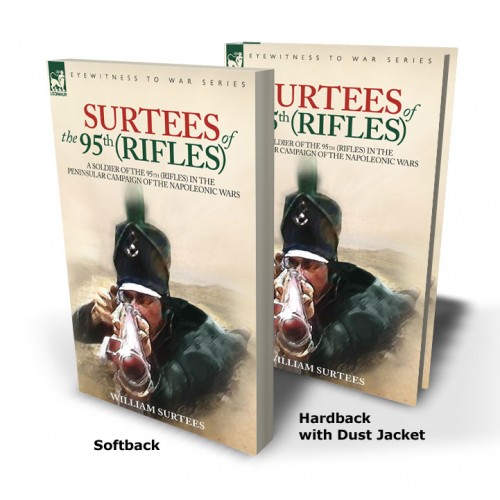
In more ways than any other writer from the ranks of the 95th, William Surtees’ story most closely resembles that of fiction’s most famous Rifleman. Surtees actually came from a humble background and served in the ranks. He was not born a gentleman but had to approximate one at a time of huge class distinctions. Surtees rose to the rank of Quartermaster. Through his tone we feel the difficulties of living with those of higher station, but through his words we also experience life on campaign from the viewpoint of a soldier who couldn’t resist picking up a rifle for a ‘pot’ at the French. An essential perspective on life in the Rifles during the Napoleonic Wars.
The enemy had adopted an excellent plan to ascertain where our columns were posted; they threw an immense number of light balls on all sides of the town, and when they found out where there was a large body, a rocket was fired in the direction of where it stood, and instantly every gun, mortar, and howitzer, not previously engaged, was turned in that direction, and grievous was the destruction their shot made in the ranks of these columns. Still our people at the breaches did not get forward, although we distinctly heard, with emotion, the bugles of our division sounding the advance. His lordship seemed now to lose all patience, and aides-de-camp were sent to ascertain the cause of the delay. They flew like lightning, while the whole rampart round the town seemed enveloped in one name of fire. Our brave but unsuccessful comrades were heard cheering every now and then; but still the fire at the breaches did not slacken. At length a dispatch arrived from General Picton, stating, that he had established himself in the castle. This was cheering news to his lordship, who expressed very strongly the gratitude he felt for that gallant General.
During the reading of the dispatch, which was done by torchlight, the enemy, perceiving the light, and that a number of people had assembled on the hill, directed a shell in that direction; but it fell short, and did us no injury. His lordship now rode off, and ordered our people at the breaches to retire, as the town was now perfectly secure. I also set off to inform my people of the happy circumstance. I found them drawn off from the glacis a few hundred yards; but, oh! what a difference in their appearance now from what they were previous to the attack. The whole division scarcely mustered at this time 2000 men, so many had been killed and wounded, and many had been sent to the rear with the latter. I informed them that General Picton had got possession of the castle, but my story appeared to them an incredible tale; for it was actually impossible, they thought; and although they made me repeat it over and over again, they could scarcely bring their minds to credit such unexpected news.
It was now dawn of day, and the firing had ceased at every point. Here I learnt the fate of my two beloved friends and messmates: Croudace had been shot through the body, and carried to the rear; Gary had fallen, but they could not tell what had become of him. I now went forward towards the breaches, where I found that several men of both the 4th and light divisions had remained; and when General Picton moved from the castle towards that point, which I believe he stated in his dispatch to be his intention, the enemy, finding themselves attacked in rear, began to abandon the defence of the breaches, and our people were then enabled to enter.
Never did I witness any thing like the artificial impediments which the enemy had here thrown up, which, added to the natural ones, that is, to the breaches not having been so perfectly practicable as was desirable, rendered it next to impossible to enter, even after all opposition on their part had ceased. In one breach (the large one) this was literally the case; for at the top of it was fixed a chevaux-de-frize extending the whole width of the breach, and composed of a strong beam of wood, with sharp-pointed sword-blades fixed in every direction, they being generally about three quarters of a yard long, and so closely set together, that it was impossible either to leap over them or penetrate between them, and the whole so firmly fixed to the works at the top, that it could not be moved. In addition, they had fitted a number of long and thick planks, with spikes about an inch or more in length, and laid them all down the breach, but fixed at the top, so that it was impossible for any one to get up without falling on these. Beyond the chevaux-de-frize several ditches had been cut, into which those must have fallen who surmounted the obstacles on the breach; but I believe none did, although I saw one Portuguese lying dead upon the ramparts; but I imagine he must either have been thrown up there by some explosion, or been one of those of the 3rd division who came from the castle. In addition to all the above, from the covered way down into the ditch was, I should imagine, at least thirty feet; our people had descended by ladders, and, I doubt not, in the dark, and, in the hurry and confusion of the moment, many were thrown down and killed. In the middle of the large ditch a smaller one had been cut, which was filled with water, and in which, added to the inundation close to the right of the breaches, (which had been caused by bringing the river partly into the ditch,) numbers were drowned. Small mines had been constructed all along in the ditch, which were exploded when it was filled with people, and which produced infinite mischief.
On the top of the ramparts the enemy had a considerable number of shells of the largest size, ready filled and fused; and when our people had filled the ditch below, these were lighted, and thrown over on their heads, each shell being capable of destroying from twelve to twenty men or more. They had beams of wood also laid on the ramparts, with old carriage-wheels, and every sort of missile imaginable, which were poured upon the unfortunate people below.

 your wishlist
 your account


 Click on image to enlarge
 Mouse over the image to zoom in