PAYMENT OPTIONS

​

Forthcoming titles

(Book titles are subject to change)

Air War: East Africa WW1

Raf Russia, 1940

The Asc In Africa

South African Gunners

The Supernatural Ludwig Tieck

Wellingtons Men

Shuttle Bury Cobb & Danby Croker

King William’s War

The Supernatural Jerome K. Jerome


Custer Volume 1: The Civil War Years

enlarge Click on image to enlarge
enlarge Mouse over the image to zoom in
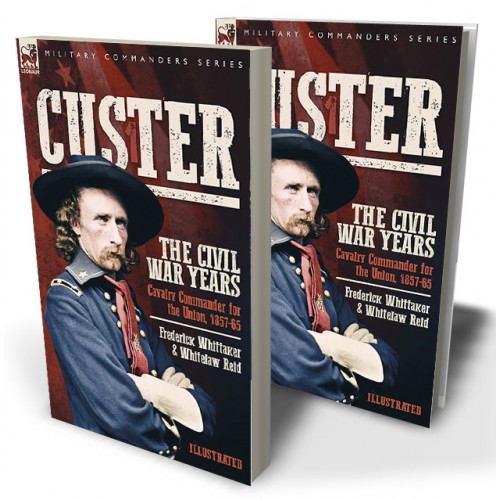
Custer Volume 1: The Civil War Years
Leonaur Original
Qty:     - OR -   Add to Wish List

Author(s): Frederick Whittaker and Whitelaw Reid
Date Published: 2023/10
Page Count: 304
Softcover ISBN-13: 978-1-916535-57-2
Hardcover ISBN-13: 978-1-916535-56-5

The 'Boy General' for the Union who would charge at everything

There can be little doubt that Custer's catastrophic defeat at the Battle of Little Bighorn attracted more retrospective attention to the man than if he had simply retired from his military career having served during the Civil War and upon the American Western Frontier. Certainly, there have been far fewer books written about American soldiers of the period who arguably served with greater distinction. The author of this biography was a well regarded American novelist during the 19th century and his book on Custer's life-published in 1876-holds the distinction of being the first  (of many ) biographies concerning his subject. Whilst some critics have referred to its content as 'adulatory', this verdict is possibly less accurate than that it is a document of its time and place and it therefore inevitably reflects the attitudes of both considerations. This biography indisputably benefits from the inclusion of opinions and recollections of participants who were still living at the time it was written. Whittaker's work-concerning Custer's entire life- was originally released as a single tome of approaching 700 pages of densely packed text delivered within large paragraphs. This  Leonaur edition has therefore divided that work into two volumes each concerning a distinct portion of his military career. The text  has been reformatted into smaller, easier to access paragraphs for the modern reader and has been enhanced by additional photographs and illustrations. This volume concerning the Civil War period is enhanced by a short independent assessment of Custer as a leader of cavalry during the war by Reid.

Leonaur editions are newly typeset and are not facsimiles; each title is available in softcover and hardback with dustjacket.


The next day, July 2nd, Kilpatrick moved on a place called Hunterstown, near Gettysburg, on the prolongation of Meade’s position. The Battle of Gettysburg was now in full progress, and the cavalry on each side was feeling its way toward the flanks of its own army. The division arrived at Hunterstown at four in the afternoon, when the very fiercest battle was in progress a few miles off, between Sickles and Longstreet. Kilpatrick ordered in Custer’s and Farnsworth’s brigades, the first on the left, the second on the right of the road leading to Gettysburg, to attack Stuart’s cavalry, (again Wade Hampton’s division) which barred the way.
Now was Custer’s time. He ordered out Co. A. Sixth Michigan for a mounted charge, and deployed two more companies of the same regiment on foot in a wheat field at the side of the road, so as to rake it with their fire. At the end of the road could be seen a party of the enemy, apparently a squadron. Capt. Thompson commanded Co. A. All was ready, and Thompson was preparing to charge, when to everyone’s surprise, the boy general flashed out his long Toledo blade, motioned his staff to keep back, and dashed out in front of Co. A. with the careless laughing remark,
“I’ll lead you this time, boys. Come on!”
Then away he went down the road at a gallop, his broad white hat on the back of his head, while the men raised a short yell of delight and followed him. Down the road in a perfect cloud of blinding dust went the boy general in front of that single company and the next moment they were into the midst of the enemy, only to find they had struck a very superior force. They were received with a rattling fire of carbines, more efficacious than common, and the next moment down went the general, horse and all, in the road, the animal shot stone dead.
The enemy raised a yell, and came rushing on. Thompson was shot down, mortally wounded, and a man rode at Custer, who was struggling up from his dead horse. The Michiganders were demoralised and turned, all but one boy named Churchill, who was near the general. He shot down Custer’s assailant, took up the general on his horse, and started back with him. They had not far to go, for the dismounted men were already nearly up to them, running and firing with the dash and vim peculiar to dismounted cavalry. Pennington’s and Elder’s batteries in the rear were both beginning to pitch shells into the rebels, and the end of the affair was that the exulting enemy was repulsed.
But the Michiganders had learned one lesson, that their “popinjay,” their “boy general,” was not afraid to fight like a private soldier, and they began to feel a little more in the humour to follow him, which they did that very night to join the main army at Two Taverns, on the right of Meade’s position at Gettysburg.
You may also like