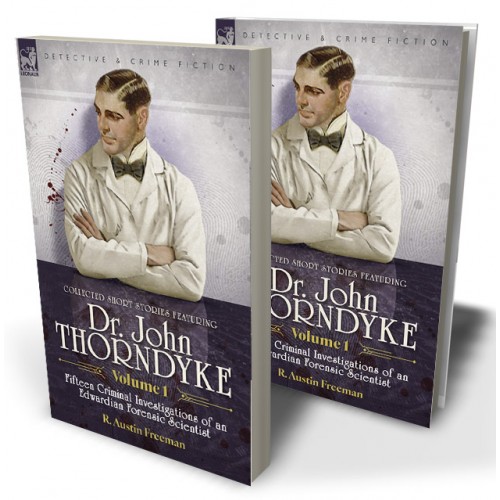
The first of three volumes of tales of crime and deduction
Dr. John Evelyn Thorndyke was the principal character in a huge collection of detective fiction published between 1905 and 1942- the final novel appearing shortly before the death of his creator, the British author Dr. Richard Austin Freeman. Almost all of Freeman's literary output concerned his doctor detective and the similarities between author and character are marked. Indeed, Freeman used some of his own experiences as the foundation of some of his stories. There are 21 novels and 40 short stories featuring Dr. Thorndyke , but this Leonaur collection focusses on the shorter fiction, bringing them together in their entirety within three companion volumes. Thorndyke was originally a medical doctor, but in due course 'turned to the bar', becoming (according to the author) a 'medical jurispractioner'. Though the term was archaic, we understand the role in modern criminology readily. Freeman actually undertook the experiments he described to ensure they were legitimate. Whilst not as familiar, to many readers, as Sir Arthur Conan Doyle's fictional detective, it is difficult not to draw comparisions between Holmes and Thorndyke, though to what degree readers can decide for themselves! Enjoy then the adventures and decisive logic of the character once described as,' the most impressive of the fictional sleuths'.
In volume one readers will discover, 'Pandora's Box','The Blue Sequin','The Magic Casket','The Dead Hand' and many other enthralling cases.
Leonaur editions are newly typeset and are not facsimiles; each title is available in softcover and hardback with dustjacket.
The proceedings which followed were unmistakable as to their object. First he carried the basin of spirit through into the sitting-room and deliberately poured its contents on to the floor by the arm-chair. Then, having returned the basin to the bedroom, he again went down to the shop, where he selected a couple of galvanised buckets from the stock, filled them with paraffin oil from one of the great drums and carried them upstairs. The oil from one bucket he poured over the armchair and its repulsive occupant; the other bucket he simply emptied on the carpet, and then went down to the shop for a fresh supply.
When this proceeding had been repeated once or twice the entire floor and all the furniture were saturated, and such a reek of paraffin filled the air of the room that Percival thought it wise to turn out the gas. Returning to the shop, be poured a bucketful of oil over the stack of bundles of firewood, another over the counter and floor and a third over the loose articles on the walls and hanging from the ceiling. Looking up at the latter be now perceived a number of greasy patches where the oil had soaked through from the floor above, and some of these were beginning to drip on to the shop floor.
He now made his final preparations. Taking a bundle of “Wheel” firelighters, he made a small pile against the stack of firewood. In the midst of the firelighters he placed a ball of string saturated in paraffin; and in the central hole of the ball he stuck a half-dozen diminutive Christmas candles. This mine was now ready. Providing himself with a stock of firelighters, a few balls of paraffined string and a dozen or so of the little candles, he went upstairs to the sitting-room, which was immediately above the shop.
Here, by the glow of the fire, he built up one or two piles of firelighters around and partly under the arm-chair, placed the balls of string on the piles and stuck two or three bundles in each ball. Everything was now ready. Stepping into the bedroom, he took from the cupboard a spare overcoat, a new hat and a new umbrella—for he must leave his old hats, coat and umbrella in the hall. He put on the coat and hat, and, with the umbrella in his hand, returned to the sitting-room.
Opposite the armchair he stood awhile, irresolute, and a pang of horror shot through him. It was a terrible thing that he was going to do; a thing the consequences of which no one could foresee. He glanced furtively at the awful shape that sat huddled in the chair, its horrible head all awry and its rigid limbs sprawling in hideous grotesque deformity. It was but a dummy, a mere scarecrow; but yet, in the dim firelight, the grisly face under that horrid wig seemed to leer intelligently, to watch him with secret malice out of its shadowy eye-sockets, until he looked away with clammy skin and a shiver of half-superstitious terror.
But this would never do. The evening had run out, consumed by these engrossing labours; it was nearly eleven o’clock, and high time for him to be gone. For if the Brattles should return prematurely he was lost. Pulling himself together with an effort, he struck a match and lit the little candles one after the other. In a quarter of an hour or so, they would have burned down to the balls of string, and then—He walked quickly out of the room; but, at the door, he paused for a moment to look back at the ghastly figure, seated rigidly in the chair with the lighted candles at its feet, like some foul fiend appeased by votive fires. The unsteady flames threw flickering shadows on its face that made it seem to mow and gibber and grin in mockery of all his care and caution. So he turned and tremblingly ran down the stairs—opening the staircase window as he went. Running into the shop, he lit the candles there and ran out again, shutting the door after him.
Secretly and guiltily he crept down the hall, and opening the door a few inches peered out. A blast of icy wind poured in with a light powdering of dry snow. He opened his umbrella, flung open the door, looked up and down the empty street, stepped out, closed the door softly and strode away over the whitening pavement.

 your wishlist
 your account


 Click on image to enlarge
 Mouse over the image to zoom in