PAYMENT OPTIONS

​

Forthcoming titles

(Book titles are subject to change)

Air War: East Africa WW1

Raf Russia, 1940

The Asc In Africa

South African Gunners

The Supernatural Ludwig Tieck

Wellingtons Men

Shuttle Bury Cobb & Danby Croker

King William’s War

The Supernatural Jerome K. Jerome


The History of the East Riding Yeomanry: Volume 3: Yeomen Forrard! : The East Riding Yeomanry from D-Day to Victory during the Second World War, 1943-1956

enlarge Click on image to enlarge
enlarge Mouse over the image to zoom in
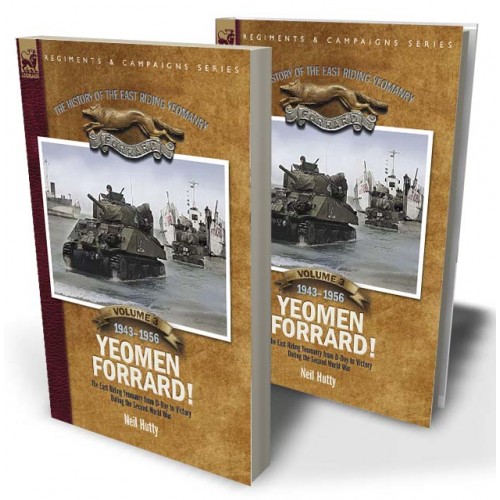
The History of the East Riding Yeomanry: Volume 3: Yeomen Forrard! : The East Riding Yeomanry from D-Day to Victory during the Second World War, 1943-1956
Leonaur Original
Qty:     - OR -   Add to Wish List

Author(s): Neil Hutty
Date Published: 2025/03
Page Count: 292
Softcover ISBN-13: 978-1-917666-05-3
Hardcover ISBN-13: 978-1-917666-04-6

The Advance from Normandy through Europe to the Baltic

In April 1943 the East Riding Yeomanry, ‘Wenlock’s Horse’, rebuilt as an armoured regiment following the debacle of 1940, learned that it would be amongst the assault waves for the liberation of Europe. This is the story, told largely through eyewitness accounts, of the East Riding Yeomanry’s part in the liberation of Europe: landing on Sword Beach on D-Day 6th June 1944 the Regiment took part in fifi erce fifi ghting to consolidate and expand the Normandy beachhead. After Normandy, the ERY saw action in Holland, liberating the city of s’Hertogenbosch, before being rushed into Belgium to help counter, and then squash, the German Ardennes offensive, known as the “Battle of the Bulge”, in the harshest of winter conditions. Subsequently re-equipped with ‘Buffalo’ amphibious carriers, the ERY was tasked with transporting the assault infantry across the river Rhine in March 1945. The Regiment ended the war at Laboe on the Baltic coast, guarding thousands of German prisoners. The story concludes with an account of the Regiment post war, until amalgamation in November 1956 to form the Queen’s Own Yorkshire Yeomanry. Today the history and traditions of the Regiment rest with ‘A’ Squadron, Queen’s Own Yeomanry in York. Leonaur editions are newly typeset and are not facsimiles; each title is available in softcover and hardback with dustjacket.

After a delay of just over an hour, the German shore batteries had been silenced and the East Riding Yeomanry’s return to the mainland of Europe could finally go ahead. The landing craft once again headed towards the beach, aiming for the Queen White sector, at Lion-sur-Mer. Touchdown occurred at approximately 14:12hrs. Ray Jones described the moment of landing:
“Final orders were given, shackles and chains released, and crews climbed into their tanks. Wireless operators switched on their No. 19 sets and carried out their netting procedure... crew commanders ordered, “Start engines.” Drivers responded. All of us pulled on our headsets essential for intercom between the crew and the radio mush dulled the sound of shell and small arms fire; somehow strangely comforting.
Gunners couldn’t make any constructive contribution at this juncture, so I peered through my periscope, turning it to maximise my restricted view. A jolt, grinding and a slight tilting. Had we been hit? Were we sinking? No, we’d hit the beach, the bow doors opened, the ramp dropped, the sea was there. Everybody off! ‘Driver, advance.’
Bob Pollard, my mate, seated about two yards in front of Lt Rodney Peake, and driving the troop leader’s tank! First crew in 2 Troop ashore! We followed, tracks rattling and squeaking. No worries about the depth of the water only about four feet judging from the tank in front, we were waterproofed up to six.” 24
Trooper Jack Farrell described his experience:
“they dropped the ramp, and then first thing that I saw was the water coming up to meet us through the periscope! Then, we went down into the water. I don’t know how deep it was, but as soon as you hit the bottom you put your foot down and got out as quick as you could. Obviously, some of them didn’t get out at all and didn’t make it, especially these army recovery vehicles and things like that loaded with all sorts of stuff. Luckily, we did get ashore even if it was rather chaotic!” 25
The tanks of ‘B’ and ‘C’ Squadrons (less the ‘B’ Squadron troop embarked on the LSTs with ‘A’ Squadron) landed successfully without loss. The regiment found the beach still in disarray. It was littered with knocked out and burning tanks, abandoned beach obstacles, and dead bodies floated along the water’s edge. Maurice Leslie remembered:
“It was chaos on the beach, because obviously there was a lot of flames, a lot of tanks, burnt out tanks, a lot of dead, a lot of smoke around.” 26
Ray Jones recalled:
“Through the litter of burning vehicles, knocked-out tanks, abandoned beach defences, we made our way across the sand, cratered by shell fire. Two badly wounded commandos, shocked, grey-faced and laid on stretchers, showed briefly in the periscope lens as we passed, their war over.” 27
You may also like