PAYMENT OPTIONS

​

Forthcoming titles

(Book titles are subject to change)

Air War: East Africa WW1

Raf Russia, 1940

The Asc In Africa

South African Gunners

The Supernatural Ludwig Tieck

Wellingtons Men

Shuttle Bury Cobb & Danby Croker

King William’s War

The Supernatural Jerome K. Jerome


With the Guards During the Waterloo Campaign,1814-15. VOLUME 2: The Campaigns of the First (later Grenadier) Guards and Letters of a Serving Officer, Alexander Fraser, Lord Saltoun

enlarge Click on image to enlarge
enlarge Mouse over the image to zoom in
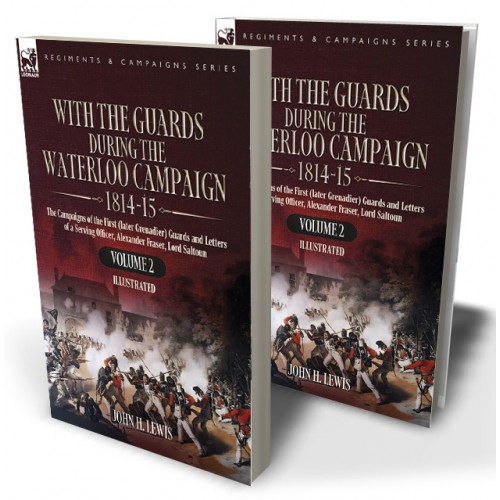
With the Guards During the Waterloo Campaign,1814-15. VOLUME 2: The Campaigns of the First (later Grenadier) Guards and Letters of a Serving Officer, Alexander Fraser, Lord Saltoun
Leonaur Original
Qty:     - OR -   Add to Wish List

Author(s): John H. Lewis
Date Published: 2025/07
Page Count: 228
Softcover ISBN-13: 978-1-916535-97-8
Hardcover ISBN-13: 978-1-916535-96-1

Part two: The First Regiment of Foot Guards and the final struggle with Napoleonic France

IMPORTANT: THE CONTENTS OF THIS BOOK WERE FIRST PUBLISHED IN 2020 AS PART OF,'THE MARCH TO HOUGOUMONT'.

This two volume work follows the campaigns of the First (later Grenadier) Guards, combined with the career of one of its most notable officers of the period, Alexander Fraser, Lord Saltoun during the first years of the 19th century. Britain was at war with its ancient enemy, France and its conflicts of revolution, before much time had elapsed, became the Napoleonic Wars. This book commences at the close of the Peninsular War when the allied armies under the command of the Duke of Wellington had finally pushed the invading French Army back within the borders of its motherland.There followed an all too brief period of peace during which Saltoun married and Napoleon Bonaparte was both exiled to the islandof Elba and had escaped to once again grasp power. Combining history with the letters and recollections of Lord Saltoun together with anecdotes by his fellow officers,the reader will follow the Guards through the battles of Quatre Bras and Waterloo. Saltoun fought with Guards light companies about Hougoumont chateau-farm and upon the allied ridge in the closing stages of the battle. Unscathed during the main fighting, he came closest to death in a minor action, scaling the walls of Peronne during the pursuit to Paris. This final volume of this two- volume set contains many maps and illustrations including views of Hougoumont created especially for this book.

Leonaur editions are newly typeset and are not facsimiles; each title is available in softcover and hardback with dustjacket. 

When the brigade had emerged from the wood to form line, a battalion of Brunswickers followed it into the open, and was forming up on the Guards’ left, when French cavalry came suddenly down upon the left flank of the second battalion, forcing it back towards the wood. As the horsemen were hard upon them, it could not form square, so the men ran for the protection of the hollow way. Once secure, the line reformed and delivered a destructive fire emptying saddles in quantity.
It was during the cavalry attack that James Lord Hay, (eldest son of the Earl of Erroll), an ensign of the First Guards and aide-de-camp to General Maitland, was killed. He was temporarily acting as adjutant to Saltoun who, noting that his young friend was mounted on a well-bred horse, advised him not delay in going down a narrow path leading into the wood before the French cavalry came close, in case his charger, which was of a type inclined to be skittish, refused when it found itself in an awkward place.
Hay replied there was no fear of that, because the horse, ‘was such a perfect hunter’. The two officers stayed together until the time came for them both to go down the path, whereupon Hay’s horse, as forecast, refused, reared, and attempted to turn about.
A man’s body, at that instant, fell across the neck of Saltoun’s horse and rolled off to the ground. He could not immediately identify who it was and called out, ‘Who’s that?’ Whereupon one of his men nearby answered, ‘It’s Lord Hay; but I shot the man that shot him.’ The momentary delay had enabled a French cavalry skirmisher to accurately fire at Hay killing him instantly. He was only eighteen years old, so that he had been promptly avenged was of cold comfort. Meanwhile, the Brunswickers, who had managed to form square, opened fire upon the passing cavalry increasing the rate of its destruction. Prisoners were taken and several riderless horses were gathered as fresh chargers for the Guards field officers.
The firing continued for as long as daylight lasted, but as the evening came on Maitland led the third battalion forward beyond the outskirts of the wood and threw out a line of picquets in his front for the night. Each army reluctantly drew apart like exhausted equally matched pugilists. Colonel Stables brought the second battalion out of action and moved his men to the chaussée, at the end of the wood, where they could briefly rest.
You may also like