Author(s):
E. Keble Chatterton & W. L. Wyllie Date Published:
2025/07 Page Count:
268 Softcover ISBN-13:
978-1-917666-29-9 Hardcover ISBN-13:
978-1-917666-28-2
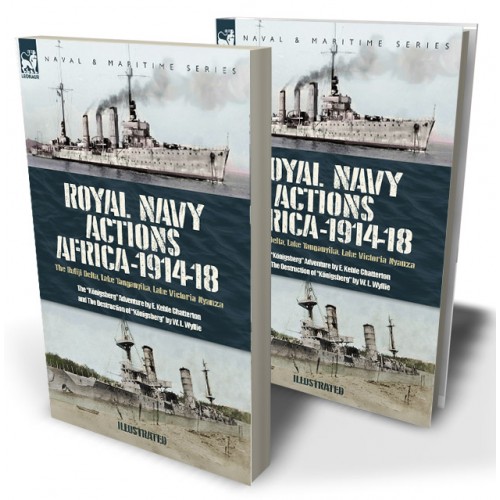
War as it was fought on the coasts and lakes of the Dark Continent
When the First World War broke out in 1914 that 'Britannia Ruled the Waves' was not jingoism. Britain, an island nation, boasted the Royal Navy whilst Germany's successes were hitherto primarily land based and its routes to the high seas geographically limited. Nevertheless, Germany sent forth its raiders to hunt the seaways and for a time-before their perhaps inevitable destruction-they caused havoc. One of these German ships,the light cruiser 'Konigsberg' became particularly illusive and infamous. This book compelling recounts-in fascinating detail-the epic struggle to bring about her ruin as she lay hidden among the mangroves the Rufiji Delta in East Africa. Both protagonists in the greater conflict had colonies far from the main theatres of the war. So small 'side-show' contests broke out. These included astonishing contests fought in the African bush and its jungles, but also upon its lakes. Two of these inland naval conflicts contested by small craft on Lake Tanganyika and Lake Victoria Nyanza are also fascinatingly explored and described in these pages. This edition also includes a second perspective on the action to destroy the 'Konigsberg'. Contains illustrations which did all accompany the original publication.
Leonaur editions are newly typeset and are not facsimiles; each title is available in softcover and hardback with dustjacket.
For example, the engines were of the “Monosoupape” type, which depended for air supply on the opening of the exhaust valve and the passage through a nose-piece. That might function satisfactorily in Europe, but it was unsuitable off Africa where the atmosphere is of thinner quality. This led to a series of experiments which in peace time would have been of entertaining duration, but every failure meant another day’s grace to the German cruiser. Petrols of different densities were tried after being fetched from such stocks as Zanzibar could supply, and mixed in varying proportions with the aviation spirit; changes were made in the engine’s timing so as to leave the exhaust valve open for a longer period; a funnel was fitted to induce more air through the nose-piece; compressed air (and likewise oxygen) were even attempted, but the results remained uncertain and discouraging. The only appreciable bit of discovery was that on days when the air was unusually humid the machine climbed less badly than on other occasions.
But amid all these tantalising preliminaries there was quite a humorous aspect, which cannot be better described than in the following words which Flight-Lieutenant (now Group-Captain) Cull has been good enough to give me, he writes:
“The usual method of getting machines out from the ship, was to hoist them out by the main derrick in a folded condition, a line being rove through a small block on the tail float, which a whaler would secure before the machine touched the water. On arrival in the water alongside the ship, pilot and passenger would unfold the wings, while the whaler would stand by to tow the machine clear. When clear of the ship’s side, the passenger would start up the engine from his seat, and since passengers were usually at a discount, the passenger, as soon as he had started up the engine would take a header over the side and swim to the boat, which by this time had allowed the line to reeve through the block thereby releasing the machine.
“For some reason or other, although it was known that the waters we were working in were infested with sharks, no signs of these were seen until about the end of April, which coincided with a change in the monsoon, and apparently brought the sharks round from the other side of the island. . . . The last occasion on which the passenger jumped overboard was when, having left the machine, the pilot observed two large and ominous-looking fins between the boat and the machine. Luckily the attention of the passenger was called to the danger as soon as he broke surface, and he managed to clamber back on to the floats.’’
Early in March there arrived off the Rufiji delta H.M.S. Goliath, now flying the flag of Admiral King-Hall, who was free to take charge of operations, seeing that the South African anxieties had passed. Before the month was out, he shifted his flag to the Hyacinth, and the Goliath was sent off to the Dardanelles where in the month of May she was sunk by enemy torpedoes. It was about the middle of March that in an endeavour to solve the seaplane engine trouble, Admiral King-Hall summoned a committee of local ‘‘experts’’ from Zanzibar.

 your wishlist
 your account


 Click on image to enlarge
 Mouse over the image to zoom in