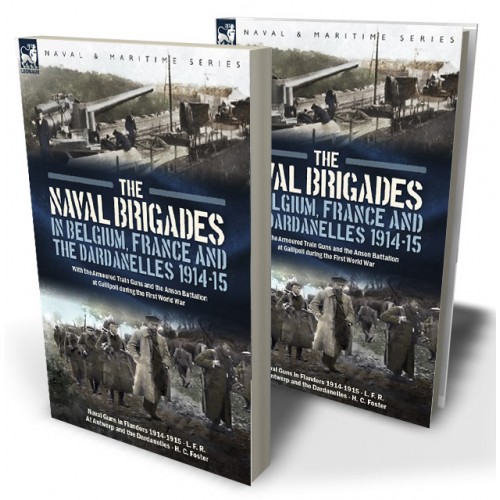
Naval Guns in Flanders 1914-1915 & At Antwerp and the Dardanelles
Two outstanding eye-witness accounts of the sailors of the Royal Navy in action ashore
This book firstly describes a particularly unusual and interesting aspect of the opening engagements of the First World War in Europe, recounted by an officer who was present. Three heavily armoured trains, built in Antwerp in late 1914, were mounted with British naval guns, and placed under the command of Commander Littlejohns, R.N.. Known thereafter as H.M. Armoured Trains, they were, Jellicoe with three 4.7-inch guns, Deguise with three 4.7-inch guns and Churchill with two 6-inch guns. These armoured trains initially fought around Antwerp, before retreating to support the advance to Ypres. Trains were operational at Ostende and Oostkerke against German batteries positioned about Dixmude. During the Spring of 1915, these trains were continuously in action, occasionally supporting an assault, but most frequently engaged in counter-battery or bombardment missions to neutralise enemy trenches and observation posts. The train mounted guns were particularly effective against German troop concentrations, though these actions also brought them within range of opposing artillery. In early March, the armoured trains supported the action at Neuve Chapell, though were withdrawn from service shortly thereafter. The second work in this special Leonaur edition is a gripping, though poignant, first- hand account of the activities of the Anson Brigade both in the early stages of the war in Europe and during its particularly hard-fought campaign against Turkish forces at Gallipoli.
Leonaur editions are newly typeset and are not facsimiles; each title is available in softcover and hardback with dustjacket.

During this time the Belgian 4.7-inch section arrived under Captain Servais to relieve us, and on the 12th, I took him and his observer to the O.P. to show them the points of note and explain the working of the O.P. and other details. At the same time, we continued our attempt to destroy the bridge, but soon after starting this the enemy shelled the O.P. so heavily that our observer had to retreat to the cellars. We got going again later, but beyond sending various girders flying and doing similar less vital damage, even ten direct hits did not eat away enough of the support to cause it to collapse; a few 9:2 howitzer hits were necessary. That night I introduced Servais to the Staff he was to work with, and then I waited over a day or two to assist him to settle down in his new surroundings, strange after his experiences when working with his own people on the Yser.
After another wild and wet day, (Feb. 14th), Servais took his section out, and I went on with his observer to the O.P. to assist during the usual bombardment prior to a successful but restricted attack by the infantry near the brickfield. From this position in the O.P. the advance and the fighting could be seen and followed much as a spectator in the grandstand watches a football match. Through flashes could be seen every detail and movement of the fighters, even to the expressions on the faces, all seeming like the dumb-show of a cinema film: a rifle pointed, and a spit of flame from the muzzle without hearing the report, and officers obviously giving orders and gesticulating.
Not that we were too far off to hear such sounds, but they were drowned in the continuous roar of the battle itself. The struggle was interesting and exciting, even from a spectator’s point of view, and more so from my own, as I was playing a part in the great game going on in front of me. Beyond our line of trenches white puffs of smoke continually burst, the shells passing overhead in a succession of rushing shrieks. Larger black volcanoes of mud and flame showed the fall of high-explosives destroying the enemy’s line, whilst occasionally a flash and a huge red dust-cloud would show where one had landed in a pile of bricks.
All along the front, on both sides, our own and the German batteries were pouring down their shells, each battery dependent for the accuracy of its fire on its observer situated similarly to myself. In a few moments a stir was apparent in the British line, a glimpse of a row of khaki figures clambering from their trench and the flicker of their bayonets, and in an instant the ground beyond was dotted with moving figures, making a fair target for the German rifles and machine guns—such as had survived the bombardment. Figures sprawled, some never to move again, others to rise and stumble on after their comrades, as yet more fortunate in being untouched.
The advance having started, the fighting-line surged forward, checked and halted, moved again—now rushing, now staggering, and so on till the edge of the German trench became dotted with bobbing heads and moving figures, the next moment to be hidden by the swarm of our men as they leaped upon them. Then suddenly this area became the object of the enemy’s artillery, endeavouring to shell out the survivors of the victorious attackers and prevent the consolidation of the position won. Now it was our turn to look round and engage the enemy’s guns and try to check their design.