Author(s):
F. W. O. Maycock & Hilaire Belloc Date Published:
2025/11 Page Count:
220 Softcover ISBN-13:
978-1-917666-55-8 Hardcover ISBN-13:
978-1-917666-54-1
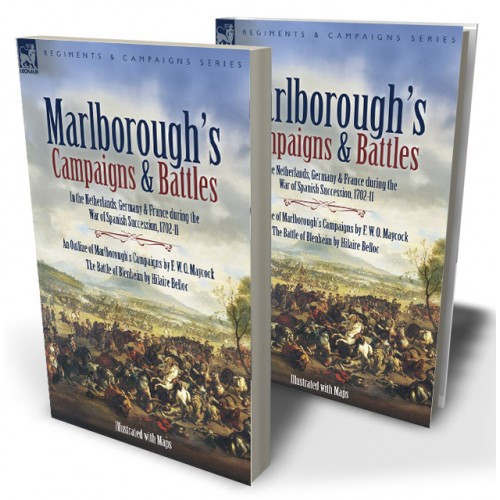
An Outline of Marlborough’s Campaigns & The Battle of Blenheim
'Corporal' John Churchill's finest military triumphs
Even before the commencement of the eighteenth century, the low-lying tract of country enclosed between the French frontier, the Meuse and the North Sea had fully established its unenviable reputation as ‘The Cockpit of Europe.’ Great Britain, France, Spain and Holland fought out their differences on its fertile well-watered plains, without regard to the misery they inflicted on the unfortunate inhabitants. The ‘Low Countries’ had long been the training-ground of the British Army and the school in which its officers had learned the art of war. First making its appearance, more or less unofficially, in support of the Dutch in their heroic efforts to free themselves from the Spanish yoke, Great Britain had then aided France in her conflict with Spain and had been finally drawn into the long and deadly struggle waged by William III. to protect the United Provinces from the aggression of Louis XIV. This was the stage upon which the great Duke of Marlborough led his army from victory to victory during the hard-fought campaigns of the War of the Spanish Succession. The names of those battles,- Blenheim, Ramillies, Oudenarde and Malplaquet -contested during this period, became iconic and adorn the flags of famous regiments. They made a national hero of the commander of those soldiers and cemented his reputation as one of the most accomplished generals in his nation's history. Maycock's readable and excellent work,written from an academic military perspective is enhanced by Belloc's brilliant analysis of Blenheim taken from his 'Battles' series.
Leonaur editions are newly typeset and are not facsimiles; each title is available in softcover and hardback with dustjacket
As the infantry moved forward against the left centre of the hostile works, they were exposed to a furious fire from the guns in the entrenchments and on the walls of the town. But though many of the British regiments were largely composed of young soldiers taking part in their first battle, they advanced with the greatest steadiness, and in spite of their heavy losses, arrived within a hundred yards of the entrenchments without having fired a shot. The hail of grape and musketry now began to tell on the crowded ranks with deadly effect, but closing up the gaps in their line, the staunch infantry pressed steadily forward. General Goor and many of the officers fell, and the column staggered for a moment, but quickly recovering itself, again surged forward.
By an unfortunate mistake the men threw their fascines into a shallow ravine some yards in front of the hostile works, and when they reached the ditch, they were seriously delayed and suffered heavily. Seeing that the assailants showed signs of wavering under the deadly fire, D’Arco ordered some French and Bavarian battalions to make a counter-attack, but the Guards, though most of their officers had fallen, stood as firm as a rock and beat back their opponents with heavy loss. The whole line then dashed forward and strove desperately to storm the entrenchments, but the garrison, fighting with dogged courage behind their breastworks, drove them back into the ditch after a sanguinary hand to hand combat. Appalled by the slaughter, some of the young soldiers from the regiments in support began to drift back into the wood, but they were driven forward into the fight by Lumley’s cavalry, who had closed up to support their hard-pressed comrades.
For over an hour the furious struggle continued. D’Arco drawing more and more troops from his left, managed to hold his own though the dauntless infantry swarmed over the entrenchments three times, but only to be hurled back by their stubborn opponents. Lumley moved the whole of his first line of cavalry into the fight to support the infantry, and a counter attack was beaten back with crushing loss, but still the Allies could not gain a foothold in the works. At this moment the Imperialists, who had advanced under the walls of Donauworth against the extreme left of the position, scaled the almost deserted entrenchments, and cheering lustily, suddenly fell on their opponents’ flank. The latter held their ground doggedly, but with a supreme effort the dauntless British and Dutch infantry, among whom the Scots Greys were fighting on foot, hurled themselves against the parapet and drove the garrison from the works they had so stoutly held.
The resistance suddenly collapsed, the French and Bavarian infantry flying in wild panic towards the pontoon bridges over the river, while the Scots Greys, hastily remounting, joined the remainder of the cavalry, which Marlborough at once launched in pursuit. Hundreds of fugitives, half mad with terror, were cut down or driven into the Wernitz, while to add to the horror of the scene, the pontoon bridges over the Danube gave way under the strain of the disorganised crowd endeavouring to force its way across. Hundreds of panic-stricken wretches were precipitated into the rapidly flowing river, and barely 3,000 stragglers succeeded in reaching the Elector’s camp at Dillingen.
Many senior officers, including the Prince of Bevern, Generals Goor and Stirum, had fallen in the desperate assaults, while 1,500 of the Allies lay dead in front of the entrenchments, and the wounded amounted to another 3,500. Though the action had lasted for little more than an hour and a half, it had been a most sanguinary struggle, and the French and Bavarians had offered such a desperate resistance, that it was only the appearance of the Imperialists on their flank which had decided the issue of the day.

 your wishlist
 your account


 Click on image to enlarge
 Mouse over the image to zoom in