Author(s):
J. D. Richardson & Sir Archibald Murray Date Published:
2026/02 Page Count:
236 Softcover ISBN-13:
978-1-917666-31-2 Hardcover ISBN-13:
978-1-917666-30-5
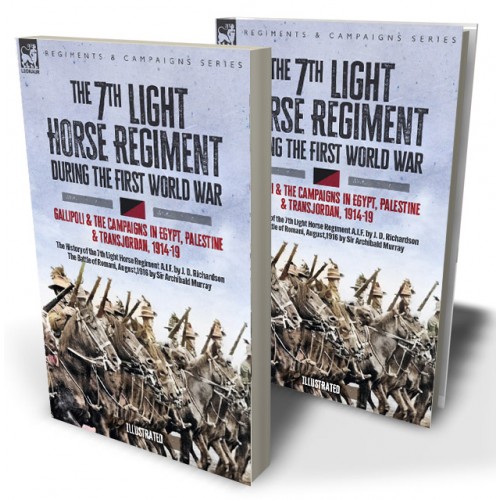
The History of the 7th Light Horse Regiment A.I.F. & The Battle of Romani, August,1916
The Great War record of a renowned Light Horse Regiment
The 7th Light Horse Regiment was a mounted infantry regiment raised in October, 1914 at Sydney, recruiting principally in New South Wales.It was assigned to the 2nd Light Horse Brigade. The Australian mounted troops were considered ideal for the mobile campaigns in the Middle East theatre fighting Germany's ally the Ottoman Turkish Empire. Accordingly, it was shipped to Egypt. However, heavy casualties at Gallipoli during the Dardanelles campaign urgently necessitated re-enforcements. Light Horse regiments were selected to serve as conventional infantry and the 7th LH was principally engaged in the defensive engagements around Anzac Cove. After the withdrawal and return to Egypt the regiment was engaged in the defence of the Suez Canal and in response to Turkish advances across Sinai, in the battles at Romani and Katia. Advance along the western flank failed after two abortive attempts to capture Gaza. The regiment took part in the innovative success to the east at Beersheba and in the pursuit of the retiring Turks and the fall of Jerusalem. Participation in the raids across the Jordan saw the 7th in action at Amman and Es Salt. The 7th Light Horse Regiment concluded it service engaged in internal security duties following civil unrest in Egypt after the conclusion of hostilities.
Leonaur editions are newly typeset and are not facsimiles; each title is available in softcover and hardback with dustjacket.
At 1 a.m. on February 23rd, the brigade moved out, with the N.Z.M.R Brigade, on a reconnaissance to “Khan Yunus”, the first Turkish village across the Egyptian border. The 7th Regiment formed the rear-guard. No casualties occurred as the brigade was not actually engaged, though the N.Z. Brigade, the advance troops, encountered fairly severe opposition: no attempt was made to force the enemy’s position. We returned to camp about 4 p.m. and moved to another site, near the beach.
On the 24th, the regiment rested, but on the 25th, another reconnaissance was made along the beach towards Khan Yunus. Only small bodies of enemy troops were seen. On the 25th “C” Squadron was sent on patrol of Hill 250, three miles south of Rafa where numerous tracks meet. No signs of enemy were seen. The country here is partly cultivated and grassed, carrying a scattered Bedouin population and a fair number of cattle and sheep. On the 26th the regiment again rested, but on the 27th moved out with the brigade on a country and road reconnaissance. The regiment was advance guard. A halt was made just north of El Abreisa, six miles south-east of Rafa, “B” Squadron going towards Hill 410, N.W. of E., in El Ghabi. “C” Squadron moved towards Hill 380, about four miles S.E. of U., in Khibu. Both these hills were occupied by the enemy, but no attack was made as the squadrons were acting as screens for surveying parties.
About 40 shots were exchanged, and during the day five of the enemy gave themselves up. The regiment rested again on the 28th. This reconnaissance was typical of many that followed, a day’s rest coming after each. The main object was to get an accurate idea of the country in the vicinity of Khan Yunus, and to the north and east of that place, and to find covered approaches for large bodies of troops to advance against the enemy’s positions at Weli Sheikh Nuran.
By the end of the month, Khan Yunus was evacuated by the enemy and this was the first town on Turkish soil to be entered by our troops. It is a typical Syrian village, surrounded by orchards and gardens, with a fine old ruined Crusaders’ Church. Enemy patrols were not active, and he contented himself with shelling at long ranges, sitting down behind entrenched positions at Weli Sheikh Nuran.
We moved, on March 7th, to another camp site on the beach, more conveniently situated for patrolling. Bir Abu Shunnar is close to Rafa, and the long marches hitherto necessary before reaching the patrol area were obviated. The enemy now evacuated the lines of Weli Sheikh Nuran, and on the 9th a reconnaissance was pushed out beyond Deir El Belah, and from the heights to the north-east of this place the white domes and roofs of Gaza could be plainly seen, with the solid rampart of the hill of Ali Muntar, soon to be so well-known, standing clear against the sky. Deir El Belah is a rather pretty mud village, as seen from a little distance, with a shallow sheet of water, dry in summer, close by. A broad level plain, fertile and well grassed, extends from Khan Yunus past Belah to Gaza. Many flocks were seen. The inhabitants—Syrian Arabs— displayed no hostility. The regiment returned to camp at 6 p.m.
On the 17th, in conjunction with the 6th Regiment, a move was made to Khan Yunus as covering party to surveyors. We returned to camp in the afternoon. The health and spirits of the regiment were now perhaps better than they had ever been before, and the keenness and smartness displayed upon patrols and reconnaissances had never been equalled. It was well that this was so, for the tests of endurance and of sound training were to be very severe.
The country between Rafa, the little Egyptian frontier police post, and Gaza, twelve miles to the north-east, is, for the most part, of a gently undulating nature, occasionally rising into higher ridges, from the summits of which wide views of the surrounding country are obtained. At Weli Sheikh Nuran, with the knoll as an observation post, the Turks had dug a very elaborate trench system, capable of holding ten thousand men. Weli Sheikh Nuran was the apex of this system and the flanks were thrown back to the Wadi Ghuzze, in the vicinity of Abu El Hisiea, to the north, and Tel El Fara, to the south.
It came as a surprise that the enemy should have evacuated these works, constructed with so much labour but if the map is studied it will be seen that the country south of Tel El Fara is practically all plain and gives excellent opportunity for a strong force of cavalry to turn the flank of the position and cut off all communication from Beersheba. Direct communication with Gaza could also be cut, without much difficulty, from the north. It was said, also, that the lines were really too elaborate, and that the enemy had insufficient troops to man them properly. These works now passed into our possession and were later used as reserve and flanking positions to our posts on the Wadi Ghuzze.

 your wishlist
 your account


 Click on image to enlarge
 Mouse over the image to zoom in