Author(s):
Major T. H. Darley & Sir Archibald Murray, Date Published:
2026/02 Page Count:
240 Softcover ISBN-13:
978-1-917666-71-8 Hardcover ISBN-13:
978-1-917666-70-1
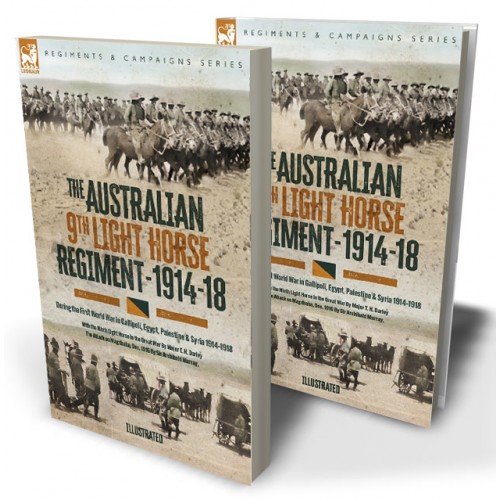
With the Ninth Light Horse in the Great War & The Attack on Magdhaba, Dec. 1916
An essential record of a renowned Light Horse regiment
The Ninth Light Horse Regiment was raised in Adelaide and trained in Melbourne for service during the First World War. Two thirds of the those who volunteered for the 9th were men from South Australia-the remainder were from Victoria. The regiment was shipped to Egypt in early 1915 to take part in the campaigns against Germany's ally in the Middle East, the Ottoman Turkish Army.
It was considered that mounted infantry were ideally suited for a mobile war, but (as part of the 3rd Light Horse Brigade) the 9th was selected to serve unmounted at Gallipoli as a consequence of high casualties suffered by the allies in the Dardanelles campaign. The regiment was in reserve during the battle of the Nek so suffered less severely. They suffered significantly, however, during the attack on Hill 60. Upon the regiment's return to Egypt following evacuation, the 9th took part in the defence of the Suez Canal and led the way in the Jifafa Raid. As the Ottomans fell back to the north the regiment took part in one its fiercest engagements at Magdhaba in December, 1916 and it is this event that is recorded in the second piece in this volume as described by Sir archibald Murray.Following the unsuccessful battles before Gaza the regiment served in the Trans-Jordan Raid, at Jenin and at Sa'sa. It entered Damascus in October 1918.This regiment concluded its war performing security services following civil unrest in Egypt after the conclusion of hostilities. This well- regarded regimental history was written by a serving officer and recommended.
Leonaur editions are newly typeset and are not facsimiles; each title is available in softcover and hardback with dustjacket.
At about 3.30 p.m. the brigade received orders to move rapidly to a position near Australia Hill. As the brigade up to this time had taken no part in the fight everyone was delighted at the prospect of doing his share. Moving at a fast trot the brigade reached Anzac Ridge, now the Headquarters of the Anzac Division, and here orders were given to the brigadier that the 3rd Light Horse Brigade was to intercept and hold off the large enemy reinforcements, consisting of about 4,000 infantry and 2,000 cavalry, which had been reported as advancing from the direction of Huj.
The 10th Light Horse were detached to act as a reserve, and the remainder of the brigade galloped out and occupied a chain of small hills about two miles east of Gaza, completely blocking the path of the enemy reinforcements which were advancing in various columns at a distance of about two miles. The regiment took the right of the brigade line, and gained touch with the Berkshire Yeomanry who were on our right.
This new force of the enemy which had to be dealt with had evidently been marching for some hours as their rate of march was below normal and they appeared tired. As soon as they came within 2,000 yards the brigade opened fire, and the Notts Battery, which had pushed well forward, opened a heavy shrapnel fire, which appeared to be well on the target. At 5 p.m. the Yeomanry on our right were heavily engaged and our line was pushed well forward and strengthened by some armoured cars and a portion of the 8th Light Horse. As this new move threatened the enemy’s flank they were obliged to fall back slightly. As darkness approached our line was shortened and an outpost line taken up.
During these movements the infantry had delivered their assault against the formidable Ali Muntar, and in spite of heavy casualties had succeeded in taking a number of the outer works, but could not drive the stubborn Turks from the main position. The British Infantry made a splendid show as they advanced by waves in the face of a withering rifle and machine-gun fire, their movements being as orderly as if on a peace parade.
Much to the surprise and disgust of all ranks, orders were received to the effect that the whole force would retire during the night to the Wadi Ghuzze. It was the first time our force had received such orders, and everyone wondered at the cause, some doubting the genuineness, but as they were verified shortly afterwards it was realised by all that there must be some good and sufficient reason for them.
The 3rd Light Horse Brigade were to cover the retirement, and remained in position until 2 a.m., at which time the 8th Light Horse were ordered to withdraw. At 3 am. the regiment withdrew acting as rearguard to the whole force, and moving round to the east and south of the defences made for the Wadi Ghuzze.
The Turks during the night had sent large reinforcements from Sheria, and when in the vicinity of Siahan our flank guards got in touch with them. “C’’ Squadron, in conjunction with the armoured cars, formed the rear and flank guards, and from this point to the wadi fought a continuous rearguard action, doing splendid work in checking the enemy’s advance, and allowing the whole column to pass in safety over the wadi.
The enemy now opened a continuous shell fire from the south and the regiment altered its formation to columns of sections moving in echelon, and by continually altering the pace and direction succeeded in completing the retirement with only two casualties, two horses being wounded. The wadi was crossed at 7 a.m. and the regiment proceeded to Deir-el-Belah, a distance of four miles, where the horses were watered, the regiment then moving to Goz-el-Taire where it bivouacked.
It was now learned that the infantry had been severely mauled during the attack, their casualties against Ali Muntar alone being roughly, 3,000. The fact that Gaza had not fallen was not due to any lack of vigour or fighting efficiency on the part of any of the troops, but was considered to be due to the heavy fog which delayed the assault for so many hours.

 your wishlist
 your account


 Click on image to enlarge
 Mouse over the image to zoom in