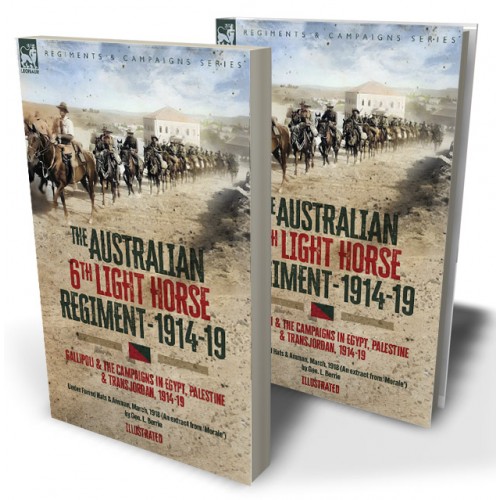
Under Furred Hats & Amman, March, 1918 (An extract from ‘Morale’)
Australia's famous Light Horsemen at war
Raised as mounted infantry in September, 1914 in Sydney as part of the 2nd Light Horse Brigade, the 6th LH was shipped to Egypt to take part in the campaign against the Ottoman Turkish Army in the Middle East. This regiment was distinguished by its wallaby fur slouch hat bands, hence the title of the principal book in this edition. Severe casualties among Allied forces during the Gallipoli landings necessitated secondment of unmounted light horse regiments to join the battle. The 6th landed in the Dardanelles, fighting about the Anzac Cove sector until the withdrawl. Upon its return to Egypt the regiment was incorporated into the ANZAC Mounted Division. Initially engaged in the defense of the Suez Canal the regiment met the advance of the Turks across Sinai, fighting notably at Romani and Katia. The 6th LH took part in both unsucessful battles to take Gaza on the western flank.Following the breakthrough at Beersheba and advance to Jerusalem, the regiment took part in Trans-Jordon operations. It concluded its service with internal security duties in Egypt. The author of both works in this book was a serving officer and the second piece is an extract which intimately and vividly describes the hard fought action at Amman in 1918.
Leonaur editions are newly typeset and are not facsimiles; each title is available in softcover and hardback with dustjacket.
The Bushman’s horse moved. Cursing, silently, he shifted into the new patch of shade and took the cork out of his water-bottle. On reflection he put it back again. There was less than half a bottle and they would certainly never get back to Katia before well into the afternoon. There might be the chance of a “boil up,” he had tea; not that it would take much boiling, but a mouthful of tea would be worth the lot as it was now.
He noticed a tiny whisp of sand rising on the sand peak against which they had halted, and mechanically he reflected that the wind was rising. Anything seemed better than the awful stillness of the burning air, yet if the wind rose much the blast off a bush fire would be nothing to it. Ah, the officers were mounting. The Bushman swung into the saddle and followed his wheeling troop round in the direction of home. He looked at his watch. A quarter past ten; perhaps they would halt at Sagia. There was a well there, but a very poor one; if he only got a chance to make his drop of tea, he didn’t care much if he didn’t get a drink till Katia. But the poor old horse floundering up the loose sand of the hillsides, he would have to suffer.
The wind was rising fast. At intervals in the sea of burning sand the precipitous sides of the dunes were veiled by a creeping, shimmering film moving gently upwards and rising in little spiral wreaths several feet high from the pointed peaks. And, occasionally, as the blast grew fiercer, the whole razor-backs broke into sweeping crests of sand which fell into drifts of molten powder on their leeward sides.
The Bushman, riding on the right flank guard, caught a glimpse of a distant hôd through the burning shimmering haze of sand. It couldn’t be Sagia, he knew. Ah, the directing troop was turning towards it; there might be a well there. A quarter of an hour later the flank guard was signalled to close in to the main body, and the Bushman rode into the hôd. Men and horses were scattered about getting what scanty shade they could from the lofty palm trees, and the few who had water left in their bottles were busily “boiling up.” A small well there certainly was, but the water stank. He saw one or two thirst-mad men take a few mouthfuls only to pay the penalty with a violent attack of nausea. His last drop of bottle-water quickly became strong tea; but, shared with his mates, it meant little more than a few gulps each. He saw men go out to it with sunstroke and exhaustion and others carrying them to shade to await an ambulance cart.
A very brief rest soon ended. Mounted once more he pushed his horse out on to the flank again. Sagia could not be very far off now, and doggedly horse and man steeled themselves to endure the next few hours.
Sagia at last. Everyone was struggling towards the well, and many a heart sank as men realised that it would take hours to water both men and horses. The order was passed round the Bushman’s troop for fit men and horses to make to Katia. Could he do it; two hours more. But there was plenty there for man and beast, and urging his horse made nearly desperate by the smell of water, he rode out of the hôd and headed for Katia. Others were going too. Nerved by the companionship, he moved slowly onwards. Hill after hill he crossed, an hour passed and he could see the dark blotch of the palm trees at Katia; or he thought he could. Might it be a mirage and the well be miles further on.
But the old horse was stepping out gamely; he knew, at any rate, that water was close. Why now it was quite close. He could see the old stone well and one or two of the fellows there already drawing up bucket after bucket. Only a few hundred yards to go. “Come on, old man, the bucket and the rope is all we want now.” And, side by side at the old stone well, they drank till they could drink no more.

 your wishlist
 your account


 Click on image to enlarge
 Mouse over the image to zoom in