Author(s):
G. H. P. Muhlhauser & W. L. Wyllie Date Published:
2026/02 Page Count:
260 Softcover ISBN-13:
978-1-917666-85-5 Hardcover ISBN-13:
978-1-917666-84-8
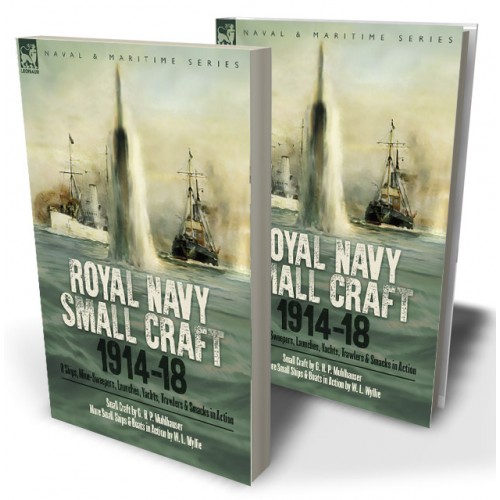
The First World War at sea as fought by small and specialist craft
Whilst the days of the broadsides of great battle fleets were not quite over, the dawn of the 20th century and the age of the machines brought new aspects to the waging of war, not excluding
within its maritime aspects. Pivotally influential was the widespread employment of submarines; a hidden menace capable of destroying the goliaths of sea whist remaining invisible. This riveting book deals with the Royal Navy's measures to combat German U-Boats. Two featured armed yachts, crewed by gentlemen- Zarefah and Sagitta-were engaged in the Auxillery Patrol on mine-sweeping and anti-submarine activities. Armed Smacks converted from fishing vessels and armed with hidden weapons were embedded within the fishing fleet to lay in wait for their opportunity to strike the enemy. Q Ships, similarly containg hidden weapons were camoflaged merchant vessels designed to lure the submarines into an ambush. Hydrophone trawlers fitted with listening devices searched for the hidden foe. The second work in this Leonaur edition continues this theme as the activities of British mine-sweepers, Mystery Ships and the fast moving Motor Launches are described.
Leonaur editions are newly typeset and are not facsimiles; each title is available in softcover and hardback with dustjacket.
On the next trip there was more excitement. We first made our way to the scene of the last encounter, but drew blank. A heavy gale then forced us to take shelter in the Wash. On coming out we made our way to Smith’s Knoll without seeing anything. At 4 a.m. on the 5th April, ’17, we had passed it, and were on our way to the North Hinder Lightship. It was rather thick, and the wind was very light. I had had my usual two cups of tea and was feeling very pleased with life in general, and especially with the prospect of a whole night in my bunk that night, when war’s rude alarms were suddenly forced on my notice. A large submarine, which looked in the mist as big as a T.B.D., appeared ahead, and then as rapidly disappeared.
The alarm was given, and there was a bustle for a few minutes, and then quiet. Everyone was at his post. The C.O. came on deck, as imperturbable as ever. He sauntered up to me in a casual sort of way to persuade the submarine, should it be watching through its periscope that it had not been sighted. With the same object the cook went to the galley and started preparing breakfast, while two of the hands scrubbed down. Just then a small upended spar was seen 100 yds. on the port bow. It showed 2ft. clear of the water, and from the top a slight rod projected for another 4ft. and terminated in a square lump 6in. in diameter. The lower portion might be a periscope, but what was the upper part?
As we looked, it slowly dipped, and disappeared. It evidently was a periscope. A few minutes later it rose on the beam, but that time without the upper part, dipped after a short interval, showed on the quarter, astern, and on the starboard side. At each appearance it showed for about a minute, and then sank out of sight. This behaviour was rather disconcerting. To be closely examined in that indecent way through a sinister looking periscope was as trying as being looked at through binoculars from a distance of 50yds. After the submarine had examined us at its leisure from all points of view there was a pause of nearly half an hour.
What was to be the next move? Had it gone off altogether, or was it working into position to torpedo us which it could have done quite easily, or was it working away under water to a distance with the idea of coming to the surface a few miles off and shelling the ship? The C.O. thought that it was doing the latter, and that all we could do was to wait. The motor was started for manoeuvring purposes, and then we sat still, and thought of many things. To reduce the number of men showing, Reid took the wheel, the C.O. represented the skipper, two hands worked about the decks, and the cook went on with the breakfast. I sat in the engine room hatchway out of sight with a notebook ready to record events.
Suddenly a shell burst alongside followed by others, but no submarine was to be seen, and the C.O. could not make out from which direction they came, until he caught sight of a flash under the sun. In that position the submarine was quite invisible, while the ship made a perfect target with the sun full on her sails, and white hull. This submarine seemed to be a much more businesslike fellow than the others we met on the last occasion. For one thing it had a bigger gun, 4.1" semi-automatic high velocity, with an effective range of 13,500 yds. The shells arrived at terrific speed, and burst with an extremely vicious sound. It was firing fast and accurately, and after the first two or three shots was well on the target. The “panic party” was ordered away, but before they could get clear a shell struck the ship amidships right on the waterline, penetrated the hull and burst inside, reducing the W/T cabin and the storeroom to matchwood, and wrecking and setting fire to the magazine.
There were two men of the ammunition party in there at the time, and one of them, Morris, was hurled right down the alleyway on to the stove in our cabin, and injured his back, while the other, Ryder, had the upper bone of his arm shattered and smashed to splinters, and was also wounded in the back. The next shell burst just short and flung sheets of water over the ship wetting everyone to the skin at the same moment. A universal gasp went up. The water was very cold. The position was not very satisfactory. The ship had no reserve buoyancy, and the water pouring in through the hole in the side was already beginning to affect her. Reid, still at the wheel, found her slow to answer the helm and stated in a doleful voice: “She is sinking, sir.”
Dense clouds of smoke were pouring out of the hatches leading to the magazine. Some action seemed called for. It was not the slightest use sitting with folded hands, waiting either to sink or blow up, whichever should happen first. We might as well have a run for our money, and the C.O. gave the order to open fire. The gun-layers could not see the submarine, hidden as it was in the mist under the sun, but they put 6,000yds. on the elevating dial, and fired over open sights at the horizon in the direction the submarine was supposed to be. Each gun fired two rounds, and then stopped, as the submarine had not replied. It ceased firing immediately we opened up, there is no reason to suppose that any of our shells hit it, or even went near it.

 your wishlist
 your account


 Click on image to enlarge
 Mouse over the image to zoom in